C&F Financial (CFFI): Liquidity partners, public listing, and what supplier relationships mean for investors
C&F Financial Corporation operates as the banking holding company for Citizens and Farmers Bank and monetizes through traditional community-bank channels: net interest income from loans and securities, fee income, and selective loan sales. Funding is a core operating lever — the firm supplements core deposits with a mix of short-term and long-term borrowings to support lending growth, while the Nasdaq listing provides market liquidity and valuation discovery. For investors evaluating supplier and counterparty exposure, the mix and maturity of these funding relationships drive both downside liquidity risk and upside leverage to margin expansion. For a deeper supplier-risk view visit https://nullexposure.com/.
Why these supplier relationships matter to the balance sheet
C&F is a regional bank with a concentrated funding posture: borrowings increased to $122.6 million at year-end 2024, driven in part by long-term advances used to support lending. That single fact makes the firm’s funding counterparties strategic suppliers rather than incidental vendors. The company’s operating model is defined by four characteristics:
- Contracting posture — mixed-term funding: Evidence shows both long-term instruments (FHLB advances and subordinated notes) and short-term facilities (repurchase agreements and overnight fed funds lines) are in use, creating a blended maturity profile that requires active treasury management.
- Concentration — meaningful reliance on borrowings: The reported borrowings size puts counterparty exposure into a material band relative to the balance sheet, elevating counterparty selection and access to wholesale markets as critical governance items.
- Criticality — funding is operationally essential: Short-term and long-term borrowings are explicitly used to fund day-to-day operations and lending; loss of access or repricing would have immediate implications for loan growth and liquidity.
- Maturity and evolution — established but active: Long-term FHLB advances and subordinated notes provide structural stability, while short-term repo and fed funds lines offer tactical flexibility; management’s procurement and oversight posture treats third-party providers as monitored service providers.
Management also documents formal processes for selecting and monitoring third-party service providers and cybersecurity controls, which signals a structured vendor governance program rather than an ad-hoc approach.
Relationship inventory: who C&F works with (and why it matters)
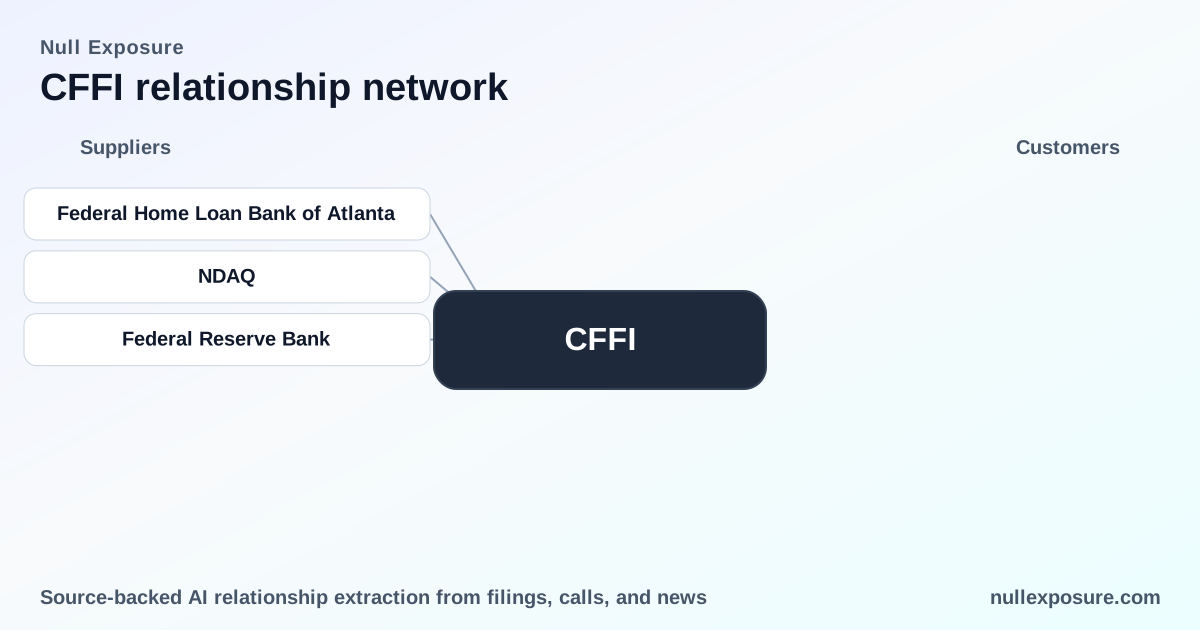
Below are the supplier and market relationships identified in the company’s disclosures and press materials, with concise takeaways and source references.
Federal Home Loan Bank of Atlanta
C&F uses FHLB advances as a principal long-term funding source, including advances that support lending activities and subordinated notes that are structurally junior to senior debt; borrowings from FHLB contributed to total borrowings rising to $122.6 million at December 31, 2024. According to the company’s FY2025 press release on GlobeNewswire, FHLB advances are a central part of the bank’s funding mix.
Source: GlobeNewswire press release, October 23, 2025.
The Nasdaq Stock Market
C&F’s common stock trades on The Nasdaq Stock Market under the ticker CFFI, providing public valuation and liquidity for shareholders; investors can assess the firm’s market multiples (trailing P/E ~8.7, price-to-book ~0.889) from public filings and market data. The Nasdaq listing is the conduit for institutional ownership and market-based capital decisions.
Source: Company disclosure within the GlobeNewswire press release and company profile data through FY2025.
Federal Reserve Bank
C&F utilizes short-term borrowings from the Federal Reserve Bank as part of its day-to-day liquidity toolkit, alongside other overnight wholesale sources, to manage intraday and overnight funding needs. The company’s FY2025 release states that short-term borrowings from the Federal Reserve Bank are part of the funding strategy for operations.
Source: GlobeNewswire press release, October 23, 2025.
How each relationship shapes risk and opportunity
- FHLB of Atlanta: This is the most material counterparty for long-term funding. Long-term advances and subordinated notes reduce roll-over risk on the margin but introduce structural subordination for certain holders of debt. The bank’s explicit use of FHLB advances to support lending is an operational lever for growth and a concentration risk if access tightens.
- Federal Reserve Bank / short-term wholesale markets: Short-term repo and fed funds lines provide liquidity flexibility and low-cost episodic funding, but they create repricing and rollover exposure in a rising-rate environment. Active treasury management and contingency liquidity plans are the relevant governance metrics to monitor.
- Nasdaq listing: Public listing underpins market access for equity capital and provides a continuous price signal. Given current valuation multiples and institutional ownership (~42% institutions), market sentiment and capital-raising optionality are material to strategic decisions.
Practical investor takeaways and monitoring checklist
- Liquidity is the operational risk center: Track FHLB advance balances and whether borrowings are increasing relative to deposits; the company reported borrowings >$100M at year-end 2024, which is a meaningful line item.
- Counterparty concentration matters: Given the prominent role of a single government-sponsored liquidity provider, monitor counterparty limits and fallback access to alternate wholesale markets.
- Short-term funding volatility is a governance test: Review management disclosures on repurchase agreements, fed funds lines, and the third-party service provider oversight program for operational resilience and cybersecurity assurances.
- Market signals are actionable: Use Nasdaq trading metrics and P/B and P/E ratios to assess appetite for equity capital and the potential dilutive risk if management pursues capital raises.
If you want a structured supplier-risk score or deeper counterparty exposure mapping, explore our service at https://nullexposure.com/.
Final recommendation
C&F Financial is a classic community bank with deliberate mixed-tenor funding and public-market discipline. For investors, the primary watch items are FHLB dependence, the evolution of short-term wholesale borrowing, and management’s vendor governance practices that underpin operational continuity. These elements directly affect the firm’s ability to grow loans without stressing liquidity or diluting equity.
For a tailored supplier-risk assessment and ongoing monitoring, see our analysis hub at https://nullexposure.com/.