Capitol Federal Financial (CFFN): the supplier landscape that underwrites a regional bank’s franchise
Capitol Federal Financial is the holding company for Capitol Federal Savings Bank and earns its margin primarily through traditional retail banking activities—net interest income from a loan portfolio, deposit spread, and fee income from core banking services. The bank runs a conservative balance sheet by regional standards: Revenue TTM is $209.7M, profit margin is 34.8%, market capitalization roughly $919M, and the business generates modest but steady returns on equity. For investors and operational partners, the critical lens is how funding, audit oversight, and market access are contracted and governed—those supplier relationships determine funding flexibility, regulatory posture, and disclosure discipline.
Explore supplier intelligence at NullExposure
Why supplier relationships matter for a regional bank
A bank’s suppliers are not IT vendors in the generic sense; they are funding counterparties, auditors who validate financial controls, and infrastructure providers that maintain listing and disclosure channels. Each relationship has a different risk profile: funding relationships influence liquidity and interest-rate exposure; auditors affect governance and market confidence; listing venues determine access to capital and investor base. Below I walk through each identified supplier relationship for CFFN and extract investor-relevant implications.
Who’s on the roster — three relationships that define operating optionality
Federal Home Loan Bank (Topeka): the core funding counterparty
Capitol Federal reports that total borrowings at September 30, 2025 were $1.95 billion, comprised of $1.85 billion in fixed-rate FHLB advances and $100.0 million in variable-rate FHLB advances tied to interest-rate swaps, with a small amount in finance leases. A recent quarterly note explains a decrease in borrowing expense resulted from FHLB borrowings that matured and were not replaced, indicating active balance-sheet management of these advances. This makes the Federal Home Loan Bank Topeka a material long-term funding provider whose advance structure directly shapes interest-rate and liquidity risk. According to the company’s filings and recent quarterly commentary (FY2025–FY2026), FHLB advances are a central funding element for Capitol Federal.
Source: company filings and FY2026 quarterly reporting summarized in a StockTitan news piece reporting on first-quarter FY2026 results.
KPMG LLP: external auditor and governance signal
Shareholders ratified the appointment of KPMG LLP as Capitol Federal’s independent auditors for the fiscal year ending September 30, 2026, alongside approval of executive compensation and an omnibus incentive plan—actions that collectively signal shareholder support for the current governance framework. The auditor appointment is a governance and disclosure quality signal investors should view as a baseline control for financial reporting and regulatory compliance.
Source: press release coverage of the company’s FY2026 shareholder meeting reported in The Globe and Mail (March 2026).
The NASDAQ Stock Market LLC: the listing venue that sets disclosure cadence
CFFN common stock is listed on The NASDAQ Stock Market, which defines public disclosure standards, listing compliance, and trading access for institutional and retail holders. The listing itself is confirmed in the company’s FY2025 material event filing, and it is the mechanism through which CFFN accesses capital markets and communicates quarterly performance to investors.
Source: SEC 8-K reporting referenced in StockTitan’s filing summary for FY2025.
What the constraint signals reveal about operating posture and risk
NullExposure’s constraint excerpts illuminate how these relationships fit into Capitol Federal’s operating model.
-
Long-term contracting posture (company-level): Borrowings disclosed have original contractual terms of one year or longer or are tied to interest-rate swaps with original terms of one year or longer, indicating a preference for multi-year funding commitments rather than short-term market reliance. This increases predictability of interest expense but also locks the company into existing rate structures.
-
FHLB as buyer/counterparty (relationship-specific): The FHLB advances are not incidental; they are a dominant, long-dated source of liquidity—$1.95B in borrowings as of September 30, 2025—so concentration risk is material and funding strategy will be highly sensitive to FHLB terms and collateral requirements.
-
Third-party service-provider governance (company-level): The company maintains a formal third-party risk program that assesses vendors for access to sensitive information, operational continuity, and contractual obligations around confidentiality, integrity, availability, and privacy, with lifecycle oversight and incident-notification requirements. This indicates mature vendor governance and a defensive posture on operational risk.
-
Segment focus on services (company-level): Contractual and assessment language centers on services providers that will access, store, process, or transmit sensitive information, highlighting that suppliers with data-handling roles are treated as higher risk and subject to stricter controls.
Taken together, these constraints suggest a financing model that is relatively concentrated and long-dated, combined with a disciplined vendor governance program—a profile consistent with a conservative regional bank that prioritizes funding stability and compliance.
Evaluate supplier risk and counterparty exposure on NullExposure
Investment implications and operational takeaways
- Funding concentration is the headline risk. The reliance on FHLB advances for the bulk of borrowings makes liquidity outcomes sensitive to changes in FHLB access and collateral rules; investors should monitor the maturity ladder and any shifts in advance terms disclosed each quarter.
- Governance and external validation are stable positives. Ratification of KPMG as auditor and shareholder approval of executive compensation indicate stable board and audit relationships, which support reliable financial reporting.
- Operational resilience is documented. The existence of a formal third-party risk program and contractual controls over vendors implies higher operational maturity than peers that lack lifecycle management and incident-notification clauses.
Bottom line for investors and operators
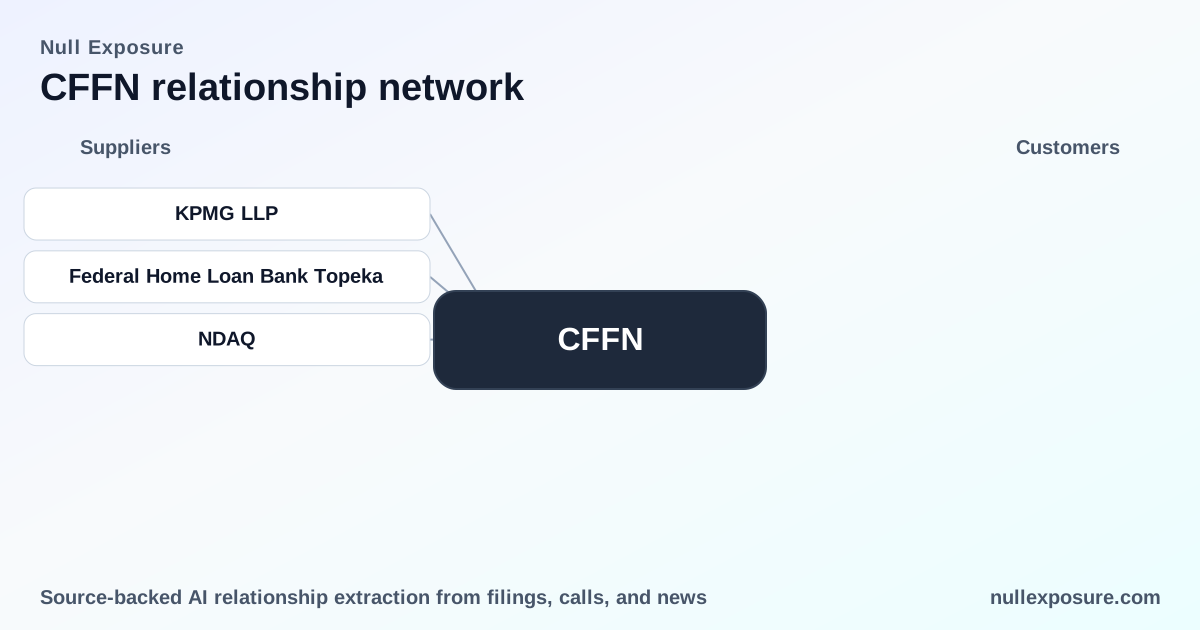
Capitol Federal’s supplier map is compact but consequential: FHLB Topeka is the strategic funding partner, KPMG provides audit validation, and NASDAQ secures market access. The company’s documented constraints point to long-term, concentrated funding and a mature approach to vendor risk—a combination that supports steady earnings but requires active monitoring of funding maturities and counterparty terms. For operators, the vendor governance program is a platform to negotiate stricter SLAs and testing cadence; for investors, interrogate quarterly disclosure on borrowings and any shifts in FHLB usage.
For a deeper read on supplier exposures and how they affect capital and liquidity risk across regional banks, visit NullExposure for curated supplier intelligence and tracking tools: https://nullexposure.com/.