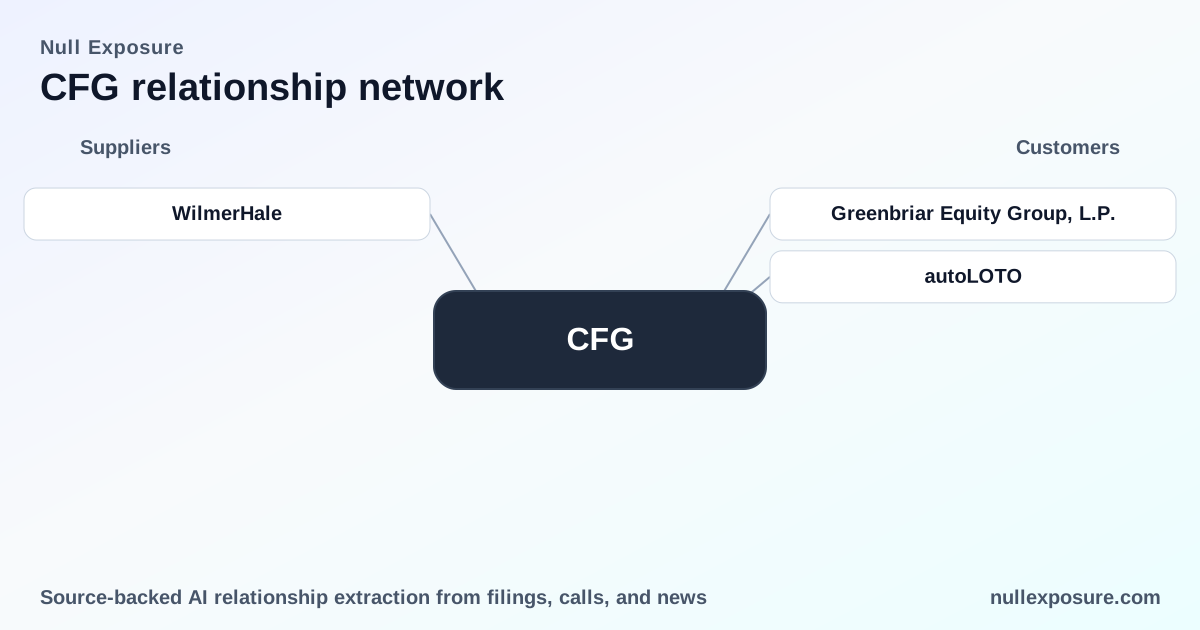
Citizens Financial Group (CFG): Supplier relationships that shape execution risk and strategic growth
Citizens Financial Group is a regional bank that monetizes through net interest income on a loan and securities portfolio, fee income from retail and commercial banking services, and targeted M&A to expand advisory capabilities. CFG’s revenue base is driven by core lending spreads and recurring deposit funding, while incremental growth is delivered through strategic acquisitions and advisory-led product expansion. Investors should evaluate supplier and advisor ties as windows into both execution risk and deal-making velocity. For an at-a-glance supplier risk view and relationship mapping, visit https://nullexposure.com/.
What the supplier footprint tells investors about how CFG runs the business
Citizens is a bank with a large balance-sheet funding program and a dependence on both long-term wholesale instruments and short-term central-bank facilities. Public disclosures show a mix of long-dated Federal Home Loan Bank (FHLB) advances alongside access to the Federal Reserve discount window for short-term liquidity — a funding posture that balances duration with contingency liquidity. These funding options indicate a practical contracting posture: stable long-term backstops for term funding alongside tactical short-term liquidity options.
Operationally, CFG discloses that third parties perform a significant portion of its information technology and business-process functions. That capability outsourcing elevates concentration and fourth-party risk: the bank’s operating model is dependent on external suppliers for critical infrastructure, and the relationship stage for those services is active. Investors should treat these vendor relationships as core to operational resilience rather than peripheral support contracts.
Key company-level signals from public disclosures:
- Long-term funding: FHLB advances with a weighted-average rate of 3.918% and maturities through 2045, signaling meaningful term debt in the capital structure.
- Short-term liquidity options: CFG retains the ability to borrow from the Federal Reserve discount window to meet short-term needs.
- Operational concentration: Third parties run a large portion of IT and hosted services, which the company classifies as critical to operations and actively managed.
These are company-level constraints and should be read as signals about maturity, criticality, and contracting posture rather than attributes of any single advisor or law firm.
The advisory relationship you need on your radar: WilmerHale
WilmerHale served as counsel advising Citizens on its acquisition of Matrix Capital Markets Group, a deal positioned to add advisory capabilities to CFG’s platform. WilmerHale’s role is transactional and strategic: the firm provided legal advisory services supporting the acquisition process (WilmerHale, March 2026). https://www.wilmerhale.com/en/insights/news/20260305-citizens-financial-group-adds-to-advisory-capabilities-with-acquisition-of-matrix-capital-markets-group
Why this matters: the use of a high‑quality advisory law firm for an acquisition that expands advisory services signals an active strategy to grow fee-based revenue and institutional capabilities. For investors tracking revenue mix and deal execution, the engagement confirms CFG’s intention to scale an advisory channel rather than rely purely on organic deposit and loan growth.
How each known supplier relationship maps to value and risk
- WilmerHale provided legal advisory on the Matrix Capital Markets Group acquisition; the engagement is transaction-specific and supports CFG’s expansion of advisory capabilities (WilmerHale news, FY2026). https://www.wilmerhale.com/en/insights/news/20260305-citizens-financial-group-adds-to-advisory-capabilities-with-acquisition-of-matrix-capital-markets-group
No other named supplier relationships were present in the reviewed results; public disclosures instead emphasize the broad set of third-party IT and business-process providers that are material and active for operations.
For a consolidated view of CFG’s supplier exposures and counsel appointments, see https://nullexposure.com/ — it surfaces counsel, advisors, and critical vendors in one place.
Operational risk: concentration, criticality and contract maturity in plain English
CFG’s supplier posture combines long-duration funding contracts with active third-party operational outsourcing:
- Concentration: The bank outsources major IT and hosted services functions, creating single-issue concentration where vendor failure could materially disrupt service delivery. Public disclosures describe fourth-party risk explicitly, making vendor management a board-level control consideration.
- Criticality: The company labels these vendor relationships as critical to its operating model; therefore, vendor performance is directly tied to customer experience and regulatory compliance.
- Maturity: The funding mix shows long-term maturities (FHLB advances to 2045) alongside short-term liquidity options via the Fed discount window; financing maturity is diversified but includes long-duration exposures that will be sensitive to rate moves.
These operating model characteristics mean investors should watch vendor remediation programs, regulatory exam results related to outsourcing, and the tenor and repricing schedule of the long-dated wholesale funding book.
Financial context that frames supplier importance
Citizens trades as a regional bank with approximately $24.2 billion market capitalization, a trailing P/E of 14.6 and forward P/E around 11.1; revenue TTM is $7.64 billion with profit margin of 24% and return on equity of 7.24%. These numbers underline a profitable franchise that is nonetheless pursuing fee-bearing advisory expansion to lift returns and diversify earnings. The WilmerHale-advised acquisition is consistent with management’s push to broaden fee streams and reduce pure spread exposure over time.
If you want a compact supplier risk scorecard and historical counsel log for CFG, visit https://nullexposure.com/ to access curated supplier relationships and material vendor signals.
Investor takeaway and actionable next steps
- Strategic signal: The WilmerHale engagement on the Matrix Capital Markets acquisition confirms CFG’s active pursuit of advisory capabilities and fee-income expansion.
- Operational risk: The bank’s outsized reliance on third-party IT vendors is designated as critical in disclosures and introduces fourth-party risk into the operational risk profile.
- Funding posture: A mix of long-term FHLB advances (weighted avg 3.918% through 2045) and access to the Fed discount window shows a deliberate balance of term funding and contingency liquidity.
Recommended investor actions:
- Monitor post-acquisition integration milestones and any advisory revenue disclosures to assess whether the deal is accretive to fee growth.
- Review vendor-risk oversight notes in upcoming regulatory filings and earnings calls to evaluate whether outsourcing concentration is being mitigated.
- Track the repricing schedule of FHLB advances and the bank’s liquidity metrics if rate volatility increases.
For a consolidated supplier and advisor view that ties these relationship signals to financial metrics, explore our platform at https://nullexposure.com/.