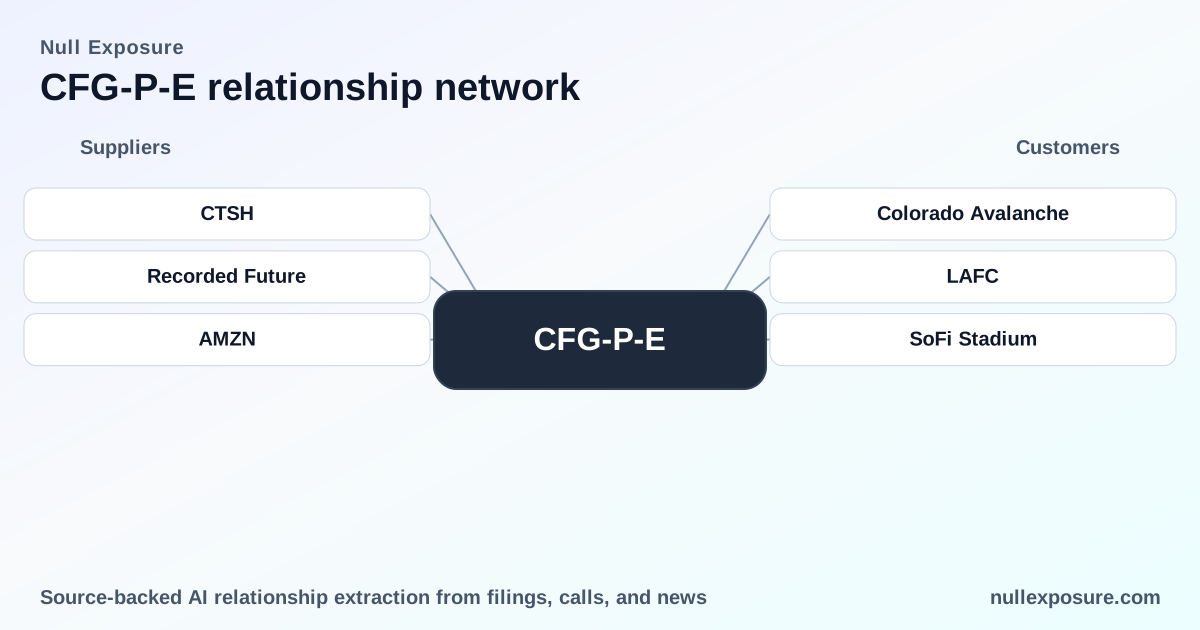
CFG-P-E: Supplier map and what it tells investors about Citizens Financial Group
Citizens Financial Group operates as a regional bank that monetizes through traditional banking activities—net interest income from lending and deposits, plus noninterest fee income from transaction services and wealth management—while increasingly leveraging third-party technology and security partnerships to scale operations and manage risk. For investors considering the preferred equity instrument CFG-P-E, supplier relationships illuminate how Citizens is executing a cloud-first technology push, centralizing delivery through global capability centers, and hardening cyber defenses, all of which influence operating leverage, execution risk, and regulatory exposure. Explore more supplier intelligence at https://nullexposure.com/ to incorporate these signals into capital allocation decisions.
What the supplier footprint implies about operating posture
Citizens’ visible supplier commitments point to an operating model that is strategically modernizing and outsourcing non-core functions rather than vertically integrating them. That posture reduces fixed-cost leverage but increases dependency on third-party execution for mission-critical functions.
- Contracting posture: Evidence of a global capability center and heavy cloud migration signals long-term, strategic contracts rather than short tactical buys. These are the kind of relationships that create multi-year vendor lock-in and require active vendor governance.
- Concentration risk: The supplier set spans technology integrators, cloud providers, and specialized cyber-intelligence firms; reliance on a small number of prime partners creates single-vendor concentration risks that investors should monitor through contract disclosure and incident reporting.
- Criticality: Cloud and cyber relationships are operationally critical; outages or security failures produce direct earnings and reputational impacts. These suppliers are not peripheral vendors — they sit at the core of service delivery and risk management.
- Maturity: Choices like building a Global Capability Centre and a measured AWS migration demonstrate an enterprise-level, staged modernization strategy consistent with mature vendor management practices, not ad-hoc outsourcing.
Key takeaway: vendor choices reflect a deliberate trade-off—reducing internal infrastructure burden while increasing third-party execution risk that needs governance and contingency planning.
Three supplier relationships investors should watch
Cognizant: GCC in Hyderabad for technology scale
Citizens selected Cognizant to launch its first Global Capability Centre in Hyderabad, a move that centralizes software development and operational support outside the U.S., signaling a push to scale technology delivery and lower unit costs. (Analytics India Magazine LinkedIn post, March 9, 2026.)
Recorded Future: augmenting cyber threat intelligence posture
Citizens engaged Recorded Future to obtain in-depth threat intelligence and context that complements internal analysis and peer-sharing networks, strengthening proactive cyber defense and incident response capabilities. (Recorded Future case study, FY2024.)
Amazon Web Services (AWS): cloud migration underpinning analytics and fraud defenses
Citizens reports being roughly 80% migrated to AWS, which the bank credits with improving data access and enhancing fraud detection capabilities as part of a five-year generative-AI and analytics vision. (Tearsheet feature on Citizens’ AI strategy, FY2025.)
Why these relationships change the investment calculus
Each partnership affects a different vector of bank performance:
- Cost structure and scalability: The Cognizant GCC signals a shift of incremental engineering and operations into lower-cost regions, enabling Citizens to scale product development without equivalent increases in compensation expense. That is a structural lever for future margin improvement.
- Operational resilience and regulatory scrutiny: Heavy reliance on AWS increases dependency on a single cloud provider for transaction and fraud systems; that improves agility but concentrates systemic risk and regulatory interest around third-party resiliency practices.
- Security posture as a capital-protection factor: Proactive engagement with Recorded Future elevates Citizens’ threat detection and contextual analysis capabilities, reducing tail risk from cyber incidents that can create outsized capital and reputational hits.
Investor implication: monitor vendor concentration disclosures, third-party risk management updates, and any vendor-related incident reports as potential drivers of both upside (efficiency gains) and downside (service interruption or regulatory fines).
Explore how supplier signals should influence portfolio weighting at https://nullexposure.com/ — our research framework maps these relationships into exposure and governance recommendations.
Practical red flags and monitoring checklist
- Demand transparency on contract terms when available: duration, change-of-control provisions, and termination rights. Long-term GCC and cloud contracts imply limited near-term flexibility.
- Track AWS service boundaries and whether Citizens retains critical runbooks and data portability assurances; absence of these increases operational risk.
- Evaluate cyber-intelligence integration: contracts with vendors like Recorded Future that explicitly buttress detection and response programs materially lower breach probability and downstream losses.
Key risks to quantify: vendor concentration, cross-border execution risk from offshore centers, and the potential for regulatory action tied to third-party outages or security breaches.
How investors should act on this intelligence
- For income investors who favor CFG-P-E, treat supplier modernization as a structural positive for cost efficiency but require evidence of robust vendor oversight before increasing allocation.
- For credit-oriented investors, demand disclosure on business continuity plans and contractual service-level commitments tied to AWS and Cognizant.
- For event-driven or activist investors, supplier concentration and offshore delivery create clear engagement points—seek improved reporting on third-party risk and contingency funding.
For more supplier-level insights and to integrate these signals into investment models, visit https://nullexposure.com/ — our platform provides ongoing supplier mapping and decision-ready analysis.
Final assessment
Citizens’ supplier choices are purposeful: cloud-first migration, an outsourced engineering hub, and specialist cyber intelligence together create a technology-forward bank that trades some operational sovereignty for scalability and defensive strength. For holders of CFG-P-E, that trade-off supports a thesis of moderated operating costs and improved fraud controls, while introducing vendor concentration and third-party risk that investors must treat as a core part of credit and governance analysis.
Actionable next steps: request third-party risk disclosures in earnings calls, follow material contract announcements, and incorporate vendor concentration into stress testing for preferred equity valuations. Visit https://nullexposure.com/ for detailed supplier profiles and to translate these signals into portfolio actions.