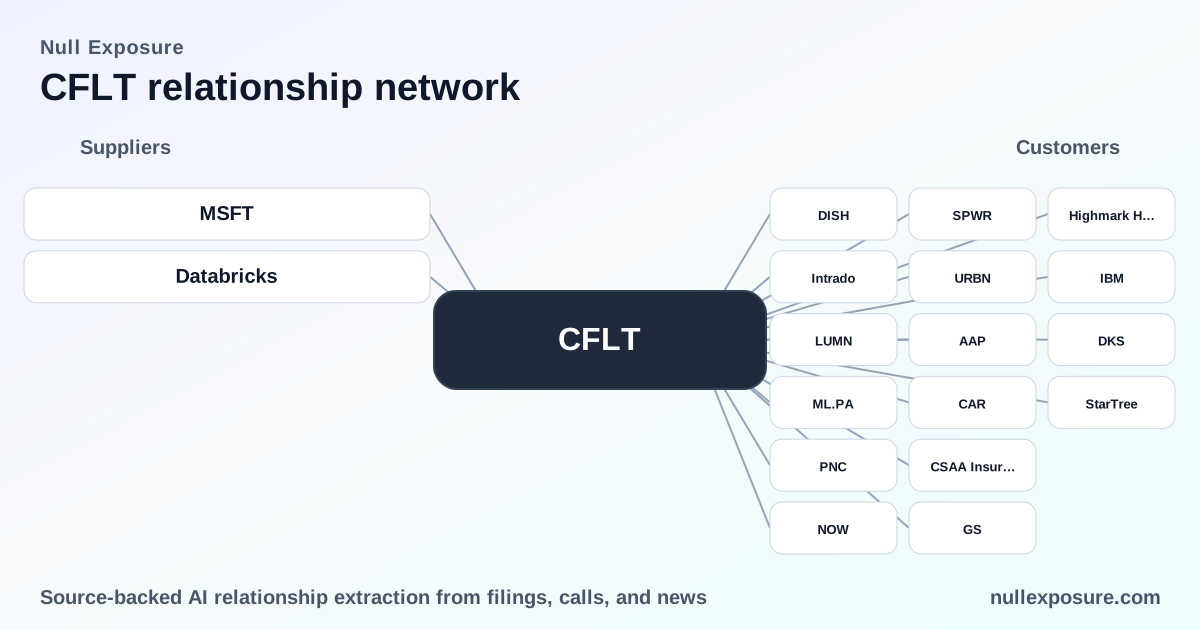
Confluent (CFLT) — supplier relationships that shape product delivery and risk
Confluent sells a cloud-native data streaming platform and monetizes through software subscriptions and Confluent Cloud managed services, with enterprise customers buying usage-based cloud access and multi-year contracts. Revenue is driven by the managed-service distribution of a proprietary streaming platform; Confluent’s cost base is therefore tightly coupled to third‑party cloud providers and strategic integrations that widen adoption. For investors and procurement officers, supplier posture and spend concentration are direct drivers of margin profile and operational resilience. For a deeper supplier risk view, visit https://nullexposure.com/.
How Confluent runs the product — and why suppliers matter
Confluent's product is delivered primarily via Confluent Cloud and associated managed offerings, which means the company outsources core infrastructure to hyperscale cloud providers and builds commercial relationships with platform partners that embed or integrate its streaming technology. The balance between recurring software revenue (TTM revenue $1.1667B) and outsourced infrastructure costs determines gross margins and capital intensity; Confluent reported negative operating and net margins in trailing figures, reflecting investment in go-to-market and cloud-driven delivery costs.
Confluent’s commercial model therefore creates two supplier risk vectors:
- Infrastructure dependence: long-term purchase obligations for third‑party cloud capacity and managed services that scale with usage.
- Ecosystem partnerships: platform integrations that expand reach (and product stickiness) but also create operational coupling with partner roadmaps and go-to-market strategies.
If you evaluate Confluent from a vendor-management or investment angle, the next sections detail the relevant supplier relationships and the company-level constraints that shape contracting, concentration, and spend.
The Microsoft relationship — managed service rights on Azure
Microsoft granted Confluent the right to offer its platform as a managed service on Microsoft Azure, enabling Confluent Cloud to be delivered directly through Azure customers and marketplaces. This is a commercially meaningful distribution channel that embeds Confluent in the Azure ecosystem and supports enterprise procurement via Azure contracts. (Capital.com coverage of Confluent, March 2026).
The Databricks partnership — tighter technical integration
Confluent expanded its partnership with Databricks to enable bidirectional integration between Confluent Tableflow and Databricks’ Delta Lake and Unity Catalog, creating a direct data-path and governance bridge between streaming and lakehouse storage. This integration reduces friction for joint customers and increases platform stickiness by making Confluent part of an end-to-end data architecture. (Diginomica report on Q4 2024 earnings, published March 2026).
What these relationships mean in plain English
Both Microsoft and Databricks are commercial and technical multipliers for Confluent. Microsoft provides marketplace distribution and cloud hosting context (Azure), while Databricks deepens technical integration with the lakehouse layer — together they increase addressable market and lower friction for enterprise adoption. These partnerships also increase reliance on third-party roadmaps and contractual terms, which investors must price into margin and operational risk assumptions.
Company-level constraints that shape supplier exposure
Confluent’s public disclosures and operating statements show clear vendor-driven constraints that are material for procurement and investment decisions:
- Long-term contracting posture: Confluent reports purchase obligations tied to non-cancelable agreements for third‑party cloud infrastructure, indicating multi-period commitments that create fixed-cost exposure as usage grows.
- Service-provider dependency: The company explicitly relies on third parties to operate critical business systems and to process sensitive, proprietary information, marking these suppliers as operationally critical rather than optional.
- Infrastructure segment concentration: Confluent outsources all infrastructure related to Confluent Cloud to AWS, Azure, and GCP as selected by customers, which establishes hyperscaler concentration as a structural feature of the operating model.
- Material spend footprint: As of December 31, 2025, purchase obligations totaled $454.3 million, with $236.5 million due within 12 months — a >$100m+ spend band that represents a meaningful component of near‑term cash outflows.
These constraints signal that Confluent’s margins and capital planning are sensitive to cloud pricing, contract terms, and the ability to negotiate favorable resale or marketplace economics with hyperscalers. For clients and investors, supplier management is not peripheral — it is central to the economics of the business.
For a practitioner-grade supplier risk profile and to monitor partner disclosures in real time, consult https://nullexposure.com/.
Risk and opportunity summarized
- Opportunity: Partnerships with Microsoft and Databricks expand go-to-market channels and technical integration, lowering customer adoption friction and supporting revenue growth from Confluent Cloud.
- Risk: Hyperscaler concentration and long-term purchase obligations expose margins to cloud price changes and contract terms; a large near-term payment bucket ($236.5M within 12 months) increases liquidity sensitivity.
- Operational criticality: Third-party service providers host and operate critical systems; outages or commercial disputes with major providers would have outsized operational and reputational impact.
Practical takeaways for investors and operators
- For investors: model sensitivity to cloud costs and contract renewals into margin projections rather than assuming static gross margins; account for high institutional ownership and the market’s expectation (Analyst target price ~30.89).
- For procurement and operator teams: prioritize contractual flex (reserved vs. on-demand capacity), marketplace economics with Azure, and integration SLAs for partners such as Databricks to protect service delivery and total cost of ownership.
- Monitor partner evolution: any shift in marketplace economics, revenue-sharing, or technical integration depth with Microsoft or Databricks will have direct revenue and cost implications for Confluent.
If you need a structured supplier relationship map or ongoing monitoring for Confluent and its partners, start here: https://nullexposure.com/.
Closing view
Confluent’s business is fundamentally a managed-service model built on third-party infrastructure and strategic platform partnerships. Microsoft (Azure) and Databricks are complementary: Microsoft widens distribution and cloud hosting, Databricks deepens technical integration — both increase revenue potential but also raise supplier concentration and contractual exposure. Investors should price in both the upside from faster enterprise adoption and the downside from hyperscaler cost dynamics. For a continuous read on supplier signals and material contract metrics, visit https://nullexposure.com/.