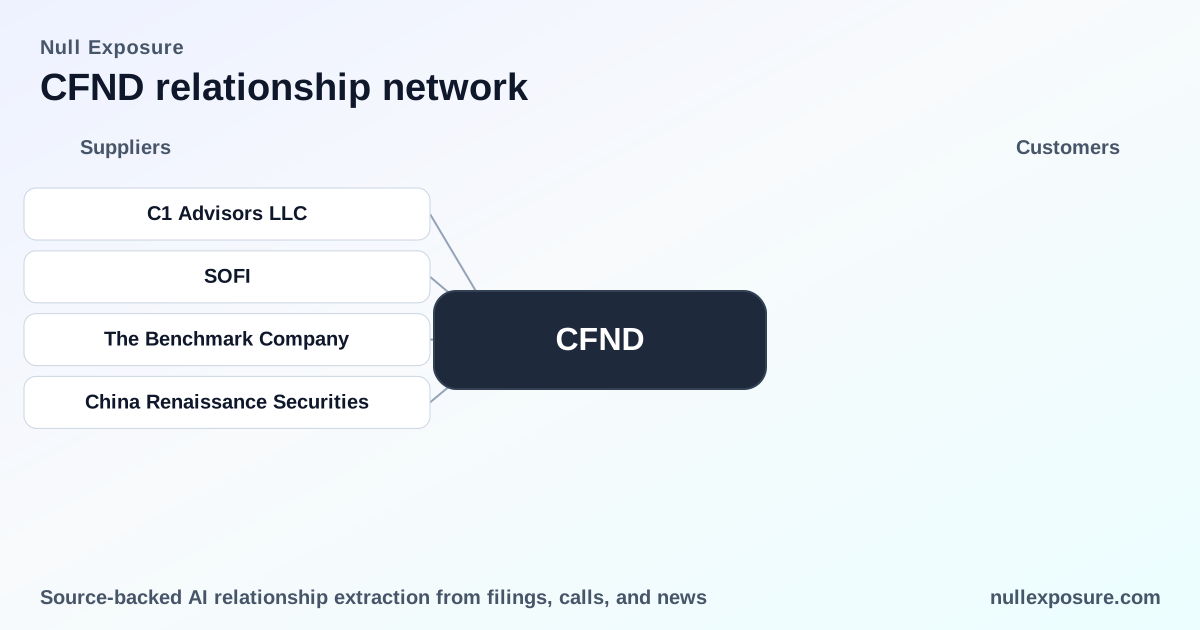
CFND supplier map: who powers the fund and why it matters to investors
CFND operates as a managed investment vehicle that outsources portfolio management and uses external capital-marketing partners to execute securities offerings. The firm monetizes through fund-level management and performance arrangements administered by an external adviser, while leveraging underwriters and co-managers to access public capital markets. Understanding these supplier relationships is essential for assessing operational concentration, capital-raising execution risk, and governance dynamics. For a consolidated view of supplier intelligence, see https://nullexposure.com/.
Quick operational thesis: outsourced management plus capital-marketing dependence
CFND runs an externally advised model: portfolio decisions and day-to-day management are delegated to C1 Advisors LLC, and capital events are executed through a structured underwriting syndicate with a single book-running manager and co-managers. This configuration concentrates execution risk with the lead book-runner while keeping investment management operationally externalized to a named adviser. Explore supplier coverage at https://nullexposure.com/ for deeper diligence.
Who CFND works with — line-by-line relationships and sources
C1 Advisors LLC
C1 Advisors LLC serves as the Fund’s investment adviser, handling the investment strategy and portfolio management responsibilities on behalf of CFND. According to Business Wire releases reported by The Globe and Mail in FY2025, the adviser relationship is explicitly identified in CFND communications. (Source: Business Wire / The Globe and Mail, FY2025 — https://www.theglobeandmail.com/investing/markets/markets-news/Business%20Wire/35490997/c1-fund-inc-announces-equity-purchase-in-chainalysis-leading-blockchain-data-and-compliance-platform/ and https://www.theglobeandmail.com/investing/markets/markets-news/Business%20Wire/36093241/c1-fund-inc-to-announce-third-quarter-2025-financial-results-on-november-20th-2025/)
The Benchmark Company
The Benchmark Company acted as the sole book-running manager for CFND’s transaction, taking primary responsibility for underwriting and leading the syndicate. A market notice of the offering identifies Benchmark as the exclusive book-runner in the syndicate disclosed during FY2025. (Source: market notice aggregated on StockTitan, FY2025 — https://www.stocktitan.net/news/CFND/page-2.html)
SoFi Securities
SoFi Securities participated as a co-manager alongside other underwriting partners, providing distribution and placement support for CFND’s offering. The underwriting roster published during FY2025 lists SoFi Securities as a co-manager on the deal. (Source: underwriting announcement aggregated on StockTitan, FY2025 — https://www.stocktitan.net/news/CFND/page-2.html)
China Renaissance Securities
China Renaissance Securities joined the syndicate as a co-manager, contributing distribution capacity and regional market reach for the offering. Public notices of the transaction in FY2025 include China Renaissance Securities among the co-managers. (Source: underwriting announcement aggregated on StockTitan, FY2025 — https://www.stocktitan.net/news/CFND/page-2.html)
What these supplier ties reveal about CFND’s operating model
The relationship set paints a clear operational picture: CFND is a fund that relies on an external adviser for investment execution and a structured underwriting syndicate for capital markets activity. From a supplier-risk and governance standpoint, several company-level signals emerge:
- Contracting posture — CFND adopts an outsourced management posture, delegating its core investment function to C1 Advisors LLC rather than internalizing portfolio management. This represents a standard asset-management contracting model where vendor performance and fiduciary alignment are principal governance levers.
- Concentration — The use of a sole book-running manager (The Benchmark Company) introduces execution concentration: Benchmark controls pricing and order allocation dynamics during offerings. Co-managers diversify distribution but do not eliminate lead-manager dependency.
- Criticality — The investment adviser relationship is operationally critical, since day-to-day portfolio construction, compliance oversight, and NAV delivery are outsourced to C1 Advisors LLC. The underwriting syndicate is transaction-critical for capital-raising events.
- Maturity and partner profile — Listed partners are established market participants (an adviser and recognized broker-dealers), indicating a mature, market-standard supplier set rather than early-stage or unproven vendors.
No supplier-level contractual constraints were recorded in the data provided. This absence is a company-level signal that no explicit, flagged contractual limitations or restrictive covenants were present in the source records reviewed.
For comparative supplier intelligence and deeper counterparty analysis, visit https://nullexposure.com/.
Investment implications — what investors and operators should prioritize
- Governance and oversight: Because portfolio management is outsourced to C1 Advisors LLC, investors should demand clear reporting, fee transparency, and documented conflict-of-interest controls between CFND and the adviser.
- Execution risk from lead manager concentration: With The Benchmark Company acting as sole book-runner, deal execution, pricing, and allocation tactics are concentrated, so monitor lead-manager track record and alignment on distribution strategy.
- Syndicate composition and market access: The presence of co-managers SoFi Securities and China Renaissance Securities broadens distribution channels; assess whether their placement capabilities materially improve market penetration for future raises.
- Operational resilience: Verify continuity plans and service-level commitments for the adviser relationship, since adviser disruption would directly impair investment operations.
Key takeaway: CFND’s supplier profile is conventional for externally advised funds, but the underwriting posture creates a measurable concentration point that influences capital-raising outcomes and investor liquidity options.
Practical next steps for due diligence
- Request the adviser agreement and recent performance reports from C1 Advisors LLC to validate governance terms and fee economics.
- Review underwriting engagement letters or offering circulars that document The Benchmark Company’s book-running rights and allocation policy.
- Monitor future offering notices to confirm whether Syndicate composition is stable or changes materially across transactions.
- Confirm that CFND’s disclosures address potential conflicts among adviser, underwriter, and fund management.
Explore supplier risk frameworks and counterparty scoring at https://nullexposure.com/ to structure your diligence.
Conclusion: supplier structure defines the operational risk frame
CFND runs a mainstream outsourced-management model with a focused underwriting arrangement that concentrates execution power in a single book-runner while using co-managers to extend distribution reach. Investors should treat the adviser relationship as mission-critical and the book-running arrangement as the principal execution risk. For organized supplier intelligence and monitoring workflows, see https://nullexposure.com/ — your starting point for structured counterparty diligence.