Cullen/Frost Bankers (CFR): supplier relationships that shape product delivery and capital flow
Thesis: Cullen/Frost Bankers (Frost Bank’s holding company) monetizes through traditional commercial and consumer banking—net interest margin, fee income and treasury services—while selectively outsourcing infrastructure and payments capabilities to accelerate product features and preserve capital. Strategic supplier ties to payment-rail providers and membership institutions support faster product rollout and community credit programs, while vendor reliance and short-term funding mechanics create operational and liquidity vectors investors must price. Learn more at https://nullexposure.com/.
How Frost runs its external relationships — a concise operating portrait
Frost operates as a regional bank with an emphasis on direct client relationships and a measured appetite for third-party partnerships to extend capabilities. Company-level signals from filings and disclosures show several consistent characteristics:
- Contracting posture: Frost documents reliance on external vendors and service-level agreements, indicating a framework-based vendor approach and formalized SLAs that govern performance expectations.
- Funding and maturity profile: The bank uses short-term secured funding techniques—securities sold under agreements to repurchase—to manage liquidity and customer needs, revealing a routine use of repo markets for tactical funding.
- Vendor role and criticality: External providers are treated as service providers crucial to day-to-day operations; cloud technologies are called out as “critical,” implying high operational dependency on third-party infrastructure.
- Scale signal: A Board-authorized $150 million repurchase in 2025 signals available capital flexibility and corporate spending at meaningful scale relative to balance-sheet size.
These attributes define the contours of Frost’s supplier exposure: formalized, critical, and operationally embedded vendors plus tactical short-term funding levers that investors should include in risk-adjusted valuations.
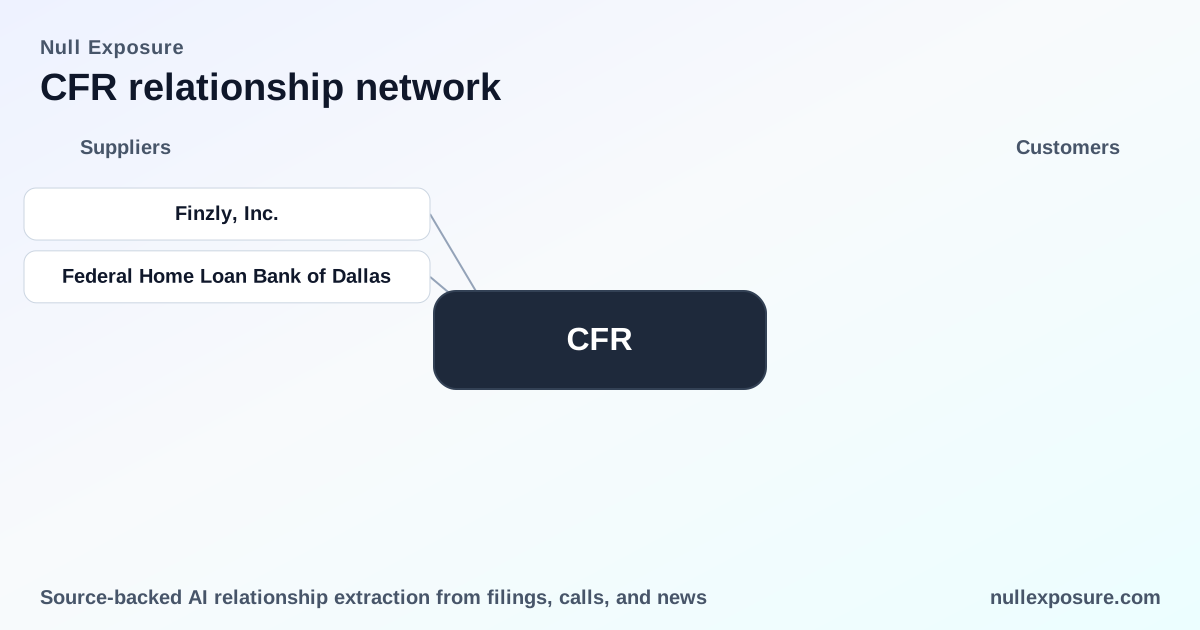
Supplier tie: instant payments platform (Finzly, Inc.)
Frost Bank partnered with Finzly to deliver instant payments capabilities to its business and consumer clients via the Federal Reserve’s FedNow and The Clearing House’s RTP rails. This relationship gives Frost a rapid-to-market path for real-time payments without building proprietary rail connectivity internally. A PRWeb release dated March 9, 2026 announced the arrangement and framed it as an expansion of Frost’s digital payments capability (PRWeb, 2026-03-09; https://www.prweb.com/releases/frost-bank-taps-finzly-to-provide-fednow-and-rtp-instant-payments-to-its-business-clients-and-consumers-302181181.html).
Supplier tie: Federal Home Loan Bank of Dallas (community and funding conduit)
Frost Bank acted as the conduit for a $750,000 Affordable Housing Program grant from the Federal Home Loan Bank of Dallas to support a senior housing development in Houston, demonstrating Frost’s role in distributing FHLB-backed community funding and supporting affordable housing projects. Coverage of the project credited Frost with channeling the FHLB Dallas grant in a March 2026 news note (StockTitan, FY2025 coverage; https://www.stocktitan.net/news/CFR/houston-texas-senior-housing-development-breaks-ground-with-support-e8rqg7lg7ftb.html).
What these relationships reveal for investors
These supplier relationships are not ancillary marketing links; they reveal strategy and execution choices that change how Frost competes and how its risk is structured.
- Product acceleration without capital substitution. The Finzly tie is a clear example of Frost using a specialist provider to add real-time rails quickly. That approach reduces time-to-market and capital outlay compared with in-house development, but it raises vendor concentration and operational dependency on a third party for a client-facing capability.
- Regulatory and community intermediation role. The FHLB Dallas activity underscores Frost’s intermediary role in community development finance and access to cooperative-bank funding and programs—a stabilizing source of grant and liquidity channels that also ties Frost to regional policy and housing outcomes.
- Operational risk anchored in service providers and cloud. Filings explicitly state reliance on vendors and cloud technologies as critical to systems operations, creating a single-point operational risk if SLA performance degrades or cloud incidents occur.
- Liquidity tactics matter. Public disclosures about repurchase agreements and the $150 million repurchase program indicate routine use of short-term secured funding and active capital management, which influences balance-sheet elasticity and sensitivity to repo market conditions.
These dynamics are consistent with a regional bank that maintains a conservative balance sheet while outsourcing sophisticated rails and leaning on cooperative institutions for programmatic funding.
Quick financial context that frames supplier risk
Cullen/Frost has a market capitalization near $8.34 billion, TTM revenue of $2.19 billion, a profit margin of 29.6%, and return on equity of 15.3%. These metrics indicate a profitable regional operator with capital to invest in digital capabilities and to absorb selective vendor spend. Investors should weigh the upside of accelerated product functionality against the concentration of operational dependency implied by the disclosed vendor and cloud reliance.
Read more analysis at https://nullexposure.com/ — covering supplier economics and counterparty risk at scale.
Practical implications and risk checklist for investors and operators
- Monitor vendor SLA adherence and escalation paths. Real-time payments are high-frequency, low-latency services where any vendor outage has direct client impact.
- Assess liquidity corridors. Repo usage and FHLB relationships create a layered funding profile; stress testing Frost’s repo and FHLB access under market strain is essential.
- Value of optionality vs. vendor lock. Outsourcing payments accelerates client features; investors should discount for potential margin compression and vendor pricing power that follows successful product adoption.
- Regulatory and reputational linkage. Acting as conduit for FHLB grants aligns Frost with community outcomes; while reputationally positive, it adds program delivery responsibilities and compliance obligations.
If you need a vendor-mapping brief or counterparty risk score for Frost’s supplier footprint, start your research at https://nullexposure.com/.
Investor takeaway and recommended next steps
Cullen/Frost’s supplier posture is strategic and pragmatic: it outsources specialized rails and leverages cooperative institutions to deliver capability and community programs while retaining core banking economics. Investors should value the revenue and product upside from payment modernization and community lending access, while pricing in operational risk from vendor reliance and short-term funding exposures.
For a deeper, operationally focused supplier risk brief tailored to institutional investors and operators, visit https://nullexposure.com/ and request the Frost supplier-risk pack.