Carlyle Group (CG): Deal flow, counterparties and supplier map for investors
Carlyle Group (CG) operates as a global alternative asset manager that earns management fees, performance (carry) fees and investment returns through a mix of private equity buyouts, energy and infrastructure funds, and credit and real assets strategies. Carlyle monetizes through recurring fee streams on committed capital plus asymmetric upside from realized exits and carried interest; the firm also uses strategic co-investments and portfolio company M&A to compound NAV growth. For investors and operators assessing supplier and counterparty exposure, Carlyle’s recent public deals and advisor relationships illuminate its deal pipeline, financing partners, and legal counsel choices—factors that directly affect fee capture, distribution arrangements and reputational risk. Read more on strategic counterparty intelligence at https://nullexposure.com/.
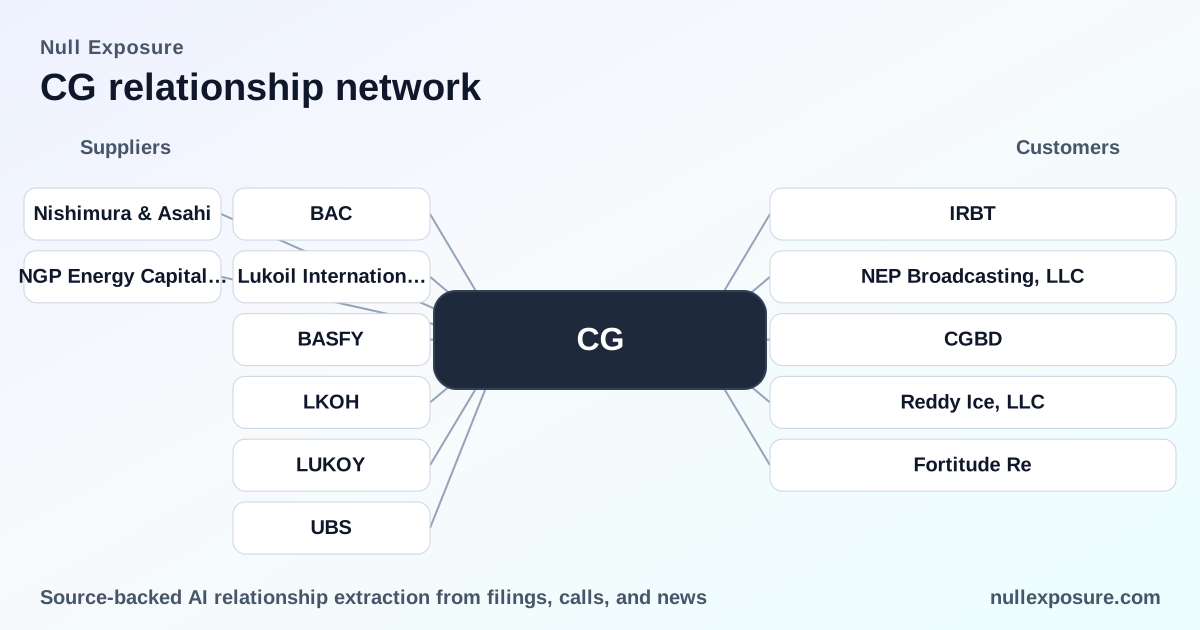
Market activity over the last reporting window shows Carlyle engaging in large asset acquisitions (energy and chemicals), using top-tier advisors and sharing distribution economics with global banks. Below I map every visible supplier/relationship in recent media coverage and extract the operational implications for stakeholders.
Quick reading: what these relationships collectively signal
Carlyle is running a high-volume, cross-border deal program with a mix of strategic investors (sovereign wealth), global banks, and specialized legal and sector partners. The relationships show: (1) large-ticket asset acquisition appetite (Lukoil units, BASF coatings), (2) use of premier advisers and distribution partners (BofA, UBS), and (3) regional legal counsel for transactional closure (Nishimura & Asahi). These dynamics reinforce Carlyle’s fee-rich monetization model but also increase execution complexity and regulatory/sovereign exposure.
Explore deeper supplier profiles and counterparty concentration with our platform: https://nullexposure.com/.
Transaction and adviser ledger — every reported relationship
BofA Securities, Inc.
Carlyle engaged BofA Securities as a financial advisor on at least one transaction referenced in recent press, indicating reliance on global investment banks for sell-side and buy-side execution support. According to MarketScreener coverage in March 2026, BofA advised Carlyle on a proposed acquisition in Asia (FY2025 reporting window). (MarketScreener, March 2026)
Lukoil International GmbH
Carlyle signaled intention to acquire Lukoil International GmbH — the foreign-asset management arm of Lukoil — through a specialized oil company, a move welcomed by Moldovan authorities as reported in early 2026; this highlights Carlyle’s strategic push into energy assets outside Russia. (Radio Moldova, March 2026)
BASF (coatings businesses)
Carlyle and the Qatar Investment Authority entered a binding agreement to acquire a 60% stake in several BASF coatings units, reflecting Carlyle’s approach of partnering with sovereign capital to underwrite large industrial carve-outs and capture value through operational improvement. The deal was reported to have moved markets and lifted Carlyle shares in March 2026. (The Globe and Mail, March 2026)
PJSC LUKOIL
Press reports state Carlyle signed an agreement to acquire LUKOIL International GmbH from PJSC LUKOIL, signaling a principal purchase from the Russian parent and underscoring the cross-border negotiation complexity such transactions carry. (MarketScreener, March 2026)
Lukoil (parent)
Lukoil announced in late January 2026 that it reached an agreement with Carlyle to sell its foreign-asset unit, estimated to manage roughly $22 billion in assets, positioning Carlyle in control of substantial overseas oil and gas operations post-close. This is a strategic scale-up in Carlyle’s energy platform exposure. (Radio Moldova / Lukoil statements, January–March 2026)
UBS (performance fee / product selling arrangements)
Market commentary notes arrangements where Carlyle (and partner CVC) agreed to pay a share of performance fees to UBS for product distribution or selling, illustrating fee-sharing agreements with prime distributors that affect net carry economics and distribution margins. (MarketScreener, March 2026)
UBS (loan loss reporting context)
Separate press coverage referenced UBS in relation to Carlyle losing over $100 million on a loan to a bankrupt portfolio company (reported FY2025), underlining counterparty and credit event exposure in Carlyle’s lending and credit-oriented strategies. (MarketScreener, March 2026)
Nishimura & Asahi
For Asia-region transactional counsel, Carlyle employed Nishimura & Asahi lawyers (named partners on the deal team) in connection with a proposed acquisition, reflecting the use of top local law firms to manage jurisdictional risk and regulatory compliance in cross-border M&A. (MarketScreener, March 2026)
NGP Energy Capital Management (NGP)
Carlyle’s public filings and segment notes list NGP-advised carry funds as included in performance reporting, indicating strategic alignment with specialized energy GP sponsors and co-invest structures inside the firm’s energy segment. (CNBC company profile / filings, FY2025)
Operating model constraints and what they mean for counterparties
Carlyle’s publicly reported constraints include a company-level disclosure about payments for aircraft usage to entities controlled by co‑founders: the firm reported $1.3 million in operating expense for aircraft used in 2024, paid at market hourly rates and routed through aircraft managers with a portion ultimately benefiting co‑founders. This is a signal of insider-linked vendor relationships and a contracting posture that is formally arms-length on price but operationally entwined with insider interests. Investors should read that as a governance and vendor-concentration flag rather than a material operational impairment given the scale, but it increases reputational and related-party scrutiny.
Other company-level signals from the relationship map:
- Concentration and criticality: Large asset purchases (Lukoil units, BASF stake) increase exposure to a handful of large counterparties and sovereign partners, raising criticality of execution and integration.
- Maturity and sophistication: The use of global banks, sovereign partners and elite law firms indicates mature contracting practices for complex cross-border buys, but also elevated legal and regulatory complexity.
- Contracting posture: Fee-sharing with distributors (e.g., UBS) shows willingness to cede portions of carry/fees for broader market distribution and liquidity.
If you’re tracking how these counterparties affect fee capture and downside risk, our platform maps exposure by counterparty and transaction stage — learn more at https://nullexposure.com/.
Investment implications and execution risk
- Upside drivers: Securing majority stakes in industrial assets (BASF coatings) and acquiring a large energy portfolio (Lukoil International) are high-return levers for carry generation and NAV growth if integration achieves cost synergies and market repositioning.
- Risk vectors: Cross-border regulatory approvals, asset-level commodity risk in energy, and distribution fee-sharing dilute headline carry potential and require active monitoring.
- Operational governance: Related-party vendor payments, while small in absolute terms versus AUM, are governance signals investors should monitor through proxy disclosures and the 10‑K/annual report.
Bottom line and next steps
Carlyle’s recent counterparties and advisor choices paint a picture of an aggressive, institutionally-backed deal program that leverages global banks, sovereign capital and local counsel to execute transformational asset buys. For investors and operators, the priority is tracking completion risk, distribution economics (fee-sharing), and governance flags around related-party vendors.
For a deeper counterparty breakdown and real-time supplier analytics, visit https://nullexposure.com/ and sign up for detailed counterparty reports. For bespoke research or to map your exposure against Carlyle’s counterparties, contact our team through https://nullexposure.com/.