Carlyle Group Inc. (CGABL) — Supplier and Counterparty Review for Investors
Carlyle Group Inc. operates as a preeminent global investment firm that monetizes through management fees, incentive/performance fees, and realized investment returns across private equity, credit and real assets. The CGABL instruments are subordinated notes that provide income-focused investors exposure to Carlyle’s balance-sheet and long-duration funding needs while sitting behind senior creditors in the capital structure. For investors evaluating supplier and counterparty risk, the relevant signal set combines active portfolio acquisitions, strategic co-investments, and a clear reliance on third‑party service providers and global office footprint. Learn more about counterparty mapping and supplier risk at https://nullexposure.com/.
Investment thesis in one paragraph
Carlyle funds operations and growth through recurring fee income and capital redeployment; CGABL subordinated notes offer higher yield compared with senior debt at the cost of lower recovery in stress scenarios. Counterparty relationships—both as a buyer across asset purchases and as a consumer of critical services (prime brokers, custodians, legal advisors)—drive operational exposure more than any single vendor concentration given Carlyle’s diversified global footprint. Investors should balance the firm’s mature fee base and diversified investment activity against subordinated credit ranking and operational reliance on third‑party providers.
What the current relationships show about activity and strategy
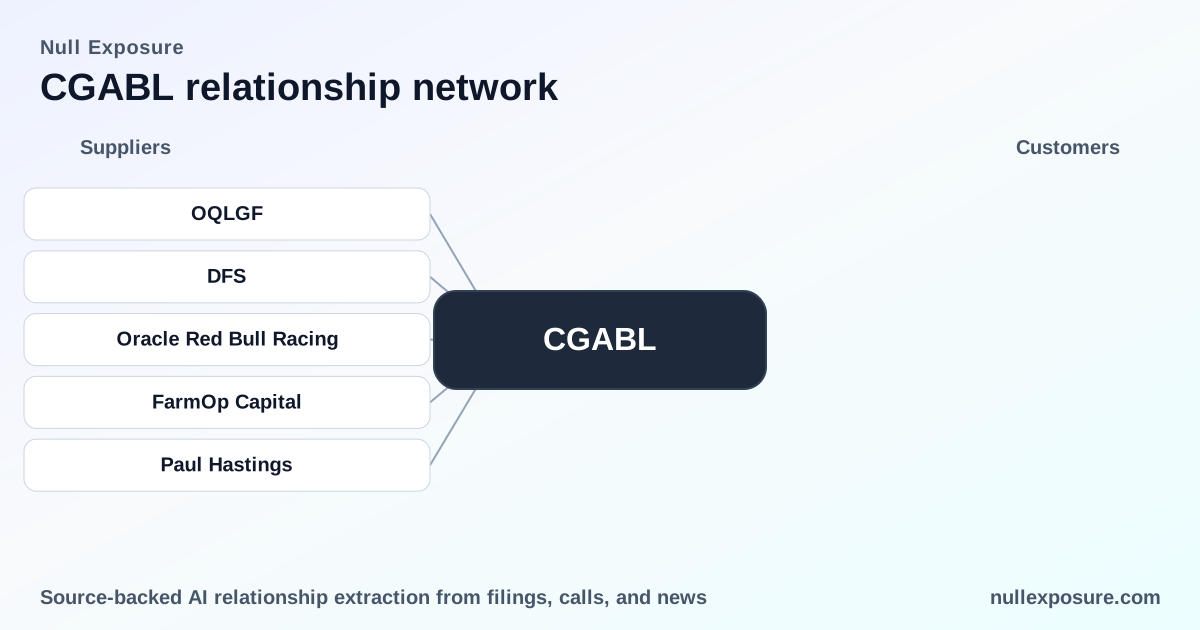
Below are the supplier and counterparty relationships surfaced for CGABL, each with a concise plain-English description and a source.
Carlyle’s purchase of NWSL club from OL Groupe
Carlyle-led investors agreed to acquire the Seattle Reign FC (formerly OL Reign) from OL Groupe in a deal valuing the NWSL club at $58 million, underscoring Carlyle’s willingness to deploy capital into sports and consumer-facing assets. Source: Sportico reported the transaction in 2024 (https://www.sportico.com/business/team-sales/2024/carlyle-sounders-reign-nwsl-sale-58-million-1234771244/).
Purchase of student loan portfolio from Discover Financial Services
Carlyle and KKR formed a partnership to acquire approximately $10.1 billion in prime student loans from Discover Financial Services, illustrating Carlyle’s activity in acquiring large credit portfolios and partnering with peers for scale. Source: Alternative Credit Investor coverage of the July 2024 transaction (https://alternativecreditinvestor.com/2024/07/17/carlyle-and-kkr-buy-10-1bn-student-loan-portfolio/).
Branding and partnership with Oracle Red Bull Racing
Carlyle executed a commercial partnership placing its branding across Oracle Red Bull Racing assets, demonstrating strategic marketing and brand-extension investments that support Carlyle’s consumer and global visibility strategy. Source: CNBC reporting from September 2025 (https://www.cnbc.com/2025/09/09/carlyle-red-bull-f1-pe.html).
Loan purchasing arrangement with FarmOp Capital
Carlyle committed to purchasing newly issued loans from FarmOp Capital to expand FarmOp’s origination capacity, signaling a direct credit-buying posture that increases exposure to originator performance while supporting agricultural finance growth. Source: Pulse2 coverage of the FarmOp financing (https://pulse2.com/carlyle-investing-250-million-in-farmop-capital-for-boosting-farmer-financing/).
Paul Hastings as legal advisor to Carlyle on FarmOp deal
Paul Hastings served as legal advisor to Carlyle on the FarmOp Capital transaction, reflecting standard use of large law firms for structuring and diligence in Carlyle’s credit and portfolio transactions. Source: Same Pulse2 report on the FarmOp transaction noting advisory roles (https://pulse2.com/carlyle-investing-250-million-in-farmop-capital-for-boosting-farmer-financing/).
Operational constraints and what they signal about supplier posture
Company-level disclosures and the relationship set generate the following operational signals:
- Global footprint across NA, EMEA and APAC — Carlyle reports major offices in Washington, D.C., New York City, London and Hong Kong, which indicates multi‑jurisdictional operations and vendor coverage that reduces single‑market concentration but increases cross‑border compliance and operational complexity.
- Dual role as buyer and large-scale investor — Carlyle frequently acquires portfolios and equity stakes, functioning as an active buyer in markets ranging from sports franchises to credit portfolios; this contracting posture demands robust origination, diligence, and counterparty negotiation capabilities.
- Heavy reliance on third‑party service providers — Filings and disclosures identify prime brokers, custodians, administrators and IT vendors as critical to day‑to‑day operations; this elevates operational risk and vendor management demands.
- Services-driven engagement model — The firm routinely contracts professional services (legal, backup/recovery, advisors) as part of deal execution, indicating mature contracting practices but also recurring outsourced dependencies.
Collectively these constraints paint a profile of a mature investment manager with global diversification, frequent buyer activity, and elevated operational dependency on specialized service providers.
For more detailed counterparty maps and supplier analytics, visit https://nullexposure.com/.
Risk / reward implications for CGABL holders
- Credit position: As subordinated notes, CGABL holders accept lower recovery priority relative to senior creditors, which increases downside volatility in stress scenarios despite Carlyle’s strong fee‑based earnings profile.
- Counterparty exposure: Large portfolio purchases (Discover student loans, FarmOp loans) and consumer‑facing acquisitions concentrate exposure in credit and asset performance channels; counterparty credit and originator underwriting quality are material to expected returns.
- Operational risk: Dependence on prime brokers, custodians and IT vendors is a persistent source of operational and continuity risk; legal advisors like Paul Hastings reduce transactional legal risk but do not eliminate vendor continuity exposure.
- Diversification upside: Carlyle’s global office footprint and diversified asset strategies support fee stability and provide multiple routes to recovery and capital redeployment absent a systemic shock.
How to act on these signals
- Institutional investors seeking income should weigh the yield premium from CGABL against subordinated recovery risk and stress-test exposure to Carlyle’s credit acquisitions.
- Operational risk managers should assess counterparty diligence on prime brokers and custodians and require transparency on loan-originator underwriting for portfolio purchases.
- Portfolio managers should monitor ongoing transaction flow—large acquisitions and credit purchases are leading indicators of balance‑sheet risk concentration.
Explore supplier and counterparty dashboards and curated relationship reports at https://nullexposure.com/ to conduct deeper diligence.
Final read: what matters most
Carlyle is an established, mature manager with diversified global reach and an active buyer posture. For CGABL investors, the trade-off is clear: higher income now for subordinated capital structure exposure later. Counterparty activity—large credit portfolio acquisitions and partnerships—strengthens revenue prospects but increases credit and operational dependencies that are critical to underwrite before committing capital.
For tailored counterparty analysis and ongoing monitoring of Carlyle relationships, start a focused review at https://nullexposure.com/.