Canopy Growth (CGC): Supplier relationships that shape revenue, costs, and risk
Canopy Growth monetizes through a hybrid model of owned brands, licensed products and third‑party manufacturing and distribution: it sells recreational and medical cannabis and hemp products under owned labels like Tweed and 7ACRES, licenses products and devices (notably vaporizers), and supplements owned supply with contracted manufacturing and regional suppliers. Revenue is driven by branded product sales and access to high‑quality flower and device assortments, while margins and execution hinge on third‑party partners, credit arrangements and post‑acquisition integration. For a concise, actionable supplier view, see https://nullexposure.com/.
Why supplier relationships matter to investors
Canopy’s top line (Revenue TTM $278m) and market capitalization (~$424m) signal a company that must extract operating leverage from both owned assets and partner networks. Supplier arrangements are not peripheral: they affect product availability, launch costs (for new SKUs like Claybourne), regulatory testing, and the capital structure through credit facilities tied to operational stability. Given negative EPS and thin operating margins, supplier flexibility and cost transparency directly influence the path to profitability.
The relationships you need to know right now
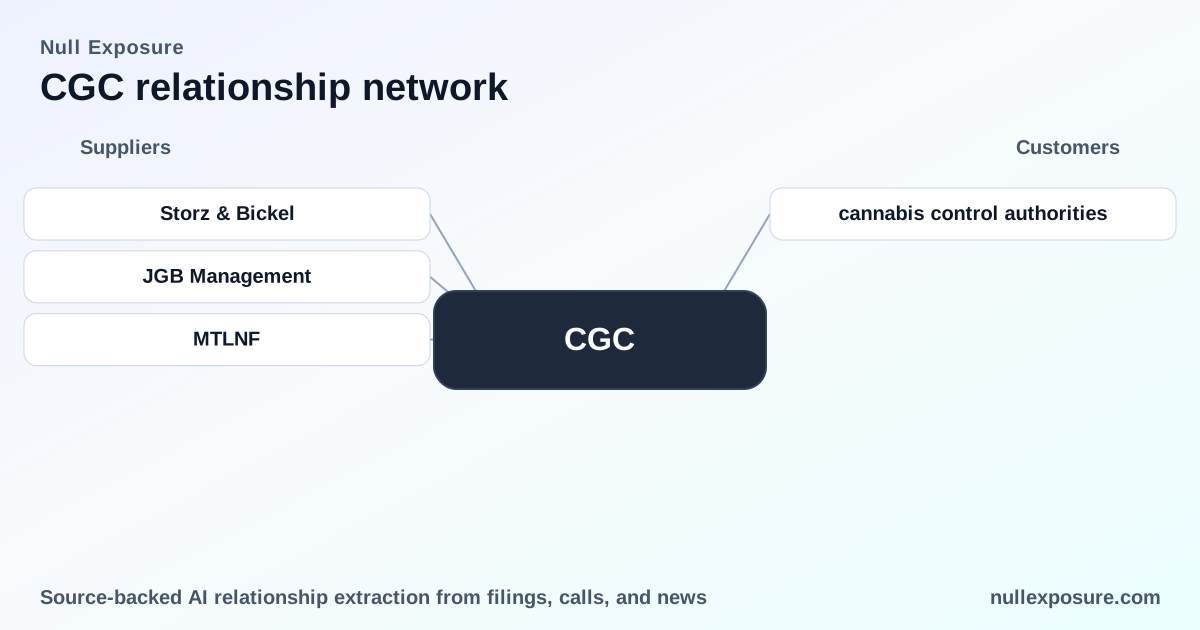
Below I list every supplier or related partner referenced in public news for FY2026 and provide a tight, investor‑oriented takeaway and source for each.
Storz & Bickel
Canopy carries category‑defining vaporization devices by Storz & Bickel across owned and licensed brand portfolios, positioning the company to capture accessory and device margin alongside consumables; public communications in March 2026 highlight these devices as part of the product mix. A separate development involved allegations in a Claybourne‑related investor suit that referenced production cost disclosures tied to Storz & Bickel devices, with that litigation later reported as voluntarily dismissed by investors. Sources: StockTitan news report on Canopy’s Q3 FY2026 communication (March 9, 2026) and StratCann coverage of the Claybourne lawsuit (March 2026).
JGB Management
A consortium led by JGB Management established a new US$150 million credit facility for Canopy in FY2026, directly supporting liquidity and near‑term operational financing needs. Source: ad‑hoc‑news report on the financing (March 2026).
MTL Cannabis (MTLNF)
Canopy announced that the acquisition of MTL Cannabis will strengthen its medical cannabis leadership in Canada, expand Quebec adult‑use presence and secure high‑quality flower supply that underpins both domestic and international growth plans. Source: Q3 FY2026 earnings call transcript coverage by InsiderMonkey (March 2026).
What the public constraints tell us about Canopy’s operating model
Canopy’s disclosed supplier posture and the extracted evidence produce clear company‑level signals about how it contracts and scales:
- Contracting posture: adaptive and mixed. Canopy blends owned manufacturing (post‑acquisitions like the Verona facility evidence from prior activity) with an “adaptive third‑party sourcing model” for vapes, edibles and extracts, indicating a pragmatic move between insourcing and contracting to manage capital intensity.
- Role diversity: buyer, manufacturer, distributor and service consumer. Public excerpts identify Canopy both as purchaser of raw materials and as a distributor/manufacturer relying on third parties for specific product lines, plus dependence on service providers for testing and courier logistics.
- Criticality: third‑party testing and distribution are operationally critical. Independent laboratories and efficient courier services are explicitly required across active markets for compliance and time‑to‑shelf; disruption in these services would directly affect revenue flow.
- Maturity and concentration: semi‑mature with heterogeneous partner base. The company leverages local/regional suppliers to complement owned operations, suggesting diversification of suppliers rather than single‑source dependency, but product launches and certain categories (devices, flower supply) depend on a small number of specialized partners.
- Relationship lifecycle: active and transactional. Evidence points to active sourcing and financing relationships in FY2026, with new credit facilities and acquisition closings driving near‑term integration work.
These constraints are company‑level signals drawn from Canopy’s public statements and are not assigned to any single supplier unless explicitly mentioned in the cited excerpt.
Commercial and financial implications for investors
Canopy’s supplier relationships intersect with capital and operational risk in four investable ways:
- Liquidity and covenant risk: The $150 million credit facility backed by a JGB‑led consortium stabilizes near‑term liquidity but increases counterparty concentration in financing; investors should track covenant triggers and lien priorities reported in subsequent filings.
- Product continuity risk: Reliance on third‑party manufacturing and regional supply for flower and extracts creates execution risk when launching SKUs like Claybourne; cost disclosures and unit economics for these launches are material to margin improvement.
- Regulatory and compliance risk: Third‑party testing is a non‑negotiable compliance input across markets; operational failures or lab capacity constraints can delay launches and reduce shelf availability.
- Litigation and reputational risk: The Claybourne litigation referenced product cost disclosures and device cost accounting; while reports indicate voluntary dismissal, litigation cycles increase legal costs and distract management during integration phases.
Given a modest institutional ownership base (~12%) and a volatile beta (~2.34), supplier events and financing disclosures will continue to drive disproportionate share‑price moves relative to fundamentals.
For a deeper supplier exposure analysis and monitoring setup, visit https://nullexposure.com/.
Practical next steps for operators and investors
- Prioritize counterparty due diligence on partners that supply flower, vapes and devices; assess concentration and alternative sourcing timelines.
- Monitor the credit facility terms provided by the JGB consortium for covenants that could constrain operating flexibility or require accelerated deleveraging.
- Validate testing and courier capacity in priority markets (Quebec and international export corridors) as part of go‑to‑market readiness for acquired assets like MTL.
If you want a structured supplier risk map tied to financial levers and covenant exposure, consult the research tools at https://nullexposure.com/.
Bottom line
Canopy Growth runs a hybrid model where supplier choices determine margin recovery and go‑to‑market speed. Storz & Bickel supplies category‑leading devices; MTL secures flower supply and local market presence; JGB Management provides meaningful near‑term liquidity through a $150 million facility. Investors evaluating CGC should treat supplier news, financing terms and testing/distribution continuity as leading indicators of whether the company can convert revenue into sustainable profitability. For continuing coverage and supplier dashboards, visit https://nullexposure.com/.