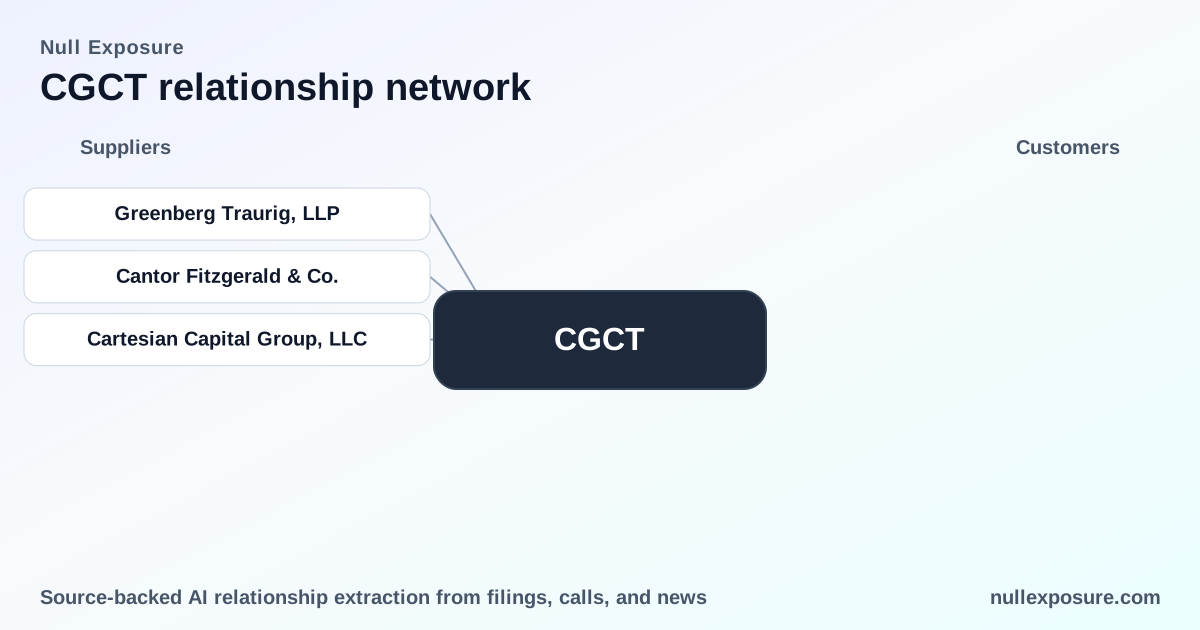
Cartesian Growth Corporation III (CGCT): supplier relationships that matter to investors
Cartesian Growth Corporation III is a NASDAQ-listed SPAC that monetizes by sponsoring and completing a business combination: it raises capital through public units and redeems or merges that capital into a target company, with upside delivered to public shareholders and sponsor equity holders. As a shell vehicle, CGCT’s economics depend entirely on its sponsor, capital markets relationships and external advisors whose roles determine its ability to consummate a merger on favorable terms. For investors and operators evaluating CGCT as a counterparty, three supplier relationships stand out as direct drivers of transaction execution and timing. Learn more on the Null Exposure homepage: https://nullexposure.com/
How CGCT operates and where value is created
Cartesian Growth Corporation III is categorized as a shell company in financial services with no operating revenue or operating margins reported in public filings; its market capitalization is approximately $354 million and it holds typical SPAC financial characteristics (zero reported revenue and negative book value). Value is generated by completing a business combination that converts trust/cash into an operating enterprise; sponsor economics and underwriting terms determine the sponsor’s return and public investors’ dilution profile. The company’s balance of sponsor alignment, capital markets execution and legal/regulatory advice determines both the probability of closing and the quality of any deal.
Why supplier relationships matter for a SPAC
For a SPAC the practical suppliers are legal counsel, placement agents / underwriters, and the sponsor entity itself. These suppliers are not optional: legal counsel shapes deal structure and disclosure; bookrunners control access to immediate incremental capital and liquidity; sponsors source and negotiate targets and provide capital support. Weakness or concentration in any of these relationships translates directly into execution risk and potential shareholder value erosion.
Read deeper analysis and comparable supplier maps at Null Exposure: https://nullexposure.com/
The concrete relationships you should evaluate
Below I profile every supplier relationship surfaced in the available records and explain why each matters to capital providers.
Greenberg Traurig, LLP — legal advisor to CGCT
Adam Namoury and Thomas Martin of Greenberg Traurig acted as legal counsel to Cartesian Growth Corporation III on recently announced transaction activity. Legal counsel from a large, full‑service firm provides transactional, securities and regulatory support that is essential to closing a business combination and to drafting the operating documents that govern sponsor economics. According to MarketScreener coverage (March 9, 2026), Greenberg Traurig’s partners served as the company’s legal advisors during the deal process.
Cantor Fitzgerald & Co. — sole book-running manager for the offering
Cantor Fitzgerald is serving as the sole book-running manager for CGCT’s upsized offering, which places it squarely in control of distribution and pricing for public units and related financing. Cantor’s role directly affects the SPAC’s capital structure and aftermarket liquidity, making it a critical commercial counterparty for completing and financing a target acquisition. StockTitan reported Cantor Fitzgerald’s sole book-running status in the March 9, 2026 announcement of the upsized offering.
Cartesian Capital Group, LLC — sponsor affiliation and deal sourcing
CGCT’s sponsor is an affiliate of Cartesian Capital Group, LLC, a global private equity firm focused on growth capital for transnational businesses. Sponsor alignment defines incentive economics, sponsor-funded PIPE commitments, and the diligence pipeline of target candidates; Cartesian Capital Group is the origin of those sponsorship incentives. StockTitan’s March 9, 2026 coverage explicitly identifies the sponsor affiliation and its role in positioning the SPAC for a business combination.
Operating-model signals and company-level constraints
The records provided contain no explicit contractual constraints such as exclusivity, termination penalties or escrow terms. That absence is itself informative for investors: no discrete supplier constraints were recorded in these supplier relationships, so the primary risks are structural and market-driven rather than the result of disclosed restrictive covenants.
From the company-level information and relationship mix, infer the following operational characteristics:
- Contracting posture — transaction-focused and time-bound. The supplier roles described (legal counsel, sole bookrunner, sponsor) are transactional with clearly defined deliverables tied to completing a business combination and any related financing. Expect supplier relationships to be governed by standard engagement letters and underwriting agreements that emphasize closing conditions and regulatory compliance.
- Concentration — high for capital markets services. Cantor Fitzgerald acting as sole bookrunner signals concentration risk in distribution and pricing power for the offering; if Cantor withdraws or underperforms, alternative syndication could be costly or slow.
- Criticality — high for legal and capital partners. Greenberg Traurig and Cantor Fitzgerald are mission-critical: legal counsel is essential for regulatory sign-off and proxy material; the bookrunner is essential for raising incremental capital and managing market reception.
- Maturity — early stage with binary outcomes. As a SPAC (no operating revenue, negative book value), CGCT’s maturity is pre-combination and thus outcome-driven; the sponsor and financing relationships determine whether the company transitions to an operating firm or returns cash to public holders.
Risk implications for investors and operators
- Execution risk is concentrated in a small set of counterparties. If Cantor falters on distribution or if legal counsel cannot clear disclosure issues, closing timelines and economics recalibrate instantly.
- Sponsor-driven selection risk. The sponsor’s track record and incentives will determine target quality; investors should assess Cartesian Capital Group’s past exits and alignment terms.
- Data anomalies that require due diligence. Public metrics show institutional ownership reported above 100%, which is a data inconsistency investors should reconcile with primary filings and transfer agent records before relying on ownership levels.
Explore CGCT’s supplier map and comparative SPAC analytics on Null Exposure: https://nullexposure.com/
Key takeaways for investors
- CGCT is a classic SPAC: its value hinges on its sponsor and a small set of external suppliers. Legal counsel (Greenberg Traurig) and the sole bookrunner (Cantor Fitzgerald) are the two operational linchpins identified in the reporting.
- Sponsor affiliation with Cartesian Capital Group is material. Sponsor sourcing and commitment will determine target selection, PIPE participation and ultimate dilution.
- Concentration in capital markets services is a notable risk. Cantor’s sole book-runner role concentrates market execution risk in a single institution.
- No supplier constraints were disclosed in the available records, which leaves the company’s contractual flexibility intact but shifts the focus to sponsor quality and market conditions.
For a deeper supplier risk profile and ongoing monitoring of CGCT’s relationships, return to Null Exposure’s analysis hub: https://nullexposure.com/
Final action point: investors should prioritize diligence on sponsor commitments, underwriting agreements and legal engagement terms ahead of any position sizing or deal participation.