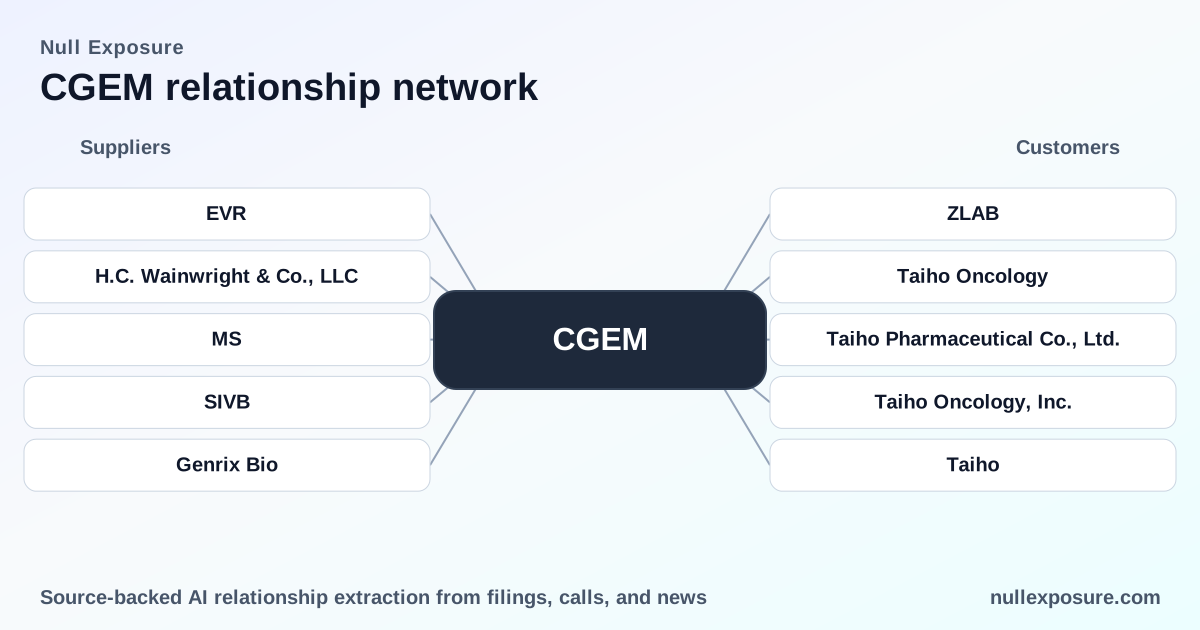
Cullinan Therapeutics (CGEM): Supplier and partner map for investors
Cullinan Therapeutics develops targeted oncology and immuno-oncology therapies and monetizes through a combination of licensed intellectual property, milestone and royalty arrangements, and eventual product commercialization. The company outsources the bulk of development and manufacturing to third parties and advances value by progressing clinical candidates to de‑risking milestones that unlock payments and sublicensing or commercialization outcomes. For investors evaluating supplier counterparty risk, the commercial thesis is straightforward: value accrues from clinical progress and partner-enabled development; supplier performance and license economics govern time-to-revenue and downside exposure.
For a concise snapshot and supplier analytics, visit the Nillexposure homepage: https://nullexposure.com/
How Cullinan runs its external relationships — an investor lens
Cullinan operates with an outsourcing-first model: research, preclinical work, clinical trials and manufacturing are largely handled by external collaborators. That operating posture produces a set of consistent constraints and risk signals investors should price into scenarios:
- Contracting posture — licensing and milestone-driven economics. Cullinan holds exclusive licenses from academic and institutional inventors (for example, the MIT License and DKFZ/Tübingen agreements referenced in filings) that carry upfront, milestone and royalty obligations. According to company disclosures, the MIT license includes milestone obligations up to $7.0 million per distinct product, establishing a clear contingent cash flow profile tied to development progress.
- Concentration and criticality — reliance on CMOs and global vendors. Cullinan depends on contract manufacturing organizations (CMOs) and external CROs for development and cGMP supply; filings explicitly state the company does not directly control manufacturing facilities and that interruptions could limit development until replacements are qualified. Manufacturing is a critical path risk.
- Geographic supply footprint — global but APAC-exposed. Cullinan utilizes manufacturers across North America, Europe and Asia, and specifically uses third parties in China for raw materials and drug substances. That geographic mix reduces single-region concentration but increases exposure to APAC regulatory and supply‑chain dynamics.
- Maturity and spend profile — development-stage, moderate supplier spend. The company is in active clinical development and outsources most functions, with supplier spend signals in the $1M–$10M band for milestone/contract commitments, consistent with clinical-stage biotechs that outsource CMC and trials.
- Relationship roles — licensor, manufacturer, and service provider. Public excerpts name licensors (MIT; DKFZ and University of Tübingen), service providers (medical investigators, CROs, Dr. Alexander Steinle as a technical services provider), and CMOs, reflecting a multi-role supplier ecosystem that is material to program timelines.
Collectively these signals create a supplier risk profile: development-outcome sensitive, manufacturing-critical, multi-jurisdictional, and license-encumbered. For deeper tracking of counterparties and to monitor these relationships over time, see https://nullexposure.com/
Who Cullinan is working with right now
Below are the counterparties and transactional partners identified in public reporting and news coverage. Each relationship is summarized in plain English with a concise source note.
Evercore Group LLC
Evercore served as a joint book‑running manager on Cullinan’s initial public offering, participating in the underwriting syndicate that brought the company to market. (Source: StockTitan news release, March 9, 2026.)
H.C. Wainwright & Co., LLC
H.C. Wainwright acted as the lead manager for Cullinan’s offering, positioning the firm at the center of the IPO distribution and capital markets execution. (Source: StockTitan news release, March 9, 2026.)
Morgan Stanley & Co. LLC
Morgan Stanley was one of the joint book‑running managers on Cullinan’s IPO, providing institutional placement and underwriting support. (Source: StockTitan news release, March 9, 2026.)
SVB Leerink LLC
SVB Leerink participated as a joint book‑running manager in the IPO syndicate, aligning the lifecycle capital raise with a healthcare-focused investment bank. (Source: StockTitan news release, March 9, 2026.)
Genrix Bio — licensing and data access for velinotamig (news summary 1)
Cullinan obtained rights related to velinotamig, a BCMA‑directed bispecific T‑cell engager, under a licensing arrangement with Genrix Bio to pursue development in autoimmune diseases. (Source: QuantisNow insight on October/2025–2026 reporting; relationship noted in FY2025 filings.)
Genrix Bio — collaborative data pathway (news summary 2)
Genrix Bio initiated a Phase 1 study in China in December 2025; Cullinan has publicly stated it will use the resulting data to accelerate global clinical development and will assume responsibility for further development of velinotamig following the Genrix study completion. (Source: GlobeNewswire corporate update, January 8, 2026.)
What these individual relationships imply for investors
- Underwriting relationships (Evercore, Morgan Stanley, H.C. Wainwright, SVB Leerink) confirm capital markets access. The syndicate composition shows broad institutional distribution and healthcare specialization in the IPO, which de-risks access to public capital in the near term and supports the company’s ability to fund development through equity issuance. (Source: StockTitan, March 2026.)
- The Genrix relationship is strategically material to a listed program (velinotamig). The license plus ongoing Phase 1 data from China creates a near-term information flow Cullinan will use to accelerate global development — a clinical inflection point that converts external trial results into internal development decisions and potential value creation. (Source: GlobeNewswire, Jan 2026; QuantisNow, FY2025.)
- Licensing and manufacturing constraints are the dominant operational risks. Milestone payments to licensors, dependency on CMOs, and APAC supply exposure are explicit company-level constraints that influence cash burn, timing and program sensitivity; investors should model delayed manufacturing qualification or clinical readouts as primary downside scenarios. (Source: company licensing excerpts and manufacturing disclosures cited in regulatory filings.)
For ongoing monitoring of these partnerships and supplier risk indicators, Nillexposure maintains a live supplier map and alerts: https://nullexposure.com/
Bottom line and investor actions
Cullinan’s value proposition is built on licensed assets and outsourced development, with outcomes driven by clinical milestones and third‑party execution. Key investor action points:
- Monitor Genrix Bio clinical data releases (Q4 2026 expected initial data) as a program value accelerator. (Source: GlobeNewswire, Jan 2026.)
- Model manufacturing disruption scenarios given the material reliance on CMOs and APAC suppliers.
- Track capital markets activity and syndicate behavior for dilution risk and follow‑on financing cadence.
To review Cullinan’s supplier exposure alongside peer comparatives and receive alerts on new filings or partner developments, visit Nillexposure: https://nullexposure.com/
Cullinan’s path to commercial revenue is clear: clinical validation converts licensed science into commercial optionality, and third‑party execution determines the pace. Investors should treat supplier contracts, licensor milestone obligations, and APAC supply lines as the primary drivers of timing and downside risk.