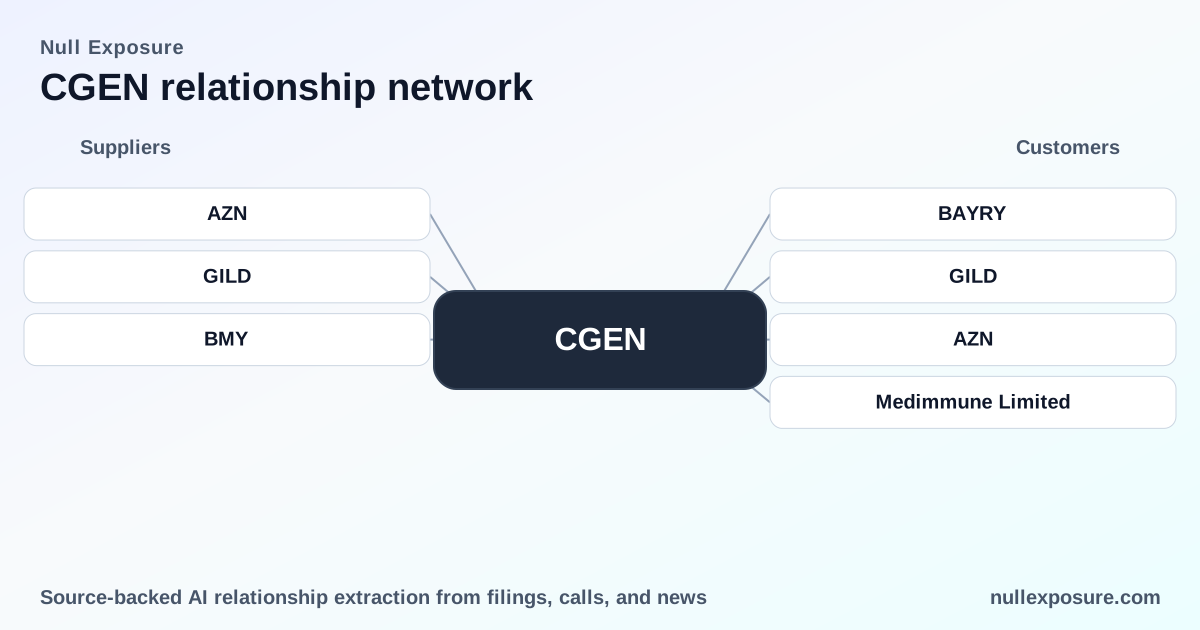
Compugen (CGEN): Partner-driven clinical strategy that monetizes through licenses, collaborations and targeted non-dilutive deals
Compugen is a clinical-stage therapeutic discovery and development company headquartered in Israel that monetizes primarily through licensing and strategic collaborations, supplemented by milestone and royalty economics and selective non-dilutive transactions. The company's operating model prioritizes partner-led development to commercialize assets while preserving shareholder equity, and its capital runway is explicitly tied to partner transactions and licensing outcomes. For deeper diligence or to compare partner histories across suppliers visit https://nullexposure.com/.
Why partners are the product for an early-stage drug developer
Compugen is not a traditional product company; it is a research-first biotech that converts discovery-stage programs into partner-funded clinical development. The company’s reported figures underline that reality: a market capitalization of ~$216 million with revenue TTM of $72.8 million and strong reported margins, which reflect licensing and collaboration economics rather than broad commercial sales. That operating stance produces a contracting posture that leans on bilateral, high-impact deals rather than broad vendor ecosystems, concentrating counterparty risk into a handful of large pharmaceutical collaborators.
Full list of partner references and what they mean for investors
AstraZeneca — non-dilutive transaction extended cash runway into 2029
Compugen told investors on its Q4 2025 earnings call that it extended its expected cash runway into 2029 through a non-dilutive transaction with AstraZeneca tied to rilvegostomig, signaling a large, structured funding arrangement linked to a specific program. According to Compugen’s Q4 2025 earnings call (reported March 7, 2026), this transaction is central to near-term financing and reduces immediate dilution risk.
Gilead — licensing relationship for undisclosed program(s)
On the same Q4 2025 earnings call, Compugen stated that at least one asset is licensed to Gilead, reflecting a classic biotech monetization route where risk and cost transfer to a larger developer in exchange for license fees and potential milestones/royalties. The Q4 2025 earnings call (March 7, 2026) is the source for this licensing disclosure.
Bristol Myers Squibb — ended collaboration as part of strategic refocus (FY2022)
A business report in FY2022 documented that Compugen ended its collaboration agreement with Bristol Myers Squibb as part of a broader change in drug discovery strategy, indicating active portfolio rationalization and a retreat from at least one external partnership structure. This was reported by Globes in FY2022.
Bristol Myers Squibb — earlier joint development activity on COM701 combination studies (FY2021)
Previously, Compugen had active clinical collaboration signals with BMS: a November 2021 earnings call transcript covered preliminary Phase 1/2 results for COM701 in combination with nivolumab and BMS’s anti‑TIGIT antibody BMS‑986207, showing that BMS participated in combination trials with Compugen’s assets. The November 2021 earnings call transcript published on The Motley Fool documents that collaboration.
What these relationships collectively signal about Compugen’s operating model
- Contracting posture: Compugen operates as a deal-oriented developer—licensing and collaboration agreements are primary monetization levers rather than direct commercialization. The AstraZeneca non-dilutive instrument demonstrates flexibility in structuring funding beyond straightforward equity raises.
- Concentration and counterparty risk: The partner list is compact and heavily weighted toward large pharma (AstraZeneca, Gilead, BMS), producing high concentration of commercial dependency. That concentration amplifies the materiality of each partner outcome on cash flow and development pacing.
- Criticality of partner outcomes: Partner decisions directly impact Compugen’s runway and development cadence—AstraZeneca’s transaction explicitly extended the company’s runway to 2029, illustrating financial criticality of individual partner agreements.
- Maturity of collaborations: Collaborations show a range from program licensing (Gilead) and clinical combination studies (BMS) to sophisticated financing tied to a program (AstraZeneca), reflecting maturing commercial relationships that go beyond early discovery support into development and structured capital solutions.
- Company-level financial posture: With reported EBITDA (~$31.8M), a profit margin reported at 48.6%, and modest institutional ownership (~13.6%), Compugen presents as a capital-efficient, partner-leveraged biotech that trades at a valuation consistent with sponsor-backed R&D trajectories.
For a consolidated view of how partner structures affect supplier risk across comparable companies, see https://nullexposure.com/ for comparative supplier analytics.
Investment implications — upside drivers and risk checklist
- Upside drivers: Successful milestone realizations from AstraZeneca- or Gilead-licensed programs would unlock non-dilutive payments and milestone revenue, materially de-risking the equity thesis given the company’s current market capitalization and revenue base.
- Key risks: The compact partner roster concentrates execution risk; the termination of the BMS collaboration highlights that partnerships can be re-scoped or ended as strategy evolves. A single partner’s decision can materially change cash runway and development timelines.
- Balance sheet sensitivity: The AstraZeneca transaction shows that Compugen uses bespoke financing structures to preserve equity—this is a strength for current shareholders but ties future liquidity to counterparties rather than diversified revenue streams.
If you want a side-by-side comparison of how partner dependency affects different suppliers, visit https://nullexposure.com/ for deeper analytics and supplier relationship benchmarking.
What to watch next and how investors should monitor progress
- Monitor formal disclosures and subsequent press releases for the AstraZeneca rilvegostomig agreement for payment schedules, milestone triggers and any linked development responsibilities.
- Track any public details from Gilead on the licensed program’s development plan and milestone timing; licensing commercialization timelines drive valuation inflection points.
- Watch for retrospective filings or updates on the BMS relationship that could clarify residual rights, data-sharing obligations, or any carryover assets from prior combination studies.
For ongoing tracking and alerts on partner-driven financing and licensing events across suppliers, return to https://nullexposure.com/ for tailored coverage and supplier relationship intelligence.
Bold decisions in partner selection and deal structure define Compugen’s risk-reward profile. Investors should treat partner announcements as primary catalysts and value inflection points rather than peripheral milestones.