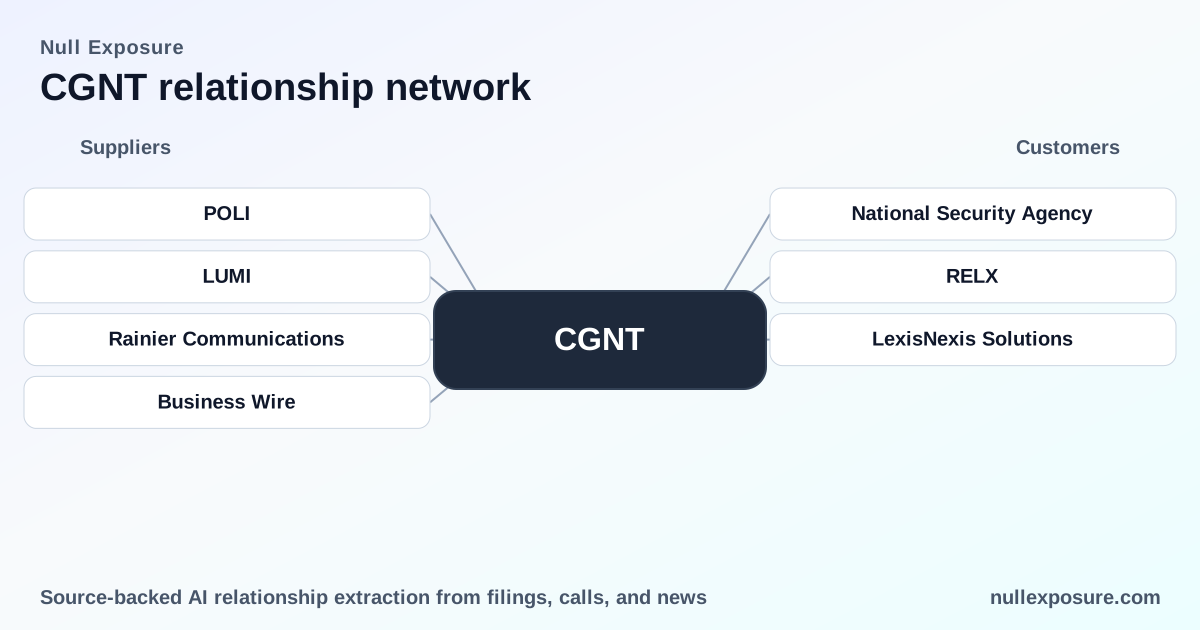
Cognyte (CGNT): Supplier relationships that matter for operators and investors
Cognyte is a specialized security-analytics software vendor that sells investigative and operational intelligence platforms to government and enterprise customers worldwide. The company monetizes primarily through software licensing, recurring maintenance/subscription contracts, and professional services tied to deployments, while supplementing liquidity with corporate credit facilities when needed. Investors should value Cognyte as a software-as-a-solution provider with high gross margins, recurring revenue characteristics, and periodic financing activity that affects capital structure and optionality. For a concise view of supplier and counterparty exposure, see https://nullexposure.com/.
Why this matters: Cognyte’s supplier and counterparty set—banks, communications firms, and press distributors—illustrates how the company funds operations, manages market messaging, and serves customers. That mix is typical for mid-cap security software vendors, but specific relationships influence financing flexibility, reputational channels, and operational cadence.
Business model in plain English
Cognyte markets analytic software to public-sector and commercial buyers and captures value across three vectors: license/recurring revenue, services income from implementation and support, and balance-sheet management through credit facilities. The company reported roughly $388 million in trailing twelve‑month revenue with healthy gross margins (about $278 million gross profit) and modest operating margin dynamics. Institutional ownership is high, and the company operates from Israel with U.S.-listed equity, which shapes its banking and PR choices.
Explore supplier exposure and counterparty patterns at https://nullexposure.com/ for more deals and signals.
What the reported relationships tell investors
Below are every supplier/partner mention surfaced in public sources for the supplier scope. Each entry is a concise, plain-English summary with its source.
-
Bank Hapoalim B.M. — credit facility counterparty. Cognyte amended and extended a credit facility with Bank Hapoalim as part of a joint extension that supports working capital and balance-sheet flexibility in FY2025. According to MarketScreener’s FY2025 report, the company executed amended and extended credit facility agreements with Bank Hapoalim.
Source: MarketScreener report on FY2025 credit facility amendments (published March 2026). -
Bank Leumi Le-Israel B.M. — credit facility counterparty. Cognyte paired Bank Leumi with Bank Hapoalim in the same amended and extended financing package in FY2025, reflecting reliance on major Israeli commercial banks for committed credit capacity. MarketScreener documented the extension of these credit facilities during FY2025.
Source: MarketScreener report on FY2025 credit facility amendments (published March 2026). -
Rainier Communications — media/PR contact. Rainier Communications is listed as Cognyte’s media relations contact for product showcases and event announcements, indicating use of an external communications firm to manage U.S. press engagement and analyst outreach. The StockTitan piece on Cognyte’s product showcase names Rainier Communications as the media relations contact in FY2025.
Source: StockTitan item referencing press contact (FY2025). -
Business Wire — press distribution channel. Cognyte distributes formal press releases through Business Wire, a mainstream PR-distribution service used to reach broad financial and industry audiences. The StockTitan article includes a link to the original Business Wire release for Cognyte’s product announcement.
Source: StockTitan noting original Business Wire release (FY2025).
Constraints and what’s missing from the record
The supplier-scope constraint records contain no explicit constraints or redacted clauses. That absence is itself a signal: no supplier-specific contractual limitations or unusual dependency flags were published alongside these relationships in the reviewed items. Presently, the public supplier relationships are routine—bank financing, PR agency, and press distribution—without disclosed supplier-imposed operational constraints.
At the company level, the lack of disclosed constraints should be interpreted as a neutral-to-positive signal on supplier concentration and contractual rigidity: Cognyte contracts with multiple classes of counterparties rather than relying on a single critical supplier, and its credit lines are with major banks rather than boutique lenders. This supports operational resilience but does not remove financial or reputational risks inherent to its markets.
Operational implications for investors and operators
-
Financing posture and liquidity: The extended credit facilities with Bank Hapoalim and Bank Leumi are evidence of proactive liquidity management. These facilities increase short-to-medium-term financial flexibility but also introduce bank covenant oversight and interest costs that affect free cash flow. Monitor covenant schedules in company filings for any covenant triggers or amortization timing.
-
Communications and reputational management: Use of Rainier Communications and Business Wire indicates a structured, professional approach to media relations and investor outreach. Good media discipline reduces market volatility around product launches and contracts, and signals a mature go‑to‑market posture.
-
Supplier concentration and criticality: The relationships identified are not operationally critical in the sense of sole-source manufacturing or cloud-provider concentration; rather, they are service and financing relationships. Operational continuity for product delivery rests more on internal engineering and customer-deployed integrations than on these external suppliers.
Key risks and upside drivers
-
Risk — balance-sheet leverage: The addition or extension of bank facilities increases financial flexibility but adds servicing costs and potential covenant risk; leverage dynamics should be tracked against EBITDA and free cash generation. Cognyte reported EBITDA of roughly $18.2 million TTM, which implies modest coverage and makes financing terms important.
Upside — recurring revenue and gross margin strength: With high gross profit relative to revenue, expanding subscription-like contracts would lift operating leverage. -
Risk — reputational exposure: Selling to government and law-enforcement buyers carries heightened scrutiny; reliance on well-managed communications channels is a practical mitigation. Business Wire and professional PR support reduce messaging missteps.
What investors should do next
- Review the full text of the loan amendments and any covenant schedules in the next quarterly filing to quantify covenant risk and maturity structure.
- Track revenue mix evolution toward recurring licensing and cloud/subscription models to gauge margin expansion potential and cash-conversion improvement.
- Monitor press and regulatory coverage linked through official releases distributed on Business Wire and company statements routed via Rainier Communications for any signal of contract wins or policy scrutiny.
For more detailed counterparty mappings and to monitor supplier exposures across your portfolio, visit the NullExposure homepage: https://nullexposure.com/.
Conclusion: Cognyte’s supplier footprint is straightforward—bank financing with major Israeli banks and professional PR/distribution partners—providing liquidity and controlled market messaging without concentrated operational supplier dependencies. That structure supports a software-centric business model but keeps attention focused on covenant terms, cash generation, and the trajectory of recurring revenue. If you want a mapped view of counterparties and supplier risk across similar firms, explore https://nullexposure.com/ for additional analyses and alerts.