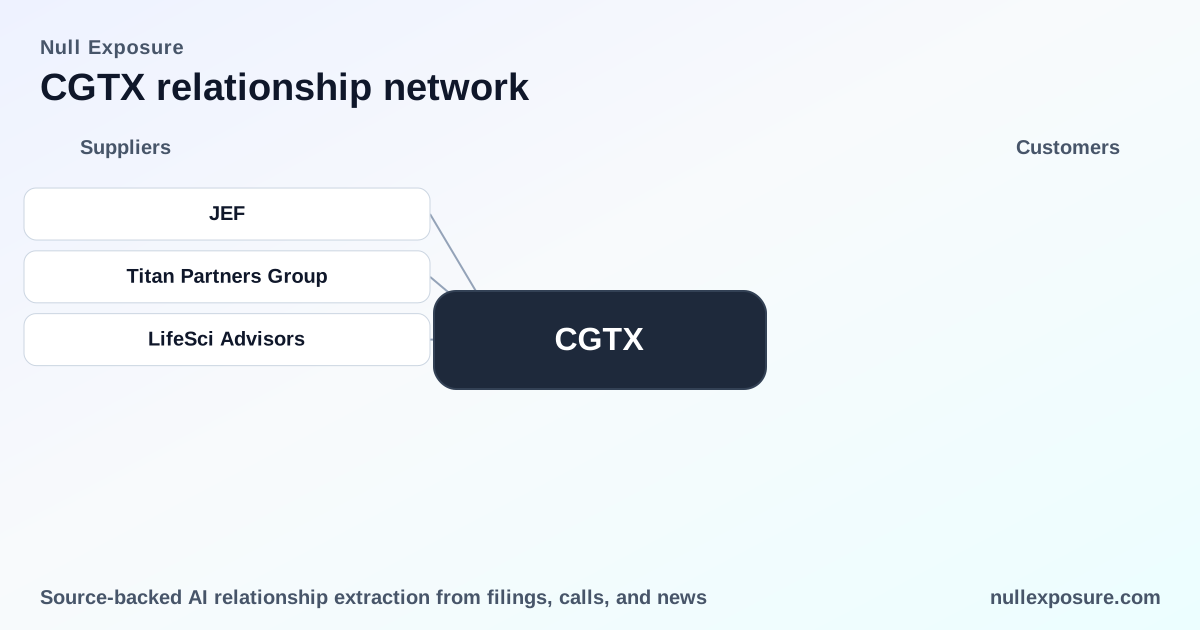
Cognition Therapeutics (CGTX): supplier relationships, financing partners, and what they mean for investors
Cognition Therapeutics is a clinical-stage biopharmaceutical company developing small-molecule therapies for age-related neurodegenerative and retinal disorders, funded through a mix of government grants and capital-market financings. The firm monetizes by advancing clinical candidates (notably zervimesine) toward regulatory approval and future commercial sales, while bridging development with equity raises and placement agents; current funding posture relies on grant capital and market-based financing tools that introduce dilution risk but preserve clinical runway. Learn more about supplier and capital relationships at https://nullexposure.com/.
The quick investment thesis — funding-driven, supplier-dependent, and dilution-sensitive
Cognition operates as a research and development–centric company without owned manufacturing, meaning third-party manufacturers, CROs and placement agents are functional extensions of the business. The company’s near-term value drivers are clinical outcomes and the efficient execution of trials; the primary balance-sheet levers are registered shelf capacity and placement/ATM programs that provide immediate financing options but create the potential for dilution. Government grants totaling over $170 million have materially funded trials to date and reduce near-term cash burn risk, yet the company still requires market access to scale into commercialization.
What the supplier and partner map signals about operating risk and capability
- Contracting posture: short-term and cancellable. Cognition’s vendor contracts are standard for the sector, typically cancelable on notice and not subject to long-term minimum purchase commitments; this gives the company operational flexibility but transfers execution risk to third parties.
- Concentration and criticality: single-source manufacturing dependency. The company depends on single third-party suppliers for drug substance and clinical supplies, which creates a single-point-of-failure for scale-up and regulatory compliance; this is a material operational risk.
- Service mix: CROs and distribution partners are central. Cognition relies on CROs for trial conduct and on third parties for packaging, labeling and distribution should marketing approval be achieved, making vendor performance a direct determinant of timeline delivery.
- Maturity and spend scale: clinical-stage with >$100M program funding. The business is not commercial; clinical programs funded by approximately $171 million in NIA grants indicate program scale and high supplier/service spend over the medium term.
These signals imply a business model that is highly externalized for manufacturing and trial execution, financing-dependent, and sensitive to vendor performance and capital-market access. For more detailed supplier intelligence and monitoring, visit https://nullexposure.com/.
Vendor and partner relationships you need to know
Below are every relationship captured in the sourced results, with concise plain-English summaries and source attributions.
Jefferies — equity placement and ATM underwriting partner
Jefferies is positioned as the manager for an at‑the‑market (ATM) facility that is part of Cognition’s S-3 shelf, enabling the company to sell up to $75 million of common stock under an ATM agreement and providing quick access to equity capital. According to StockTitan reporting on the December 18, 2025 S‑3 shelf filing, the shelf authorizes up to $300 million of securities including the $75 million Jefferies ATM (StockTitan, 2026-03-09: https://www.stocktitan.net/news/CGTX/cognition-therapeutics-extends-expanded-access-program-for-tpr639m97p3g.html).
Titan Partners Group — placement agent for registered direct offering
Titan Partners Group acted as the sole placement agent for a $30 million registered direct offering that closed, driving an immediate capital infusion. This role was announced in a GlobeNewswire release on August 28, 2025 and picked up in subsequent financial coverage of the closing (GlobeNewswire, 2025-08-28: https://www.globenewswire.com/news-release/2025/08/28/3140463/0/en/Cognition-Therapeutics-Announces-30-Million-Registered-Direct-Offering-of-Common-Stock.html; Yahoo Finance coverage of the offering closing: https://finance.yahoo.com/news/cognition-therapeutics-closes-30-million-200000007.html).
LifeSci Advisors — investor relations and communications support
LifeSci Advisors functions as Cognition’s investor relations and corporate communications contact, with Mike Moyer listed as an investor relations contact for press and investor engagement tied to clinical updates and conference participation. This contact role is present in both event participation notices and the January 6, 2026 GlobeNewswire clinical results release (StockTitan/GlobeNewswire citations: https://www.stocktitan.net/news/CGTX/cognition-therapeutics-to-participate-in-37th-annual-piper-sandler-jtd1j9p0ybk0.html; https://www.globenewswire.com/news-release/2026/01/06/3213500/0/en/Cognition-Therapeutics-Publishes-Phase-2-Clinical-Results-Showing-Zervimesine-s-Potential-to-Slow-the-Progression-of-Dementia-with-Lewy-Bodies.html).
Operational implications for investors and operators
- Financing flexibility vs. dilution: The S‑3 shelf and Jefferies ATM provide immediate financing flexibility and reduce the need for dilutive block-placement pricing, but active utilization of an ATM would increase share count and depress per‑share metrics. Monitor ATM utilization reports and Form‑8‑K disclosures for timing.
- Execution risk is supplier-driven: Single-source manufacturing and outsourced clinical execution transfer regulatory and timeline risk to vendors. Operational diligence should prioritize manufacturing quality audits, fallback supply contracts, and CRO performance KPIs.
- Grants de‑risk near-term trial funding but not commercialization: The ~$171 million in NIA grants is a structural advantage that funds multiple Phase 2 programs, yet commercial-scale manufacturing, regulatory filings and market launches require additional capital or partner licensing.
- Contract posture supports agility, not predictability: Short-term, cancellable contracts allow the company to adjust spend quickly but reduce predictability for long-lead manufacturing or capacity reservations; this is a trade-off that influences partner selection and contingency planning.
What investors and procurement leads should watch now
- Track any ATM sales and registered direct closings as they directly influence dilution and cash runway.
- Obtain regular updates on manufacturing qualification and whether secondary manufacturing sites are contracted to reduce concentration risk.
- Review CRO timelines and milestone payments to evaluate execution risk on critical trials.
For tailored supplier-risk monitoring and deeper relationship analytics, see https://nullexposure.com/.
Bottom line: active monitoring and contingency planning are essential
Cognition Therapeutics operates a classic clinical-stage biotech model: externalized manufacturing and trial execution, grant-funded trial progression, and market financing capacity via placement agents and ATMs. The company’s partners — Jefferies, Titan Partners Group, and LifeSci Advisors — provide capital access and investor communications capacity that are central to the company’s near-term viability; supplier concentration and the short-term nature of contracts are the principal operational constraints to manage. Investors and operators should prioritize visibility into ATM use, manufacturing backups, and CRO performance to protect timelines and value. If you want ongoing supplier intelligence and relationship tracking for CGTX, start with https://nullexposure.com/.