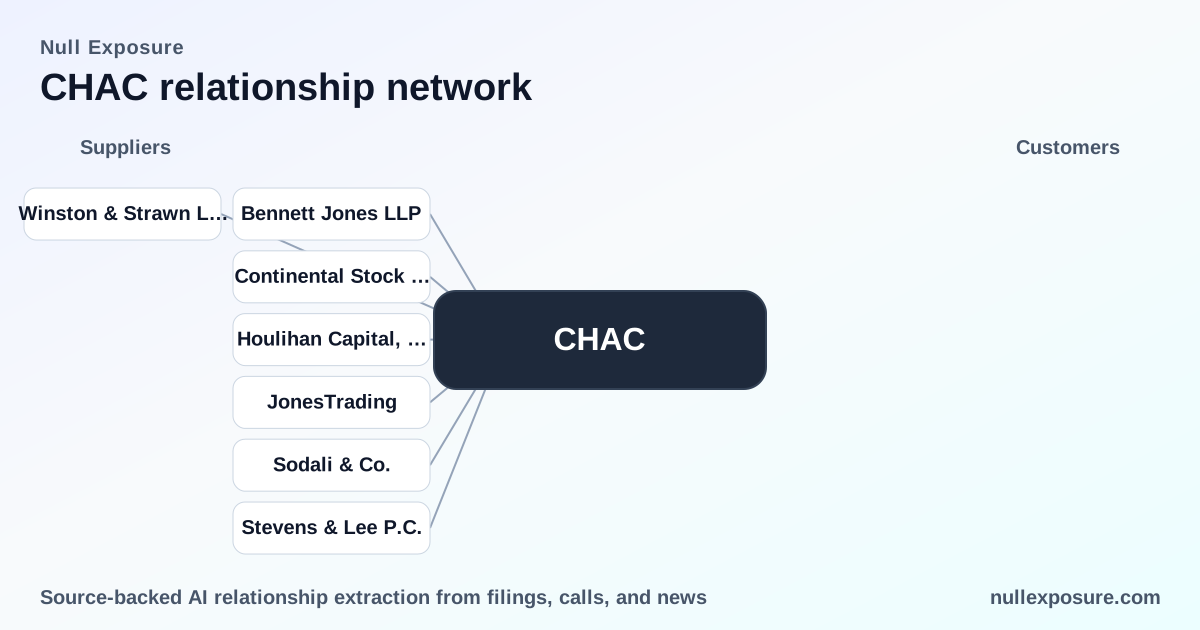
Crane Harbor Acquisition Corp. (CHAC): A supplier-network read for investors
Crane Harbor Acquisition Corp. (CHAC) is a NASDAQ-listed blank-check vehicle that monetizes primarily through sponsor arrangements, trust-account management and transaction-related fees tied to completing a business combination. The company’s economics are transaction-driven: sponsor and administrative fees provide steady short-term revenue while the material value realization occurs at deal close or liquidation. For investors and operators evaluating supplier relationships, CHAC’s vendor roster reflects a standard SPAC playbook—legal, capital-markets and administrative partners engaged on discrete tasks with concentrated, short-duration spend profiles. Learn how these relationships shape execution risk and where value concentrates; for a broader supplier risk view visit https://nullexposure.com/.
How CHAC operates and where the money flows
CHAC is operating as a SPAC (industry: Shell Companies) with no recurring operating revenue reported in the latest periods; its balance sheet and cash in trust are the central assets until a business combination closes. Key monetization channels include:
- sponsor fees and affiliated administrative charges (a disclosed $20,000 per month payment for office and admin services),
- underwriting and transaction expenses that drive one-off costs (the company disclosed $13,786,773 in IPO-related transaction costs),
- contingent capital-markets advisory fees tied to successful combinations (a $750,000 contingent fee disclosed for JonesTrading).
These features produce a short-term contracting posture, concentrated supplier spend, and high criticality for a small set of specialized service providers that manage execution risk around deal completion. For a full supplier-risk platform and supplemental analysis, visit https://nullexposure.com/.
What the supplier list reveals about execution capability
CHAC’s disclosed suppliers cover the expected SPAC advisory spectrum—legal counsel, transfer agent, proxy solicitation, fairness opinion provider and capital markets advisor. The roster signals a conventional execution stack appropriate for a listed SPAC preparing and closing a business combination.
Bennett Jones LLP
Bennett Jones served as legal counsel to Crane Harbor Acquisition Corp., supporting the company’s transactional documentation and regulatory work during the business-combination process, according to a MarketScreener report covering the Xanadu transaction, March 2026.
Continental Stock Transfer & Trust Company
Continental Stock Transfer & Trust Company acted as CHAC’s transfer agent, handling shareholder recordkeeping and issuance mechanics for the SPAC, per MarketScreener coverage of the March 2026 transaction announcement.
Houlihan Capital, LLC
Houlihan Capital provided a fairness opinion to CHAC’s board on October 30, 2025, supplying independent valuation support for the proposed business combination, as noted in MarketScreener reporting (March 2026).
JonesTrading
JonesTrading is CHAC’s capital markets advisor; the company disclosed a capital markets advisory agreement that includes a contingent $750,000 fee payable upon successful completion of a business combination, documented in CHAC’s SEC filing and summarized in a TradingView report (FY2026) and MarketScreener's March 2026 coverage.
Sodali & Co.
Sodali & Co. acted as proxy solicitor for Crane Harbor, managing shareholder outreach and voting logistics for the combination vote, according to MarketScreener’s March 2026 article.
Stevens & Lee P.C.
Stevens & Lee P.C. served as legal counsel for Crane Harbor, providing transaction and compliance legal services related to the merger process, as reported by MarketScreener in March 2026.
Winston & Strawn LLP
Michael J. Blankenship of Winston & Strawn LLP acted as legal advisor for Crane Harbor Acquisition Corp., contributing specialist counsel during the deal preparation and filing period, per MarketScreener’s March 2026 coverage.
Operating constraints that shape supplier risk and contracting posture
CHAC’s public filings and reported disclosures deliver clear company-level signals about how relationships are structured:
- Short-term, transaction-focused contracts are dominant. The trust proceeds were held in short-dated U.S. treasuries or Rule 2a-7 money market funds intended as temporary holdings to facilitate a business combination; a promissory note described in filings was explicitly short-dated and payable on IPO completion or close-out events.
- Geography is concentrated in North America, with treasury and money-market placements in U.S. government instruments and operations centered in U.S. offices.
- Most vendors operate as service providers, not strategic partners. Auditor fees, office rent paid to a sponsor affiliate, and one-off transactional advisors indicate a supplier base configured for discrete services rather than long-term integrated supply chains.
- Relationships are active and event-driven. The company pays an affiliate $20,000 per month for office and administrative services that cease upon completion of a business combination or liquidation.
- Spend shows two tiers: modest recurring administrative spend and large, single-event transaction costs. Audit and professional fees totaled roughly $150k for the year, monthly administrative fees are $20k, and total IPO-related transaction costs exceeded $13.7m — a mix of low-to-mid recurring spend and high-consequence transaction spend.
These constraints point to execution sensitivity: a small set of professional services providers is critical to successful deal close, and the balance between modest ongoing spend and concentrated transaction costs elevates counterparty importance for short windows.
Investment implications and what to watch next
For investors and operators evaluating CHAC supplier relationships, prioritize the following:
- Counterparty quality over cost. Given the high-stakes, short-duration nature of SPAC execution, legal, fairness opinion and capital-markets advisors materially affect timing and outcome; contract terms such as contingent fees and termination provisions matter.
- Concentration risk. A limited roster of providers increases operational leverage; verify counterparties’ capacity and conflicts of interest (sponsor affiliations, repeated roles across deals).
- Event timing and cash sufficiency. Large transaction costs versus modest recurring spend underscore the need to monitor cash in trust and contingent liabilities through the close window.
If you need a deeper supplier-level exposure map and dynamic alerts on material changes, explore our platform at https://nullexposure.com/ for tailored reporting and risk scoring.
Final read: where CHAC stands as a supplier-risk profile
Crane Harbor’s supplier network is textbook SPAC: specialist advisors engaged on short-term, high-impact mandates with concentrated spend around deal execution. That structure benefits speed and control but produces elevated counterparty concentration and execution risk during the combination interval. For investors, the most material signals are the contingent fee arrangements, the disclosed transaction-cost magnitude, and the sponsor-affiliate administrative payments — all of which drive the economics and operational fragility around a single corporate event. For continuous supplier monitoring and actionable intelligence on CHAC and comparable issuers, visit https://nullexposure.com/.