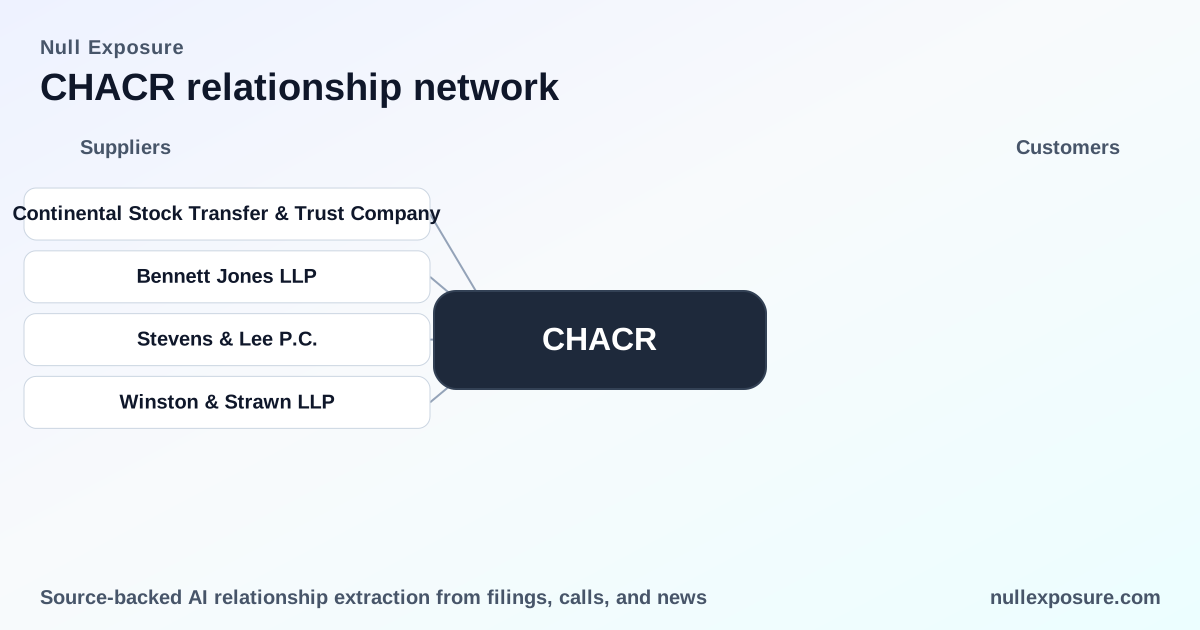
Crane Harbor Acquisition Corp. (CHACR) — supplier footprint and operational signals for investors
Crane Harbor Acquisition Corp. is a blank‑check acquisition vehicle that currently monetizes through the mechanics of a SPAC: raising capital via its IPO structure and preserving those funds in a trust while it sources a target business combination, while sponsors and underwriters extract fees and discounts tied to the IPO and operating administration. CHACR records no operating revenue to date, relies on third‑party trustee and legal counsel for capital stewardship and deal execution, and pays a recurring sponsor affiliate fee that will stop only at business combination or liquidation. For a concise supplier-risk dashboard and ongoing monitoring, see https://nullexposure.com/.
How CHACR runs its supplier relationships and why it matters to investors
CHACR’s commercial posture is that of an early‑stage SPAC with a small, concentrated set of counterparties that are functionally critical to the vehicle’s mission. The company’s accounting and disclosures reveal a subscription-style recurring expense for office and administrative services and a material underwriter economics tied to the public offering. These characteristics drive four practical operating signals for investors and counterparties:
- Contracting posture: The company pays a fixed monthly fee ($20,000 per month) to a sponsor affiliate for office space, utilities and administrative support, which demonstrates a subscription-like vendor relationship and predictable run-rate expense until a business combination occurs. This arrangement is disclosed in the FY2025 10‑K.
- Concentration: A limited number of external partners — trustee, legal counsel and underwriters — hold outsized operational roles; continuity with those providers is critical to preserving the trust account and completing a deal.
- Criticality: The trustee relationship governs access to investor trust funds and is therefore mission‑critical; legal counsel and underwriters are equally critical for transaction execution and financing economics.
- Maturity and spend profile: CHACR’s supplier spend is concentrated in two bands — mid-single hundred‑thousand operational spend in 2025 and a multi‑million deferred underwriting discount associated with the IPO — reflecting low running operational spend but large event-driven liabilities tied to capital markets activity.
These signals should influence vendor diligence, counterparty credit and regulatory checks by operators and investors.
The explicit supplier and advisor relationships (what the filings and press identify)
Below are every supplier relationship identified in the reviewed materials, with a plain‑English summary and a concise source reference.
-
Continental Stock Transfer & Trust Company — Identified as the trustee that holds CHACR’s trust account and therefore the counterparty responsible for safeguarding investor funds held pending a business combination. According to Crane Harbor’s FY2025 10‑K filing, Continental Stock Transfer & Trust Company is the trustee with respect to the trust account (FY2025 10‑K filing).
-
Bennett Jones LLP — Listed among Crane Harbor’s legal counsel in press reporting on the announced merger activity; Bennett Jones is serving as one of the legal advisers to Crane Harbor on the transaction mentioned in media coverage. A March 2026 report in Canadian Lawyer Magazine noted Bennett Jones LLP is serving as legal counsel to Crane Harbor in connection with the proposed transaction (Canadian Lawyer, March 2026).
-
Stevens & Lee P.C. — Named in the same press coverage as part of Crane Harbor’s legal counsel team, Stevens & Lee P.C. provides transaction and regulatory counsel in the announced deal context. The Canadian Lawyer article covering the proposed merger lists Stevens & Lee P.C. as counsel to Crane Harbor (Canadian Lawyer, March 2026).
-
Winston & Strawn LLP — Also identified by media as legal counsel to Crane Harbor; Winston & Strawn LLP is participating in the deal counsel slate that will handle regulatory and transactional work for the proposed business combination. The Canadian Lawyer article cites Winston & Strawn LLP among counsel serving Crane Harbor on the transaction (Canadian Lawyer, March 2026).
What the company disclosures say about contracting, spend and exposure
CHACR’s FY2025 disclosures and related press reporting produce a clear set of company‑level signals that are relevant to procurement, legal and investor teams:
-
The company commenced a $20,000/month arrangement (effective April 25, 2025) with its sponsor or an affiliate to provide office space, utilities, secretarial support and administrative services; those fees are recorded through December 31, 2025 as $163,333 incurred and $20,000 accrued. This is a recurring subscription expense that will terminate on completion of a business combination or on liquidation, per the FY2025 10‑K.
-
CHACR incurred $163,333 in sponsor affiliate fees in 2025 (inception through Dec 31, 2025) and had $20,000 accrued at year‑end — a clear signal that operational administrative spend is modest but consistent while the SPAC searches for a target.
-
On the capital markets side, underwriters are entitled to a deferred underwriting discount of $0.40 per unit, or approximately $8.8 million in aggregate, which demonstrates that while routine operating spend is limited, event‑driven transfer costs tied to the IPO are material and non‑recurring but significant to the company’s net proceeds.
These signals indicate a low baseline operating burn but potential for large one‑time costs tied to financial transaction mechanics. For programmatic monitoring and supplier scoring, consider integrations and alerts at https://nullexposure.com/.
Operational and investment implications
-
Operational continuity risk: Because the trustee controls the trust account and legal counsel sits at the center of the proposed transaction, any disruption or change in these relationships would materially affect deal timing and investor liquidity. Investors should prioritize verifying trustee confirmations and counsel engagement letters during diligence.
-
Sponsor alignment and cost structure: The sponsor affiliate fee is a recurring outflow that benefits the sponsor’s operating support functions. The fee stops only on combination or liquidation, so sponsors retain an incentive to fund administrative continuity during the search period. This has cash‑management implications for runway and eventual deal economics.
-
Event‑driven exposure: The deferred underwriting discount is a large, discrete liability tied to the IPO; investors must treat underwriting economics as an unavoidable drain on trust proceeds and adjust net cash expectations accordingly.
Practical next steps for investors and operators
- Review the trustee’s role and confirmations for any restricted cash or transfer mechanics; require written attestation of trust account balances and withdrawal triggers.
- Validate the sponsor affiliate fee schedule and payment history as part of financial due diligence; consider modeling sponsor fee runoff at time of combination.
- Confirm counsel scopes and contingent fee structures for transaction work to estimate legal spend through closing.
For a concise supplier‑risk scorecard and automated monitoring for CHACR and similar issuers, visit https://nullexposure.com/.
Crane Harbor’s supplier picture is compact but consequential: few counterparties, critical custody and counsel roles, a steady sponsor expense and material underwriting economics. Investors assessing CHACR should focus on trustee confirmations, sponsor fee disclosures and the legal counsel roster as primary operational risk levers. For tailored monitoring and alerts tied to these supplier relationships, see https://nullexposure.com/.