Core AI Holdings (CHAI): Supplier relationships and what they signal for investors
Core AI Holdings develops and publishes AI-driven mobile games and monetizes through game launches, in-app purchases, and licensing of its IP; the company operates as an early-stage games publisher with limited public revenue disclosure and a market capitalization near $29.5 million. Management’s strategic posture today is acquisition and partnership-driven — the company’s profile is defined as much by corporate combinations and third-party relationships as by organic product cash flows. For investors and operators evaluating CHAI as a supplier or counterparty, the focus should be on counterparty concentration, commercial criticality of IP, and execution risk around M&A integration. For background and ongoing coverage of supplier exposures, visit https://nullexposure.com/.
Why the supply relationships matter now
Core AI’s public filings and market metrics show no reported trailing revenue or earnings, a small public float and modest institutional ownership, and a tight market-cap base that makes supplier terms and strategic partnerships highly material to valuation. The company’s operating model will be governed by a mix of purchased services, third‑party platform providers, and strategic alliances that can rapidly change the revenue runway post‑merger or product release. Counterparty stability, exclusivity clauses, and milestone-driven payments will determine whether the firm’s growth is durable or transitory.
If you want a consolidated view of supplier risk and partner concentration for CHAI, see the full homepage at https://nullexposure.com/ for tracking and alerts.
How to read the relationships: practical constraints and business signals
With no explicit contractual constraints filed, treat the following characteristics as company‑level signals derived from public financials and relationship disclosures:
- Contracting posture — acquisitive and milestone-oriented. CHAI’s disclosed activity centers on transactions and fairness opinions tied to mergers, implying heavy reliance on negotiated deals rather than long-term supply contracts.
- Concentration — high potential concentration risk. Small scale and limited revenue disclosure mean a single partner or transaction can materially change the business outlook.
- Commercial criticality — high for key partners, low for commoditized suppliers. Relationships that supply IP, platform access, or distribution are functionally critical; peripheral suppliers less so.
- Maturity — early-stage corporate profile. Financial metrics indicate pre-commercial or early revenue stages; counterparties should price for execution risk and short operating history.
These are company-level signals and are not assigned to specific relationships unless a disclosure explicitly names a counterparty.
The relationships you need to know now
Below I cover every relationship listed in the public results and summarize what each means for CHAI’s supplier and partner profile.
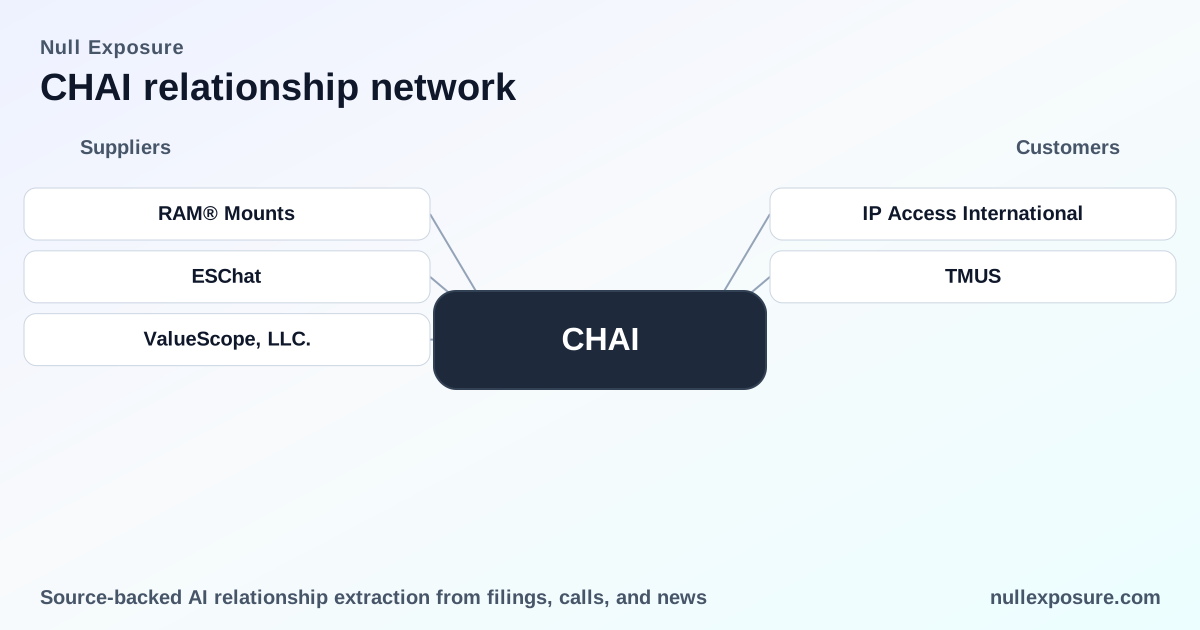
RAM® Mounts — indirect hardware/accessory linkage through Siyata
Siyata Mobile announced a strategic partnership with RAM® Mounts to deliver in-vehicle solutions tailored to Siyata’s SD7 family of devices; the announcement is relevant to CHAI because Siyata disclosed a definitive agreement to merge with Core Gaming, bringing potential hardware accessory channels into the combined entity’s ecosystem. According to a PR Newswire release (FY2025 / March 9, 2026), RAM® Mounts will provide rugged mounting solutions for Siyata’s handsets, which could influence device distribution and go‑to‑market logistics post-merger (https://www.prnewswire.com/news-releases/siyata-mobile-and-ram-mounts-partner-to-launch-innovative-in-vehicle-solutions-for-push-to-talk-handsets-302506626.html).
ESChat — platform for critical communications used by Siyata handsets
Siyata’s SD7 handsets were deployed using the ESChat communications platform for critical-event coverage (notably Burning Man 2025); this relationship is material to CHAI insofar as the Siyata-Core Gaming merger folds these communications service relationships into a broader operational footprint, creating optional distribution or services dependencies. The PR Newswire release (FY2025 / March 9, 2026) details ESChat powering SD7 handset deployments for critical communications (https://www.prnewswire.com/news-releases/siyata-mobile-and-eschat-to-provide-critical-communications-support-at-burning-man-2025-302536828.html).
ValueScope, LLC. — fairness opinion provider for the Siyata/Core Gaming merger
The Siyata Board obtained a fairness opinion from ValueScope, LLC., valuing Core Gaming at $160 million as part of the definitive agreement to merge; that valuation and the use of a third‑party fairness opinion are central to how the merger was structured, priced, and communicated to investors. PR Newswire cites the ValueScope fairness opinion in the merger announcement (FY2025 / March 9, 2026), which is consequential for CHAI because it materially influenced the transaction economics and perceived valuation of Core Gaming assets (https://www.prnewswire.com/news-releases/siyata-mobile-signs-definitive-agreement-to-merge-with-leading-ai-gaming-developer-core-gaming-302386037.html).
Implications for investors and operators
- Integration risk is the dominant near-term operational risk. Merging a hardware‑centric company (Siyata) with a gaming/IP entity (Core Gaming/Core AI) reshapes supplier needs across manufacturing, distribution, and platform services; expect renegotiations and transitional service agreements.
- Single-transaction valuation sensitivity. The disclosed $160 million fairness opinion highlights that CHAI’s valuation trajectory is susceptible to deal outcomes and third‑party valuations rather than recurring operating cash flow.
- Supplier diligence should prioritize exclusivity and termination triggers. Given the small scale and limited reported revenue, counterparties should negotiate clear payment milestones, termination protections, and performance bonds where appropriate. Operators evaluating CHAI should insist on clarity around who controls IP, distribution, and platform relationships post‑close.
For ongoing monitoring of CHAI’s supplier and partner exposures, review our coverage at https://nullexposure.com/.
Bottom line and next steps for stakeholders
Core AI Holdings operates as an early-stage, acquisition-driven game publisher with material execution risk concentrated around partner integrations and limited disclosed operating cash flows. Every supplier negotiation must be evaluated against the likelihood of merger-led strategy shifts and the company-level signals above. For buyers and creditors, structure commercial terms to protect against counterparty concentration and post-merger re-prioritization.
If you are an investor or operator planning to engage with CHAI, the practical next steps are: confirm post-merger governance of IP and distribution, demand milestone-based economics, and maintain contingency plans for rapid partner substitution. For a consolidated view of CHAI’s supplier exposures and real‑time alerts, visit https://nullexposure.com/.