City Holding Company (CHCO): Where liquidity relationships sit in the capital stack
City Holding Company is a banking holding company that monetizes through net interest margin on loans and securities, deposit and fee income from wealth and trust services, and selective noninterest revenue tied to payment services and merchant processing. The company underwrites regional credit, funds those assets with core deposits plus short- and long-term borrowings, and supplements liquidity through government-backed facilities when necessary — a classic regional-bank funding mix that supports steady profitability and a 41% reported profit margin on recent results. For investors evaluating supplier and funding counterparties, the balance between deposit funding and contingent access to Federal Home Loan Bank and Federal Reserve facilities is a central operating lever.
Explore more supplier intelligence at https://nullexposure.com/.
Why funding counterparties matter for CHCO’s economics
City National’s ability to convert loans into stable earning assets depends on predictable access to wholesale funding when deposit growth lags loan demand or during stress episodes. Wholesale lines are not revenue drivers but are critical to preserving asset growth and meeting short-term liquidity requirements. The bank’s capital allocation and pricing decisions reflect this mix: strong return on equity, modest price-to-book, and a heavy institutional ownership base that watches liquidity metrics closely.
How CHCO funds the balance sheet: deposits first, backstops second
City Holding runs a deposit-centric funding model that uses wholesale borrowings as a backup. The company reports both short-term borrowings and long-term advances in its filings, indicating a layered approach: short-term paper to smooth daily flows and term FHLB advances to fund longer-duration loans or manage interest-rate mismatches. This structure supports steady earnings but introduces counterparty concentration and reliance on government-related facilities as a liquidity backstop.
All publicly disclosed supplier relationships (one place)
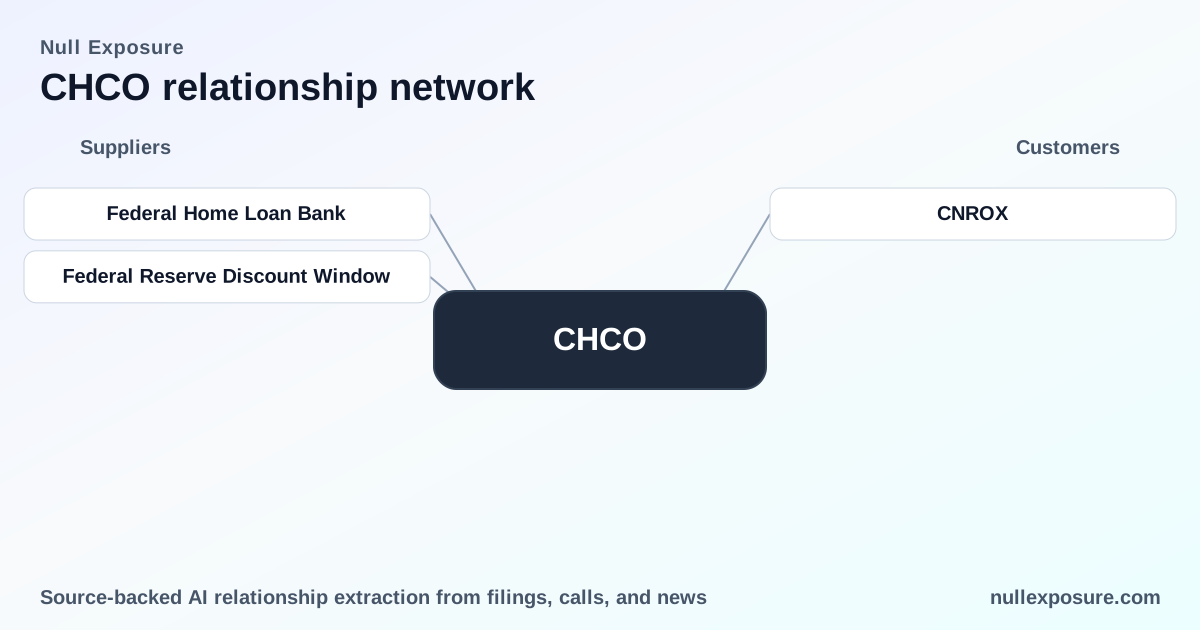
City Holding’s supplier relationships disclosed in its FY2024 Form 10‑K include two explicit government-related funding sources. Each relationship is summarized below.
-
Federal Home Loan Bank: City National accesses long‑term advances from the Federal Home Loan Bank to fund longer duration lending and term asset growth; the 10‑K lists FHLB advances explicitly as a funding source and records a line item of “FHLB long‑term advances 150,000” in the filing. According to the company's 2024 Form 10‑K (FY2024), borrowings from the FHLB are a documented component of available funds.
Source: City Holding Company 2024 Form 10‑K (FY2024). -
Federal Reserve Discount Window: The company discloses the Federal Reserve Discount Window as an available liquidity source for short-term needs, reflecting operational access to the central bank’s intraday and overnight facilities when required. According to the company's 2024 Form 10‑K (FY2024), the Discount Window is listed alongside other borrowing channels as a contingency funding option.
Source: City Holding Company 2024 Form 10‑K (FY2024).
These two relationships are not fee-for-service suppliers in the traditional vendor sense but are funding counterparties that shape liquidity posture and funding cost dynamics.
What the constraints tell investors about CHCO’s operating model
The extracted constraints from company disclosures reveal practical characteristics of the funding program and overall supplier posture:
-
Contracting maturity is mixed. The filing explicitly names an FHLB long‑term advance (the excerpt “FHLB long-term advances 150,000”), signaling the bank uses term wholesale funding for structural asset-liability management as well as short-term borrowings. This is a deliberate contracting posture: hedge term risk with term funding while relying on short-term lines for transactional needs.
-
Short-term dependence is material. Short-term borrowings are separately disclosed (“Short-term borrowings … 339,372”), which indicates routine use of near-term wholesale funding to balance daily and quarter-end liquidity, bringing rolling refinance risk into the funding profile.
-
Counterparty mix includes government facilities. City National lists both FHLB and the Federal Reserve Discount Window among sources, so government-backed facilities are explicit backstops in the funding toolkit rather than theoretical options.
-
Third-party service relationships exist outside these facilities. The company also discloses merchant credit card processing through a third-party vendor, which is a operational supplier relationship impacting fee income and payments infrastructure rather than liquidity.
Taken together, these constraints paint a company-level signal: a conservative regional bank that layers funding sources, combines term and transactional borrowings, and relies on government-related facilities as contingent but actively used instruments.
Investment implications: concentration, criticality, and timing
-
Concentration risk: While deposits are primary, reliance on FHLB advances and short-term borrowings introduces counterparty concentration to a small set of wholesale providers. These are highly reliable counterparties, but their terms and availability influence net interest margin and liquidity stress tolerance.
-
Criticality: Access to the FHLB and the Discount Window is critical for episodic liquidity and for backing longer-duration lending. If funding markets tighten or pricing shifts, the marginal cost of growth will increase and compress earnings.
-
Maturity management: The explicit presence of both long-term and short-term borrowings shows active maturity management. This reduces refinancing shocks but creates ongoing interest rate and roll-over dynamics to monitor.
For a deeper look at supplier relationships and how they affect bank funding strategies, visit https://nullexposure.com/ for structured supplier risk intelligence.
What investors should watch next
- Monitor quarterly updates for changes to outstanding FHLB advance balances and short-term borrowings, which will signal shifts in liquidity stance.
- Track changes in deposit growth relative to loan originations to assess whether wholesale funding is being used as a structural or temporary tool.
- Watch merchant services and payments vendor disclosures if fee income or operational concentration becomes a more material part of noninterest revenue.
Conclusion: read the funding lines, not just the income statement
City Holding’s profitability profile and conservative balance sheet are supported by a hybrid funding strategy: core deposits first, government‑backed advances and central bank facilities as disciplined backstops. That configuration reduces the probability of forced asset sales in stress but leaves investors exposed to wholesale funding cost volatility and roll-over dynamics. For operational and supplier-focused diligence that ties these relationships to credit and liquidity scenarios, review the supplier intelligence available at https://nullexposure.com/.