CHEB-U (Chenghe Acquisition II Co.) — Underwriters and supplier relationships that shape a newly public vehicle
Chenghe Acquisition II Co. monetizes through the classic SPAC route: it raised capital via a public offering of units and now relies on its underwriting and sponsor network to execute de-SPAC activity or return capital to investors. Revenue and optionality are driven by the size and terms of the trust account created at IPO and the sponsor’s ability to source and close a merger, while supplier relationships — primarily underwriters and co-managers — determine initial market access, pricing, and investor reach.
If you are evaluating CHEB-U as an investor or counterparty, focus on the composition of the underwriting syndicate and the operational signals embedded in that syndicate. For more supplier-level intelligence on public offerings and counterparty exposures, visit https://nullexposure.com/.
Why the underwriting roster matters for a SPAC investor
Underwriting partners are not just distribution channels for a $86.25 million transaction; they are gatekeepers of market credibility, liquidity and institutional placement. The named book-runners and co-managers influence investor mix (retail vs. institutional), aftermarket stability, and the pool of potential target introductions. The March 2026 closing transaction for CHEB-U demonstrates a typical SPAC underwriting footprint — a lead book-runner supported by a joint book runner and multiple co-managers — which signals a deliberate distribution strategy to balance institutional and retail demand.
For a deeper look at how these supplier relationships translate into exposure, processes, and counterparty risk, see full coverage at https://nullexposure.com/.
The roster: who was on the deal and what they did
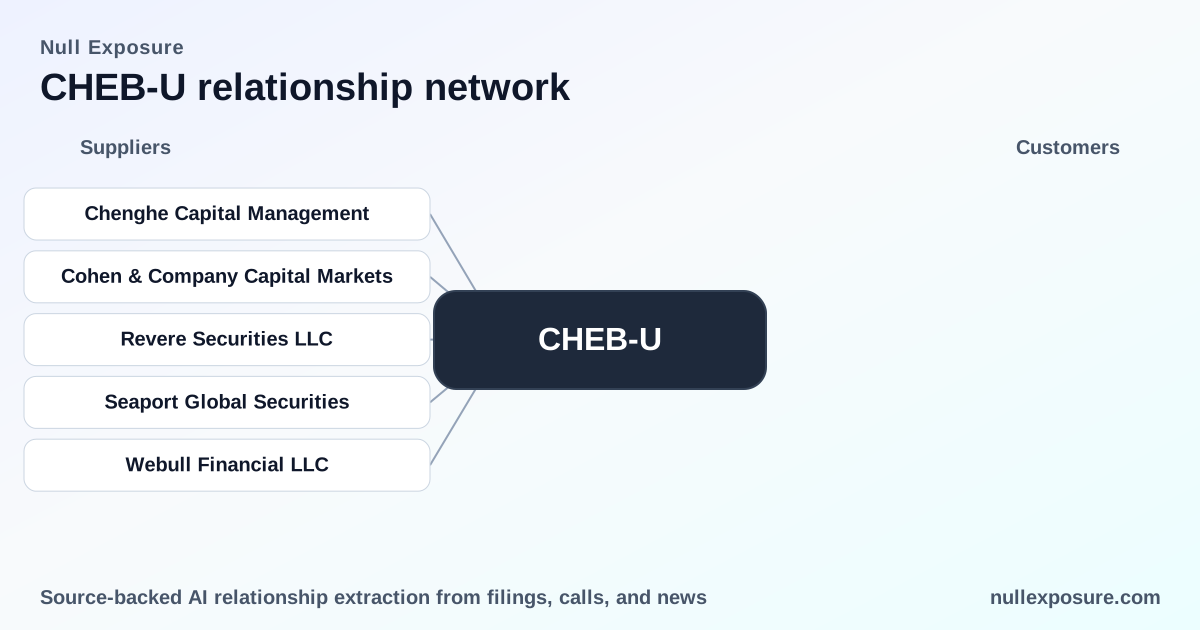
The news release reporting the closing of the $86.25 million offering lists five named firms. Each relationship below is summarized plainly so investors can assess direct supplier exposure.
Cohen & Company Capital Markets
Cohen & Company Capital Markets acted as the Lead Book-Running Manager, responsible for primary syndicate leadership and pricing guidance for the offering. According to the Macau Business report dated March 9, 2026, Cohen & Company led the book-running duties on the deal (https://macaubusiness.com/chenghe-acquisition-ii-co-announces-closing-of-86-25-million-initial-public-offering).
Seaport Global Securities
Seaport Global Securities served as a Joint Book Runner, sharing primary distribution responsibilities and supporting institutional placement across the syndicate. The same March 9, 2026 press coverage identifies Seaport Global as the joint book runner on the offering (https://macaubusiness.com/chenghe-acquisition-ii-co-announces-closing-of-86-25-million-initial-public-offering).
Revere Securities LLC
Revere Securities LLC was listed as a co-manager, contributing placement and ancillary distribution support to the syndicate. The Macau Business notice of the closing records Revere Securities among the co-managers for the FY2024 period (https://macaubusiness.com/chenghe-acquisition-ii-co-announces-closing-of-86-25-million-initial-public-offering).
Chenghe Capital Management
Chenghe Capital Management participated as a co-manager, indicating sponsor-adjacent capital markets support and likely involvement in retail or targeted investor outreach. The closing announcement cites Chenghe Capital Management as a co-manager for the offering (Macau Business, March 9, 2026 — https://macaubusiness.com/chenghe-acquisition-ii-co-announces-closing-of-86-25-million-initial-public-offering).
Webull Financial LLC
Webull Financial LLC is also named as a co-manager, which signals direct retail distribution channels were part of the go-to-market plan and supports broader retail participation in the unit sale. The March 9, 2026 release lists Webull among the co-managers (https://macaubusiness.com/chenghe-acquisition-ii-co-announces-closing-of-86-25-million-initial-public-offering).
Operational signals and business model characteristics investors should extract
No formal constraints were extracted from the supplier review, which itself is an important company-level signal: there are no flagged contractual limitations or public constraint notices tied to CHEB-U’s supplier relationships in the available record. Read as an operational characteristic, this implies:
- Contracting posture: Transaction-focused and market-standard — the offering used a conventional syndicate structure (lead book-runner, joint book runner, co-managers) rather than bespoke bilateral counterparty arrangements.
- Concentration: Moderate diversification across distribution partners — five named firms reduce single-counterparty distribution risk while preserving concentrated leadership via a single lead book-runner.
- Criticality: High short-term criticality for these suppliers — underwriters are essential to execution and aftermarket stability in the immediate post-offering period.
- Maturity: Early-stage public lifecycle — the closing of the unit offering is a liquidity event; the business model now depends on subsequent corporate actions (target identification and merger execution) rather than operating revenue.
These are company-level signals and not attributions from specific contractual excerpts.
If you need to map counterparty concentration, contractual posture, or exposure across additional financings and bank relationships, explore supplier intelligence at https://nullexposure.com/.
What this means for investors and operators
- Short-term exposure: Investors hold units backed by the trust created at IPO; the underwriting syndicate’s composition matters for immediate aftermarket behavior and secondary liquidity.
- Execution risk: The sponsor and its capital markets partners determine the speed and quality of potential mergers; the co-manager mix shows deliberate retail and institutional balance.
- Counterparty monitoring: Track each underwriter’s recent deal flow and regulatory posture — leadership credit and distribution capability will affect valuation outcomes for the eventual business combination.
Final read: clear takeaways
- CHEB-U monetized via a $86.25 million unit offering executed through a conventional underwriting syndicate that blends institutional leaders and retail-oriented co-managers. (Macau Business, March 9, 2026: https://macaubusiness.com/chenghe-acquisition-ii-co-announces-closing-of-86-25-million-initial-public-offering)
- Supplier relationships are operationally critical in the near term; the syndicate composition reduces single-source distribution risk while creating dependence on the lead and joint book runners for market credibility.
- No extracted contractual constraints is itself informative: CHEB-U’s public record contains no flagged supplier constraints, implying standard market terms govern these relationships.
For a focused supplier-risk briefing or ongoing coverage of Chenghe Acquisition II’s counterparties, visit https://nullexposure.com/ and request a tailored report.
Concluding recommendation: maintain active surveillance on the lead underwriter and sponsor activity, and prioritize counterparties that demonstrate stable deal flow and robust distribution into both institutional and retail channels. For primary-supplier intelligence and cross-deal exposure mapping, go to https://nullexposure.com/.