Chenghe Acquisition III (CHEC): A short thesis for suppliers and investors
Chenghe Acquisition III Co. is a NASDAQ-listed special purpose acquisition company (SPAC) that monetizes through sponsor-led capital raises and a single-purpose listing vehicle rather than operating revenues; its value derives from merger execution, sponsor credibility, and the capital markets relationships that underwrite and distribute its public offering. With no operating revenue reported and a market capitalization near $173.6 million, CHEC’s counterparty profile is concentrated around investment banks and placement agents who determine its access to public capital and potential transaction partners. For a fast read on connected counterparties and supplier implications, visit the Null Exposure homepage: https://nullexposure.com/.
How the company operates and where it earns its return
- Chenghe Acquisition III is a shell company focused on completing a business combination; it does not report revenue, EBITDA, or operating margins, and shows a negative book value on the balance sheet. Its commercial value is transactional and timing-dependent: the SPAC’s execution of a de-SPAC transaction is the primary path to value creation for equity holders and counterparties.
- Concentration of counterparties matters more than breadth. A small roster of bookrunners and co-managers controls deal placement, downstream investor access, and the public-market reception for any proposed business combination.
- Shares outstanding and institutional ownership are notable inputs for liquidity: the company reports roughly 13.06 million shares outstanding with ~76.7% institutional ownership, reinforcing that institutional sentiment and distribution are central to any sponsor or underwriter strategy.
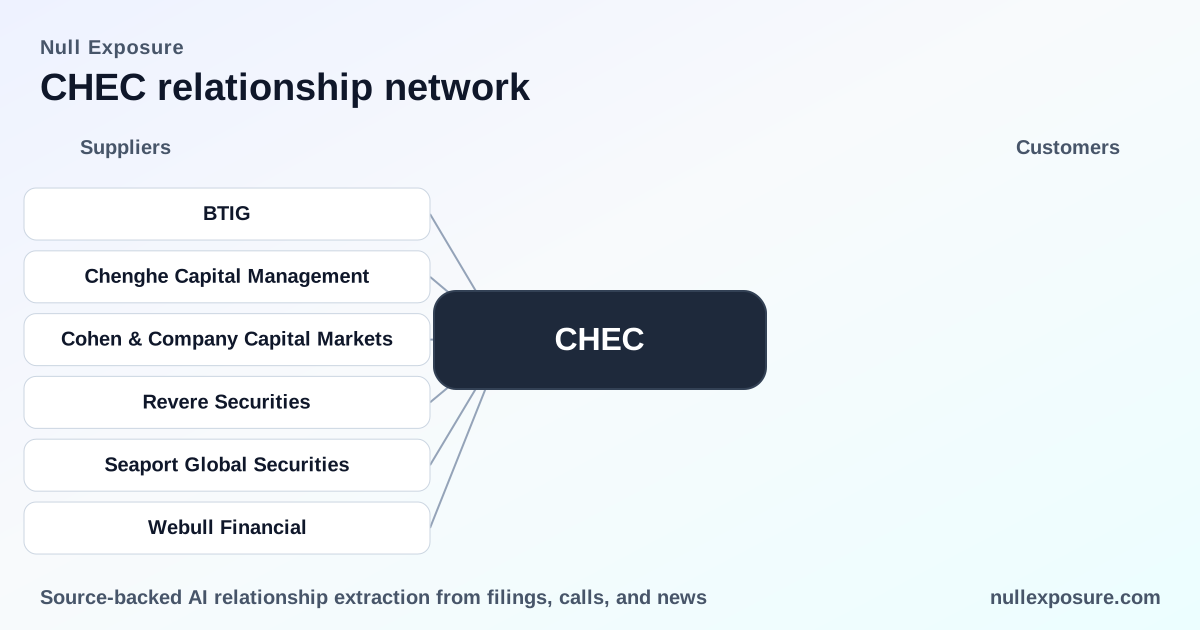
Brokerage and capital markets partners you should know Below I cover every counterparty relationship surfaced in public coverage. Each relationship is described plainly with its source so you can map CHEC’s supplier and distribution posture.
BTIG: the sole bookrunner cited for a listing round
According to a Renaissance Capital news note (first seen March 2026 / FY2025), BTIG is listed as the sole bookrunner on a CHEC offering, signalling a concentrated underwriting relationship and an outsized role for a single bank in determining distribution and pricing. Source: Renaissance Capital news (Mar 2026).
Chenghe Capital Management: sponsor/co-manager role reported
WealthBriefingAsia (FY2026 coverage) reports that Chenghe Capital Management acted as a co-manager on a related Chenghe SPAC offering, reflecting internal sponsor involvement in placement alongside external capital markets firms and indicating alignment between sponsor and underwriting teams. Source: WealthBriefingAsia (FY2026).
Cohen & Company Capital Markets: lead book-running manager on related issuance
WealthBriefingAsia’s FY2026 article notes that Cohen & Company Capital Markets served as the lead book-running manager for a Chenghe vehicle, which suggests CHEC’s strategy includes pairing with boutique or regional lead managers rather than only large bulge-bracket houses. Source: WealthBriefingAsia (FY2026).
Seaport Global Securities: joint book runner participation
Per the WealthBriefingAsia report (FY2026), Seaport Global Securities is listed as a joint book runner, indicating another point of distribution for the SPAC’s shares and potential investor channels in the U.S. middle-market capital networks. Source: WealthBriefingAsia (FY2026).
Revere Securities: co-manager role on the underwriting syndicate
WealthBriefingAsia (FY2026) shows Revere Securities acting as a co-manager on a Chenghe SPAC issuance, reinforcing a multi-party syndicate approach that mixes lead managers and co-managers to broaden distribution. Source: WealthBriefingAsia (FY2026).
Webull Financial: co-manager and retail distribution touchpoint
Also captured in WealthBriefingAsia’s FY2026 coverage, Webull Financial is named as a co-manager, providing a clear retail-channel capability in the syndicate and expanding electronic retail access to the offering. Source: WealthBriefingAsia (FY2026).
What these relationships mean for investors and operators
- Underwriting concentration is high: coverage shows a small set of banks and broker-dealers running and co-managing deals; where a single bookrunner like BTIG leads, execution risk and pricing are more closely tied to that firm’s distribution strength.
- Distribution mix includes retail and institutional channels: the presence of Webull alongside institutional-focused firms implies a hybrid target audience for equity placement, which affects aftermarket volatility and lock-up dynamics.
- Sponsor alignment is explicit: Chenghe Capital Management’s co-manager role signals that sponsor economics and underwriting strategy are coordinated, increasing operational control over transaction timing and partner selection.
Operational constraints and company-level signals The available data contains no explicit supplier contract constraints recorded for CHEC. Treat this absence as a company-level signal: CHEC is a transaction-oriented entity with minimal operating infrastructure, so supplier commitments are short-term and execution-focused rather than long-term procurement relationships. This structure creates:
- A contracting posture that is transactional and event-driven (underwriting and placement for an IPO or de-SPAC),
- High concentration risk because a small number of underwriters and co-managers control access to public capital,
- Low operational maturity in the conventional sense—no operating revenues or operating metrics—so counterparty strength is measured by capital markets credibility and distribution reach.
Risk profile — concise, actionable observations
- Execution risk dominates: CHEC’s value is binary—successful de-SPAC or failed combination—so partners that control placement and institutional demand shape outcomes.
- Counterparty concentration is a single point of failure when a sole bookrunner is involved; an underwriter withdrawal or reputational issue would materially affect prospects.
- Retail distribution increases volatility: Webull’s presence can amplify short-term trading activity and post-offering price swings.
Practical next steps for investors and counterparties
- Review lead manager track records and syndicate allocation practices for the specific offering handled by BTIG and Cohen & Company; these determine aftermarket stability.
- Monitor sponsor statements from Chenghe Capital Management and any transaction filings to assess timing and target-sector focus.
- Evaluate liquidity and institutional stickiness given the high institutional ownership; if institutions are supportive, post-deal price stability improves.
For more supplier-relationship intelligence and to benchmark CHEC against peer SPACs, visit Null Exposure: https://nullexposure.com/. If you want a tailored map of counterparties and underwriting exposure for your portfolio or PE deal flow, explore the services available at https://nullexposure.com/.
Bottom line Chenghe Acquisition III is a classic SPAC: value is contingent on execution and underwriting relationships rather than operating cash flow. The listed broker-dealer and sponsor relationships—BTIG, Cohen & Company Capital Markets, Seaport Global, Revere Securities, Webull Financial, and Chenghe Capital Management—constitute the critical supplier set whose performance will determine CHEC’s ability to complete a value-accretive business combination. Investors and operators should prioritize underwriter credibility, syndicate depth, and sponsor alignment when assessing exposure to CHEC.