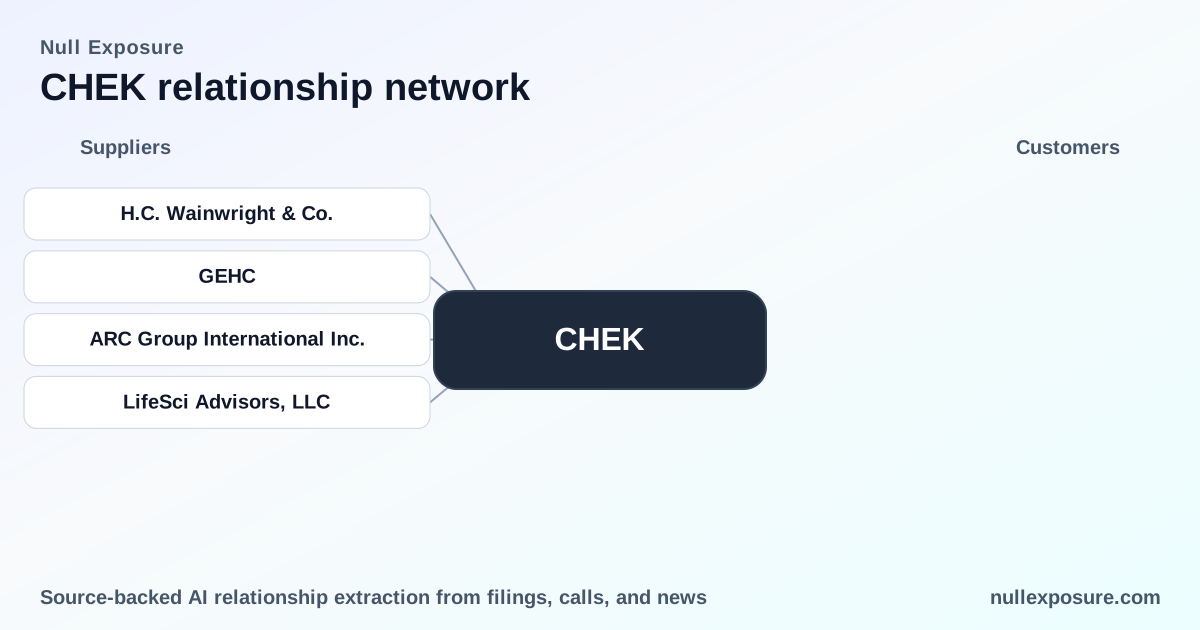
CHEK supplier relationships: capital partners, manufacturing, and investor outreach — what investors should know
Check-Cap Ltd. operates as a medical-device developer for the C-Scan® gastrointestinal imaging system and monetizes through device commercialization and recurring service and manufacturing arrangements, while funding growth through repeated equity offerings and committed credit lines. The company’s supplier relationships show a clear pattern: outsourced manufacturing with an established OEM partner, recurring use of investment banks to access capital, and retained investor-relations support—each relationship directly tied to Check‑Cap’s ability to scale production and preserve liquidity. For a deeper look at supplier exposures and the competitive implications for portfolio decisions, visit https://nullexposure.com/.
Why the supplier map is an investment signal, not just a contact list
Supplier relationships are the operational lifelines of a medical‑device company. For Check‑Cap, manufacturing partnerships determine time‑to‑market and unit economics, while placement agents and underwriters determine access to capital and dilution pacing. The sample of relationships in public filings and press releases shows a repeatable working model: outsource specialized manufacturing, tap boutique and life‑science-focused financiers for capital raises, and retain investor‑relations firms to support liquidity events and market communications.
Because the data in market filings and press releases disclose discrete commercial and capital actions, investors can infer contracting posture (vendor outsourcing and transactional capital raises), concentration risk (few visible strategic suppliers), criticality (manufacturing and capital partners are mission‑critical), and maturity characteristics (a company in commercialization and capital‑raising phase rather than self‑sustaining cash flow). There are no explicit contractual constraints published in the materials reviewed here, which is itself a company‑level signal about the visibility of long‑term procurement commitments and contingent obligations.
Supplier relationships — what the record shows
H.C. Wainwright & Co. — acting as placement agent and book‑running manager across multiple capital raises. Check‑Cap used H.C. Wainwright as the exclusive placement agent for a $35 million registered direct offering and previously engaged the firm as sole book‑running manager for a $20.2 million public offering, signaling a long‑running financing relationship with a boutique life‑science securities firm. According to PR Newswire, H.C. Wainwright was the exclusive placement agent on the registered direct placement (PR Newswire, March 2026) and served as sole book‑running manager on the earlier public offering (PR Newswire, 2018).
GE Healthcare — outsourced manufacturing line transfer and qualification for the C‑Scan® system. Check‑Cap completed a manufacturing line transfer and qualification run operated by GE Healthcare, establishing GE Healthcare as a production partner for the C‑Scan® device and implying that mass production leverages an external, large‑scale contract manufacturer. This operational milestone is documented in a PR Newswire release covered in market summaries (PR Newswire, August 7, 2019; reported via Finviz).
ARC Group International Inc. — equity line of credit access up to $30 million. Check‑Cap registered shares in connection with an equity line of credit provided by ARC Group International, giving the company access to up to $30 million in discretionary growth capital subject to registration effectiveness—an important contingent financing source for near‑term liquidity and dilution planning. This was disclosed in a Form F‑1 registration filing announced via GlobeNewswire and syndicated press (GlobeNewswire/Canadian Press, 2026).
LifeSci Advisors, LLC — retained investor‑relations support for capital events. Check‑Cap listed LifeSci Advisors as its investor‑relations contact in materials tied to a registered direct offering, indicating the company retains specialized IR support to manage investor outreach and communications around financing transactions. Contact details and IR representation were included in the PR Newswire offering announcement (PR Newswire, 2021).
Operational implications: concentration, criticality, and contracting posture
- Manufacturing is outsourced and mission‑critical. The GE Healthcare line transfer and qualification establishes a dependency on a large OEM partner for production capacity and device qualification. If production scales, GE’s operational performance will directly affect Check‑Cap’s revenue ramp and timing.
- Capital raising is a repeatable, active channel. Multiple engagements with H.C. Wainwright and the ARC equity line indicate that Check‑Cap relies on transactional capital access rather than on internal free cash flow; financing partners are integral to sustaining operations and growth.
- Communications and investor support are outsourced. Retaining LifeSci Advisors underscores a deliberate investor‑relations posture intended to support offering execution and investor confidence during dilutive events.
- Concentration risk is elevated but typical for commercializing med‑tech. The visible supplier universe is small; that concentration amplifies counterparty risk but also suggests focused operational relationships appropriate to a company still scaling production and market penetration.
- Contract transparency is limited at the company level. There are no explicit contractual constraints published in the materials reviewed here, which signals limited public visibility into long‑dated supply contracts, minimum purchase commitments, or penalty structures.
Risk factors that track to supplier relationships
The supplier map creates three high‑priority monitoring points for investors: manufacturing continuity and qualification data from GE Healthcare; the cadence and terms of capital raises with H.C. Wainwright and ARC Group that govern dilution and runway; and investor communications run through LifeSci Advisors that shape market perception during financing. Each of these relationships is operationally or capital‑structurally critical and therefore should be integrated into any risk model for CHEK exposure.
Learn more about how supplier relationships shift valuation risk at https://nullexposure.com/.
What to watch next — actionable investor indicators
- Watch for operational updates on the C‑Scan® manufacturing qualification and capacity ramp from GE Healthcare; any delays or quality events will directly affect revenue forecasts.
- Track the effective execution of the ARC equity line (Form F‑1 outcomes and drawdowns) and future placement agent announcements with H.C. Wainwright for timing and dilution details.
- Review investor‑relations disclosures from LifeSci Advisors around financing announcements and clinical or commercial milestones that affect market reception.
Bottom line and next step
Check‑Cap’s public supplier footprint identifies a classic commercialization profile: an outsourced manufacturing partner providing production capability and a set of capital‑market relationships supplying recurring funding. These relationships are strategic levers that determine whether Check‑Cap converts clinical and regulatory progress into durable commercial revenue or continues to rely on transactional financing to fund operations. For investors and operators mapping counterparty risk and capitalization strategy, these are the relationships to prioritize.
For an integrated supplier exposure analysis and to monitor updates in real time, visit https://nullexposure.com/ — your entry point for supplier‑level risk intelligence.