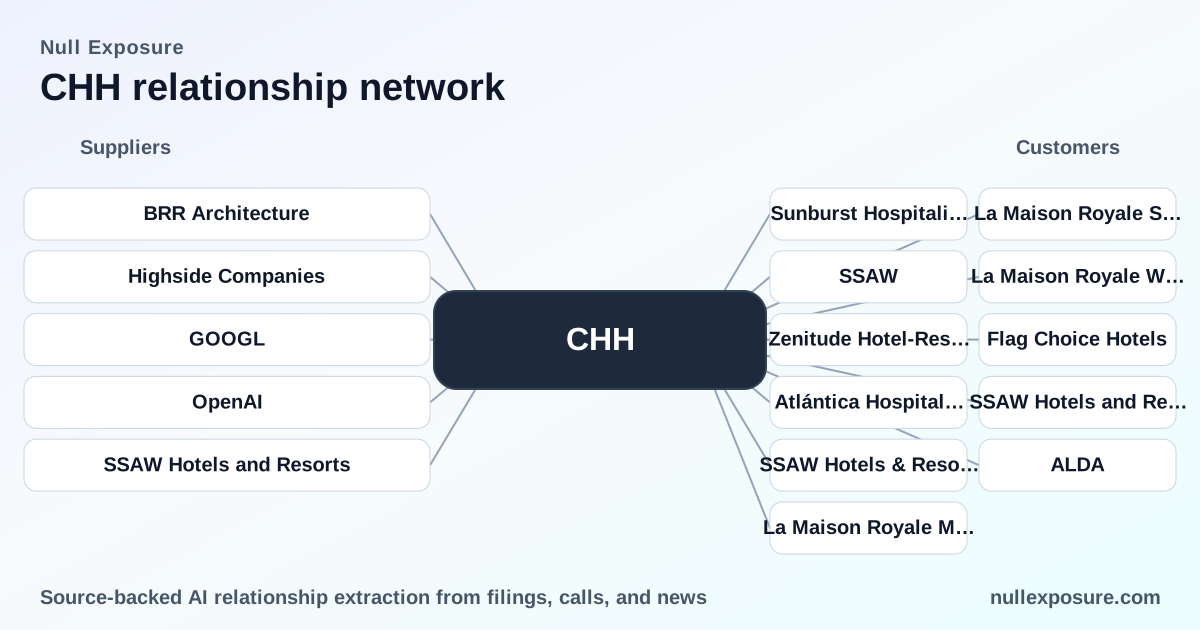
Choice Hotels (CHH) supplier relationships: what investors need to know
Choice Hotels is a global hotel franchisor that monetizes through franchise fees, brand licensing, and distribution agreements rather than hotel ownership; revenue is driven by system size, fees tied to room revenue, and international distribution partnerships. For investors and operators evaluating CHH supplier relationships, the strategic focus is on scalable design partners for growth (especially extended-stay Everhome Suites), third-party developers/franchisees for rollout, and large technology partners that amplify distribution and bookings. Learn more about relationship signals and sourcing at https://nullexposure.com/.
How Choice organizes suppliers and why that matters to returns
Choice operates a light-asset model: brand, distribution, and franchise support are the product. That operating model produces high margins (reported operating margin ~45% and profit margin ~37.7% in the trailing period) and strong return on equity (ROE ~54.4%), but it also concentrates operational risk in third-party vendors who design, distribute, and provide critical technology. Investors should read supplier ties as levers on growth (speed of room additions), cost control (design and construction efficiency), and revenue capture (distribution partnerships with platforms that influence bookings).
Design & development partners that scale the extended-stay roll‑out
-
BRR Architecture — Choice identified BRR as the architect of record for its extended-stay brands, ensuring the Everhome Suites prototype is buildable and scalable across markets; this is cited in the company’s prototype announcement (FY2026) on PR Newswire and hospitality trade outlets. Source: PR Newswire/FY2026 https://www.prnewswire.com/news-releases/choice-hotels-international-introduces-redesigned-everhome-suites-prototype-advancing-smarter-extended-stay-development-302678714.html and HospitalityNet coverage https://www.hospitalitynet.org/news/4130761.html and Morningstar distribution https://www.morningstar.com/news/pr-newswire/20260204ph77689/choice-hotels-international-introduces-redesigned-everhome-suites-prototype-advancing-smarter-extended-stay-development.
BRR’s role is operationally significant: having a repeatable, buildable prototype reduces per-unit capex risk and accelerates franchisee deployment, which directly supports fee revenue growth. -
Highside Companies — Highside is a longtime collaborator and was credited with developing newly opened Everhome Suites properties in several U.S. states during FY2026. Source: StockTitan/FY2026 https://www.stocktitan.net/news/CHH/everhome-suites-expands-footprint-with-openings-in-texas-and-3o6tyjadynfo.html and TopHotel/FY2026 https://tophotel.news/three-states-27-everhome-suites/.
Highside functions as a local developer/franchise partner; their activity signals on-the-ground execution capability that converts prototypes into fee-bearing rooms.
Technology partners that expand distribution and demand capture
-
Google (Alphabet Inc.) — Choice cited collaboration with Google on AI-powered travel planning capabilities as part of its partnerships discussed in the FY2026 Q4 earnings call transcript. Source: Q4 2025 earnings call transcript (InsiderMonkey, FY2026) https://www.insidermonkey.com/blog/choice-hotels-international-inc-nysechh-q4-2025-earnings-call-transcript-1699737/.
This relationship is strategically important because distribution algorithms and travel planning integrations directly influence conversion and room revenue, the basis for much of CHH’s fee income. -
OpenAI — Choice confirmed participation in OpenAI’s ChatGPT advertising pilot during FY2026 commentary, reflecting an experimental approach to reach travelers through conversational AI platforms. Source: Q4 2025 earnings call transcript (InsiderMonkey, FY2026) https://www.insidermonkey.com/blog/choice-hotels-international-inc-nysechh-q4-2025-earnings-call-transcript-1699737/.
Use of these platforms is a distribution lever: new ad and discovery channels can improve direct bookings and lower commission leakage if executed effectively.
International distribution and franchise partners
- SSAW Hotels and Resorts — Choice completed onboarding more than 8,300 rooms in China under a distribution agreement with SSAW Hotels and Resorts, per company reporting in FY2026. Source: Lodging Magazine/FY2026 https://lodgingmagazine.com/choice-hotels-international-reports-q4-and-full-year-2025-results/.
The SSAW tie demonstrates rapid international room-scale via distribution licensing rather than direct investment, expanding Choice’s addressable royalty base while transferring local execution risk to a regional operator.
What the relationship mix tells investors about risk and execution
-
Contracting posture: Choice’s relationships favor long-standing, repeatable vendor arrangements (architecture firms, development partners, and branded franchise agreements) rather than one-off suppliers. That posture supports predictable rollouts, but success depends on consistent partner execution. Company-level governance requires third-party security and risk assessments for service providers, indicating structured contracting and oversight of critical suppliers as part of its cybersecurity and vendor management program (company disclosures on third-party security practices, FY2026).
-
Concentration and criticality: Technology partners like Google and OpenAI are high-impact, high-leverage: they influence distribution and revenue capture at scale. Design and developer partners (BRR, Highside) are critical for unit economics and speed-to-market. The SSAW distribution agreement points to an aggressive international expansion strategy that transfers execution to a single regional partner, increasing concentration risk in that market.
-
Maturity of relationships: The mix includes long-standing collaborators (BRR, Highside) and newer, experimental digital partnerships (OpenAI ChatGPT ad pilot). That combination provides stable rollout capability while testing new demand channels — a balanced approach to scaling and innovation.
Explore the full supplier analysis and comparable supplier maps at https://nullexposure.com/ to benchmark CHH against peers.
Investment implications: growth levers and hazard flags
-
Growth levers: scalable prototypes (Everhome Suites), repeat developer partners, and expanded international distribution provide a clear path to royalty and fee revenue growth without capital-intensive ownership. CHH’s high operating margin and ROE reflect the light-asset franchise model, which benefits directly from successful partner execution.
-
Hazard flags: concentration in key partners and reliance on channel partners (Google/OpenAI) for demand generation create single-point risks to revenue conversion if integrations falter or platform economics change. The SSAW arrangement implies geopolitical and execution risk concentrated in a regional partner for a major room count.
-
Operational controls: Company disclosures show Choice requires periodic security risk assessments of third-party service providers, signaling mature vendor governance around cybersecurity and risk management. This is a company-level control, not tied to any single named partner in the constraint text, and it reduces but does not eliminate third-party operational risk.
If you want a tailored report on supplier concentration and contract exposure for CHH or peer comparisons, visit https://nullexposure.com/ for a detailed supplier map and sourcing intelligence.
Bottom line for investors and operators
Choice’s supplier ecosystem is purpose-built to scale room counts and fee revenue while keeping capital deployment low. The combination of repeatable design partners, active developer/franchise collaborators, and strategic technology partnerships positions Choice to capture growth from both physical expansion and new distribution channels. Key risks are partner concentration and the execution quality of those partners, which directly translate into the company’s top-line royalty and fee performance. Evaluate franchise pipeline metrics and partner performance as primary inputs to any CHH investment thesis.
Final action: for deeper supplier diligence and contract-level signals on CHH and competitors, go to https://nullexposure.com/.