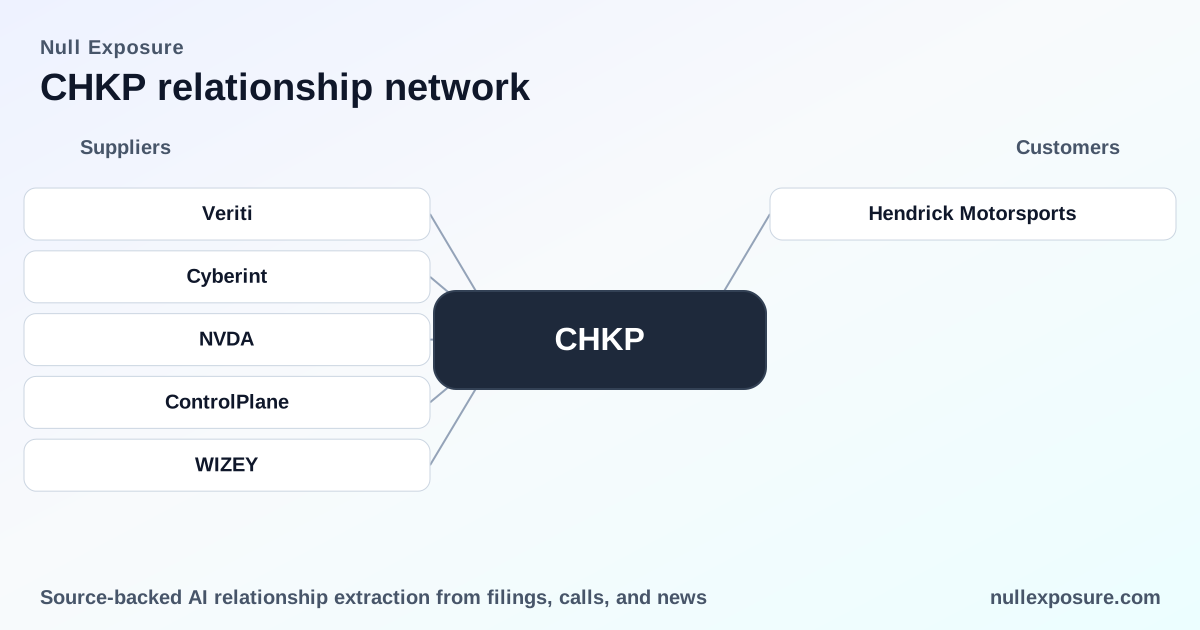
Check Point (CHKP): Supplier relationships that deepen AI and cloud security reach
Check Point monetizes by selling enterprise-grade network and cloud security products and recurring subscriptions—combining appliance and software licensing with services and support—generating high gross and operating margins from a globally diversified customer base. The company’s go-to-market blends direct enterprise sales, channel partners, and technology alliances that accelerate product features (especially around AI and cloud security) without large incremental R&D spend. Investors should view recent supplier tie-ups as capability accelerants that shift product differentiation from pure proprietary engineering toward curated partner integrations.
If you want a consolidated view of Check Point’s partner signals and commercial implications, start here: https://nullexposure.com/
Why the new supplier signals matter for investors
Check Point’s financial profile (roughly $2.7B revenue TTM, ~31% operating margin, and a trailing P/E near 16) reflects a mature security vendor with strong profitability. Strategic partnerships today are not peripheral marketing deals: they are the primary route to embed Check Point into the enterprise AI and cloud stacks where customers prefer best-of-breed integrations. That pattern reduces time-to-market for new capabilities and lets Check Point preserve margin leverage while expanding addressable workloads.
- These partnerships show a deliberate move into AI-centric exposure and cloud-security stacks rather than a pivot away from core perimeter and threat-prevention products.
- NVIDIA and AI consultancies accelerate product credibility for customers building production AI factories, while security specialists like Wiz, Cyberint and Veriti supply detection, threat intelligence and operational context that Check Point integrates into exposure management workflows.
Explore supplier intelligence and relationship context at https://nullexposure.com/ to support procurement or investment diligence.
Supplier relationships: what Check Point is announcing and why it matters
Below I cover every relationship flagged in recent reporting and what each partnership contributes to Check Point’s product and go-to-market posture.
Veriti
Check Point cites Veriti as a powering partner for its Exposure Management offering, contributing to threat visibility and remediation context that unify several intelligence feeds. According to a Zawya press release (March 9, 2026), Veriti is named alongside Cyberint as a collaborator in the new Exposure Management capability. (Zawya, Mar 9 2026 — https://www.zawya.com/en/press-release/companies-news/check-point-introduces-ai-driven-exposure-management-to-close-the-cyber-security-remediation-gap-uvoj2naw)
Cyberint
Cyberint is another named partner powering real-time situational awareness and dark-web insights inside Check Point’s Exposure Management product; the partnership supplies external threat intelligence and attack-surface monitoring that feeds automated remediation. TechAfricaNews and the same Zawya announcement referenced Cyberint’s role in January–March 2026 coverage. (TechAfricaNews, Jan 26 2026; Zawya, Mar 9 2026 — https://techafricanews.com/2026/01/26/check-point-launches-exposure-management-to-combat-ai-era-cyber-threats/)
NVIDIA (NVDA)
Check Point launched “AI Cloud Protect” for enterprise AI factories using NVIDIA BlueField, signaling a dependence on NVIDIA’s data-center and AI-infrastructure stack to secure production AI deployments. Industry write-ups note the BlueField integration as part of an October 2025 product launch and follow-up 2026 commentary. (StockTitan reporting on CHKP product releases, referencing Oct 2025 launches; see stocktitan.net entries, early 2026)
ControlPlane
Check Point is teaming with AI security consultancy ControlPlane to offer regulator-ready frameworks for large language models and agentic AI, aimed at enterprises deploying production-grade AI. SimplyWall.St highlighted the ControlPlane collaboration in its FY2026 coverage of Check Point’s product positioning for LLM governance and deployment controls. (SimplyWall.St, early 2026 — https://simplywall.st/stocks/us/software/nasdaq-chkp/check-point-software-technologies/news/a-look-at-check-point-software-technologies-chkp-valuation-a-3)
Wiz (WIZEY)
Check Point integrates Wiz to provide deep, context-rich visibility across multi-cloud environments; analysts and press cited GigaOm praise of Check Point’s Wiz integration as enabling a connected graph for faster detection and remediation prioritization. The integration is positioned as a practical way to cover cloud-native blind spots in customer environments. (GigaOm coverage noted in GlobeNewswire and other press, Feb 2026; example coverage: GlobeNewswire, Feb 17 2026 — https://www.globenewswire.com/news-release/2026/02/17/3239355/0/en/Check-Point-Software-Earns-Leader-Fast-Mover-Position-in-GigaOm-Radar-for-Cloud-Network-Security.html)
How these relationships change Check Point’s operating and commercial profile
- Contracting posture: Check Point continues to sell durable subscription and support contracts, but the supplier mix shifts delivery risk toward partner-managed services and third-party integrations for AI and exposure management—accelerating time-to-market without proportionate internal development spend. This implies contracting language and SLAs will increasingly reference integrated partner capabilities.
- Concentration and criticality: Partnering with NVIDIA raises a criticality vector for AI workloads—customers building on NVIDIA hardware will favor vendors that certify BlueField integration. Meanwhile, integrations with Wiz, Cyberint and Veriti reduce single-vendor blind spots but introduce multi-party operational dependencies.
- Maturity: The company’s margins and profitability (high gross and operating margins) indicate a mature vendor able to buy or partner for capability rather than develop everything internally. This is a classic scale-with-partners model: leverage alliances to expand product capabilities while preserving margin structure.
- Commercial implications for customers and operators: Expect bundled offerings where Check Point provides the sales and contractual front-end while partners supply specialized telemetry, remediation automation, or certified AI infrastructure.
Investment and procurement takeaways — what to watch next
- Upside: Partnerships accelerate enterprise AI and cloud adoption without heavy incremental R&D; this sustains recurring revenue growth and defends margins. The NVIDIA tie shapes Check Point’s addressable market for AI-factory security, a potentially higher-value segment.
- Risk: Increasing reliance on third-party technology and specialized consultancies introduces operational glue points—customers will demand clear SLAs and joint-support commitments from Check Point and named partners. Watch for how Check Point codifies multi-vendor support obligations.
- Actionable signal: Monitor product certification cadence (e.g., BlueField compatibility), joint go-to-market announcements, and any revenue attribution disclosures in future filings; these will show whether partnerships are tactical marketing or foundational to product revenue.
If you need a supplier-risk summary or contract exposure map for Check Point, find tailored reports and sourcing intelligence at https://nullexposure.com/
Closing thought and next steps
Check Point’s recent supplier disclosures show an intentional shift: accelerate AI and cloud security capability through partnerships while preserving the predictable, high-margin subscription economics investors value. For investors and procurement teams, the critical question is how these relationships translate into measurable adoption and retention—or, alternatively, into added operational complexity for enterprise customers.
For a deeper supplier risk and dependency assessment that ties partner signals to contract language and procurement exposure, visit https://nullexposure.com/ and request a tailored briefing.