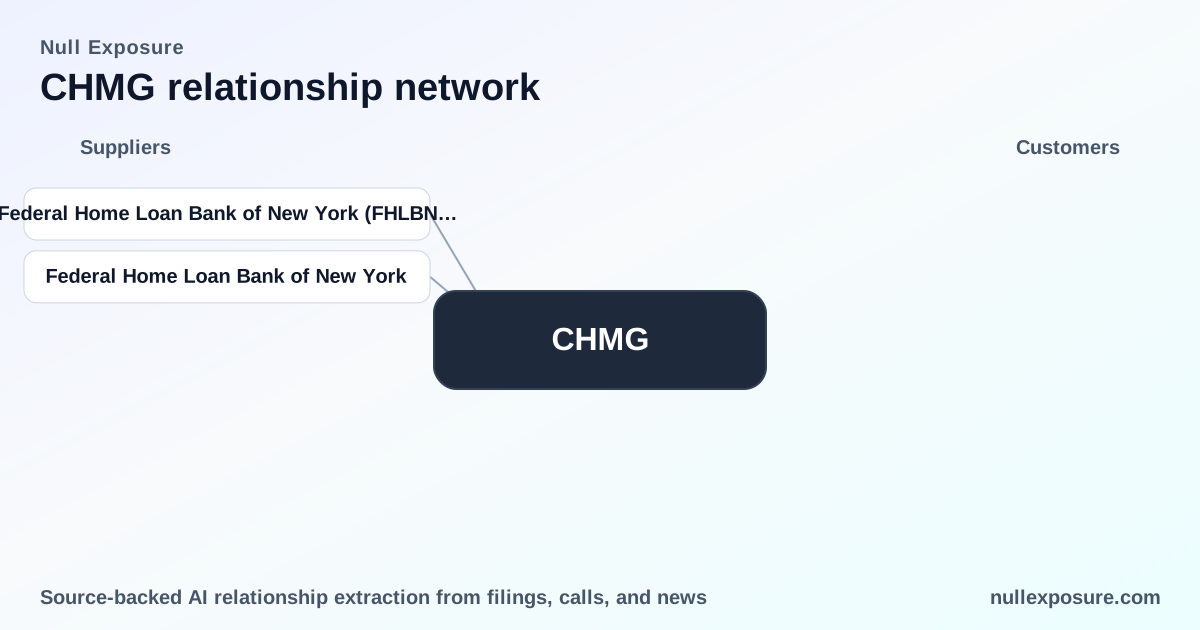
Chemung Financial (CHMG) — supplier exposures and what they mean for investors
Chemung Financial Corporation is a regional bank holding company that monetizes through traditional banking spreads, fee income from trust and wealth services, and strategic balance-sheet management such as advances and subordinated debt issuance. The company uses correspondent liquidity from system utilities like the Federal Home Loan Bank of New York and episodic subordinated capital to manage interest rate and funding risk, while relying on third‑party vendors for non-core operations. For investors evaluating CHMG as a supplier to the financial ecosystem or as a counterparty, the primary external relationships of consequence are funding lines and derivative counterparties that shape liquidity capacity and risk-transfer strategies. Learn more about supplier exposures at the firm level on the NullExposure homepage: https://nullexposure.com/.
Quick read: what investors should take away
Chemung runs a typical small regional-bank funding stack: core deposits, contingent advances from the Federal Home Loan Bank (FHLBNY), and market instruments including subordinated debt. The FHLBNY relationship provides meaningful committed capacity, but advances were actively managed in FY2025 and FY2026, while the bank also increased subordinated debt to strengthen capital and reduce reliance on short-term borrowing. Operationally, the bank outsources non-core functions to third parties and uses mirroring swaps with very large banks for interest-rate management, which creates both utility and concentration considerations for counterparties.
Visit the NullExposure homepage for deeper supplier analysis: https://nullexposure.com/.
How Chemung’s supplier relationships show up in the business model
Chemung’s operating model is shaped by a few clear characteristics:
- Contracting posture: The bank maintains committed liquidity through the Federal Home Loan Bank system and supplements it with market instruments such as subordinated debt and derivative relationships with large banks. This is a conservative posture that privileges optionality over sole reliance on short-term money markets.
- Concentration and criticality: Access to the FHLBNY is a critical utility for the firm’s liquidity management; while not the only source of funding, the relationship is operationally significant because it establishes a defined advance capacity that the bank can draw against in stress.
- Maturity and sophistication: Chemung uses traditional bank tools—term advances, subordinated debt, and mirroring swaps—indicative of a mature regional bank treasury rather than early-stage or bespoke financing arrangements.
- Third‑party dependence: The bank relies on a network of vendors and service providers for operations, creating standard operational vendor risk that is manageable but worth monitoring for concentration in core processing or fintech relationships.
These characteristics position Chemung as a conservatively managed regional bank with predictable supplier needs — liquidity utilities and large-bank derivative counterparties are the two supplier classes that warrant primary investor attention.
Relationship map: Federal Home Loan Bank of New York (FHLBNY)
FHLBNY — FY2025 (term advances paid down)
Chemung reported that it paid off term advances from the Federal Home Loan Bank of New York using proceeds from sales of available-for-sale securities, which reduced average balances of borrowed funds; this reduction was partially offset by a $33.9 million increase in average subordinated debt following issuance in June 2025. (GlobeNewswire press release, October 21, 2025: https://www.globenewswire.com/news-release/2025/10/21/3170652/23119/en/Chemung-Financial-Corporation-Reports-Third-Quarter-2025-Net-Income-of-7-8-million-or-1-62-per-share.html)
FHLBNY — FY2026 (advance capacity and utilization)
As of December 31, 2025, Chemung disclosed total advance line capacity at the FHLBNY of $178.5 million, of which $87.1 million was utilized and $91.4 million remained available — indicating a materially available liquidity buffer through the FHLBNY facility. (GlobeNewswire press release, January 26, 2026: https://www.globenewswire.com/news-release/2026/01/26/3225982/0/en/Chemung-Financial-Corporation-Reports-Fourth-Quarter-2025-Net-Income-of-7-7-million-or-1-61-per-share-Annual-Financial-Results.html)
How these relationships affect investor risk and opportunity
- Liquidity flexibility is a positive: The disclosed $178.5 million FHLBNY capacity with roughly half undrawn provides Chemung with a meaningful contingent source of liquidity that reduces reliance on volatile deposit flows.
- Funding mix changes change risk profile: The FY2025 payoff of FHLBNY term advances funded by securities sales, coupled with a $33.9 million uptick in subordinated debt, indicates active liability management to extend duration and shore up regulatory capital.
- Counterparty concentration warrants monitoring: The FHLBNY is a government-sponsored utility; the constraints data explicitly identifies it as a government counterparty, reinforcing its role as a systemic liquidity provider to Chemung. At the same time, the bank’s use of mirroring swaps with Domestic Systemically Important Banks (D-SIBs) introduces a relationship with very large counterparties that is material from a counterparty‑credit and operational perspective.
- Operational third‑party exposure is present: Chemung relies on multiple service providers for operations, which is a standard vendor footprint for banks this size but creates operational dependencies that investors should monitor through vendor concentration reporting and service-level disclosures.
Practical implications for counterparties and ops teams
- For suppliers of liquidity or risk services, Chemung’s clear advance capacity and subordinated capital issuance indicate creditworthiness aligned with a small, well-managed regional bank — pricing and documentation should reflect a low-to-moderate counterparty risk profile.
- For fintech or service vendors, the presence of multiple third‑party providers means integration and continuity plans should be emphasized in contracting, and counterparties should negotiate standard vendor risk controls and SLAs.
- For investors evaluating CHMG shares, the capital structure moves (subordinated debt issuance) and conservative use of the FHLBNY are credit-positive signals that support the bank’s dividend and return-on-equity profile shown in recent financials.
Explore a consolidated view of CHMG supplier relationships and risk signals on NullExposure: https://nullexposure.com/.
Final assessment and next steps for investors
Chemung Financial manages funding through a combination of deposit inflows, FHLBNY capacity, and subordinated capital while outsourcing non-core functions to third-party vendors. The FHLBNY relationship is a meaningful liquidity utility; its disclosed capacity and utilization are central to stress resilience, and the issuance of subordinated debt in 2025 strengthens the bank’s capital profile. Counterparty relationships with very large banks for swap mirroring and a distributed vendor base are operationally standard but require oversight.
If you are modeling CHMG’s funding resilience or assessing supplier concentration, use the FHLBNY capacity figures and recent subordinated debt issuance as primary inputs and review vendor contracts for operational concentration. For continued monitoring and supplier-level intelligence, visit NullExposure to see structured relationship profiles and evolving constraint signals: https://nullexposure.com/.