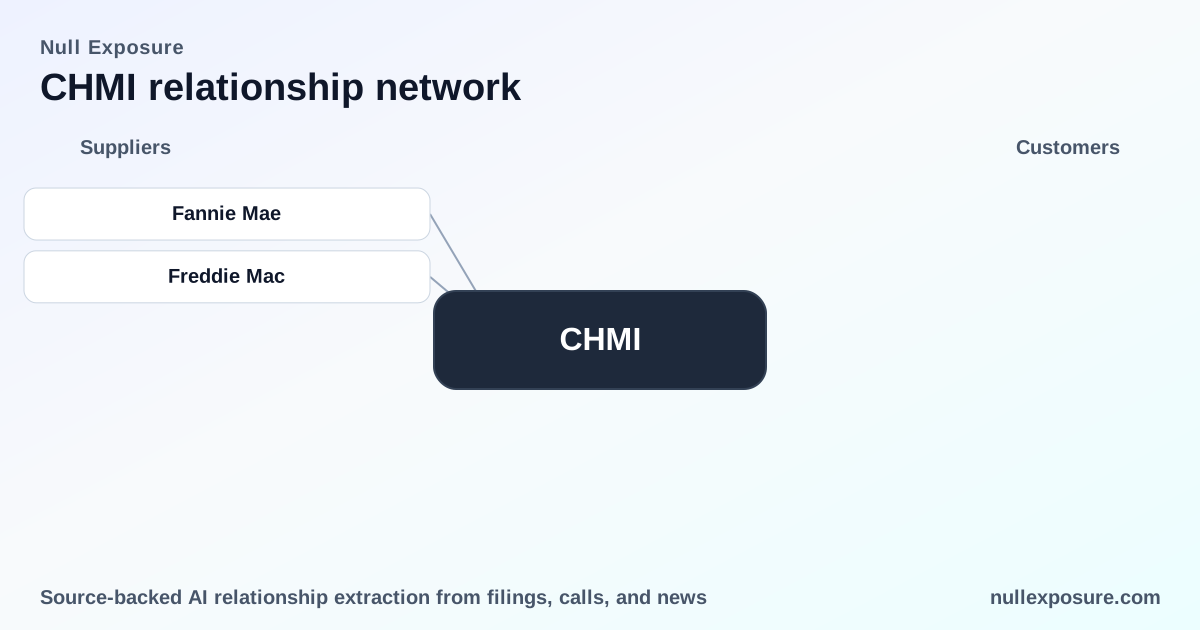
Cherry Hill Mortgage Investment Corp (CHMI): supplier relationships, financing posture, and practical implications for counterparties
Cherry Hill Mortgage Investment Corp operates as a residential mortgage REIT that acquires and manages mortgage-related assets, monetizing through interest spread on mortgage-backed securities (RMBS), servicing-related cash flows and targeted MSR financing structures. The company funds asset positions primarily with short-term repurchase agreements and dedicated MSR revolvers, and it contracts out servicing while retaining economic exposure to MSR cash flows. For investors and counterparties, CHMI’s model is capital-light on operations but capital-intensive in funding — the business profits from leverage on mortgage assets while relying on a network of structured financing and subservicers. Learn more about supplier relationships and counterparty risk at https://nullexposure.com/.
How CHMI makes money and where suppliers fit in
Cherry Hill’s revenue mix is anchored in two streams: net interest and servicing-related earnings tied to mortgage assets, and financing arbitrage enabled by repurchase funding and MSR credit facilities. The company draws on short-dated repo lines to finance RMBS and uses two MSR revolvers to monetize servicing rights, while outsourcing loan servicing to third parties. This operating construct concentrates counterparty importance on repo providers, MSR lenders, and subservicers because disruption in any of those links directly affects liquidity and cash collections.
- Funding concentration: large aggregate repo borrowings and named MSR revolvers create lender-dependency.
- Operational outsourcing: CHMI does not do direct loan servicing; third-party subservicers perform those functions.
- Asset-liability sensitivity: short-term funding coupled with longer-duration mortgage cash flows creates roll and liquidity risk that lenders and counterparties price aggressively.
If you are evaluating counterparty credit or supplier selection, the firm-level financing posture is the first-order risk to assess. For a deeper supplier map and relationship analytics visit https://nullexposure.com/.
Principal relationships disclosed in filings
Below are every supplier/relationship mentioned in the available results for CHMI’s FY2024 disclosures, with plain-English summaries and source references.
Fannie Mae
CHMI’s FY2024 10‑K reports that Aurora and QRS III pledged their rights in all existing and future MSRs for loans owned or securitized by Fannie Mae to secure borrowings, and CHMI maintains a dedicated Fannie Mae MSR Revolving Facility (up to $150.0 million) secured by Fannie Mae MSRs. According to the 2024 Form 10‑K, the Fannie Mae facility had approximately $95.6 million outstanding at December 31, 2024. (Source: CHMI FY2024 10‑K, company disclosures on MSR financing and pledges.)
Freddie Mac
CHMI’s FY2024 10‑K discloses that Aurora pledged all of its existing and future MSRs on loans owned or securitized by Freddie Mac as part of its MSR financing arrangements, and CHMI operates a Freddie Mac MSR Revolver (up to $100.0 million) that had approximately $56.5 million outstanding at December 31, 2024. (Source: CHMI FY2024 10‑K, related MSR financing excerpts.)
Key takeaway: CHMI’s MSR financing is explicitly tied to agency relationships with both Fannie Mae and Freddie Mac and is collateralized by the related Agency MSRs; these agency linkages are central to how CHMI secures and structures its MSR credit lines.
Operating constraints and what they imply for supplier risk
The company’s 2024 disclosures outline several constraints that shape supplier relationships and counterparty exposure. Presenting these as company-level signals unless the excerpt names a relationship entity:
- Short-term contracting posture: CHMI funds RMBS largely with repurchase agreements; the firm reported approximately $1,077.3 million outstanding under repo lines at year-end 2024, with weighted average remaining maturities around 18 days. This creates continuous roll risk and makes CHMI sensitive to repo market conditions and counterparty appetite. (Source: CHMI FY2024 10‑K repurchase agreement disclosures.)
- Framework and revolving facilities for MSRs: CHMI maintains two MSR financing facilities — a Freddie Mac MSR Revolver up to $100 million and a Fannie Mae MSR Revolving Facility up to $150 million — with revolving periods and a stated 24‑month revolving period for the Fannie facility that can be extended by agreement. These are mid-term credit frameworks used to monetise servicing rights and are material to capital structure. (Source: CHMI FY2024 10‑K.)
- Concentration and material spend bands: The firm reports repurchase borrowings totaling over $1 billion from multiple counterparties (35 counterparties; $1,077.3 million outstanding from 12 of those counterparties). Counterparty concentration and large absolute borrowings signal critical dependencies on wholesale funding markets. (Source: CHMI FY2024 10‑K.)
- Operational outsourcing and reliance on subservicers: CHMI contracts with third-party subservicers to perform servicing functions and pays customary fees; the company historically leased employees from Freedom Mortgage prior to internalization and terminated a related management agreement with CHMM in November 2024. Operational continuity thus depends on external service providers and the stability of those contracts. (Source: CHMI FY2024 10‑K; management and subservicing disclosures.)
A constraint excerpt explicitly names RoundPoint as a subservicer and seller: RoundPoint acted as a subservicer and a seller of Fannie Mae and Freddie Mac MSRs pursuant to a flow purchase agreement with Aurora. That linkage makes RoundPoint a direct operational counterparty for agency-related MSRs. (Source: CHMI FY2024 10‑K.)
What investors and counterparties should watch
- Liquidity risk and cost of funds: With a large share of financing in short-term repos, any tightening in wholesale funding rates or counterparty lines will pressure CHMI’s spreads and could force asset sales or revolver draws. Monitor repo utilization and lender behavior.
- MSR revolver capacity and covenant terms: The Fannie and Freddie MSR facilities provide structural liquidity; lenders can enforce covenants or demand additional collateral in stress, impacting CHMI’s capital plans.
- Service continuity and operational control: Outsourced servicing and the termination of the CHMM management agreement shift operational reliance to subservicers such as RoundPoint and in-house resources; operational failures can impair cash collections and valuations.
- Counterparty diversity: The firm has many repo counterparties, but material exposure to a subset of lenders and two named MSR revolvers implies concentrated credit exposure that investors and suppliers should price.
For a mapped view of CHMI’s supplier network and real-time relationship risk scoring, see https://nullexposure.com/.
Bottom line and recommended next steps
Cherry Hill operates a leveraged, agency‑tethered MSR and RMBS strategy that depends on short-duration repo markets and two significant MSR revolvers tied to Fannie Mae and Freddie Mac collateral. The principal commercial risk is funding continuity rather than loan-level credit performance: if repo terms adjust or MSR lending conditions tighten, CHMI’s liquidity profile will change immediately. Investors and counterparties must underwrite both funding counterparties and the subservicers that execute loan-level operations.
- Action for investors: stress-test funding scenarios and Review MSR revolver covenants in any diligence.
- Action for potential suppliers/partners: confirm contract terms and operational SLAs with named subservicers and lenders.
Learn more about supplier exposures and craft informed counterparty strategies at https://nullexposure.com/.