Cherry Hill Mortgage Investment (CHMI-P-B): Supplier Relationships and What They Mean for Investors
Cherry Hill Mortgage Investment Corporation operates as an externally managed mortgage REIT that monetizes a diversified portfolio of single‑family residential mortgage loans and agency/non‑agency mortgage‑backed securities, while using preferred equity instruments like the 8250 Series B fixed‑to‑floating cumulative preferred to attract capital focused on steady income. The company generates cash flow through interest income from loans and MBS, management fee arrangements with its external manager, and active balance‑sheet positioning using derivatives to control duration and interest‑rate exposure. Investors in CHMI‑P‑B are effectively taking exposure to Cherry Hill’s underwriting, portfolio composition, and hedging program rather than to a standalone operating business.
For a deeper read on supplier exposures and relationship mapping, visit the NullExposure homepage: https://nullexposure.com/
Why supplier relationships matter for a preferred‑holder in a mortgage REIT
Preferred equity in a mortgage REIT is a claims product that sits above common equity but below unsecured creditors; operational counterparties and market infrastructure directly affect cash flow stability and credit risk. External management contracts determine incentive structures and cost of oversight; government‑sponsored enterprises (GSEs) and guarantors affect credit performance and liquidity of agency securities; and market infra for hedging (exchanges and futures/clearing venues) determine operational resiliency when rates move.
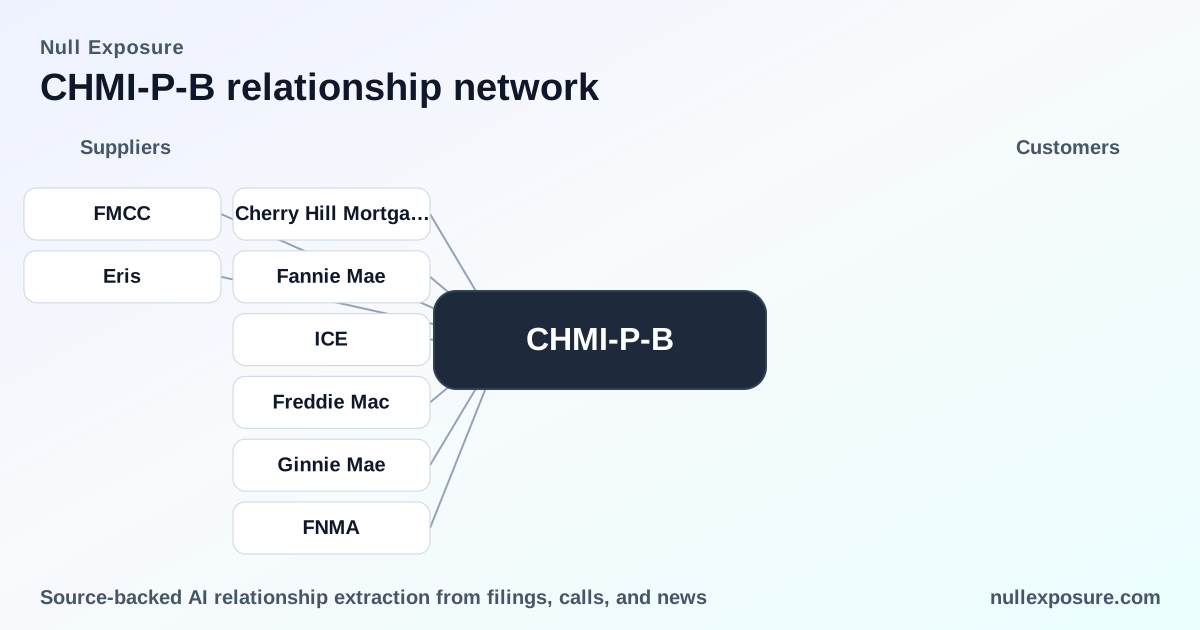
The relationship map — every supplier reference extracted from public commentary
Below are the counterparties and market relationships explicitly mentioned in Cherry Hill’s recent public commentary, each followed by a concise plain‑English summary and source.
Cherry Hill Mortgage Management, LLC
Cherry Hill is externally managed by Cherry Hill Mortgage Management, LLC, which controls portfolio implementation, capital allocation, and hedging decisions — a structural dependency for the REIT’s performance and fee economics. According to a Q4 FY2026 earnings call highlight (Intellectia, March 2026), the manager runs day‑to‑day operations and investment strategy. https://intellectia.ai/news/stock/cherry-hill-mortgage-investment-corporation-q4-2025-earnings-call-highlights
Fannie Mae
A material portion of the portfolio is invested in mortgage‑backed securities guaranteed by Fannie Mae, connecting Cherry Hill’s credit profile and liquidity to the agency market and GSE guarantees. MarketBeat’s FY2026 earnings coverage notes the company holds agency and non‑agency loans and MBS issued or guaranteed by Fannie Mae. https://www.marketbeat.com/instant-alerts/cherry-hill-mortgage-investment-nysechmi-announces-earnings-results-hits-estimates-2026-02-25/
Freddie Mac
Freddie Mac‑guaranteed MBS also populate the portfolio, providing access to liquid agency paper whose cash flows are backed by the GSE guarantee rather than Cherry Hill’s balance sheet. MarketBeat’s FY2026 summaries list Freddie Mac among the guarantors represented in the company’s securities holdings. https://www.marketbeat.com/instant-alerts/cherry-hill-mortgage-investment-nysechmi-announces-earnings-results-hits-estimates-2026-02-25/
Ginnie Mae
Ginnie Mae‑issued securities appear as part of the agency mix, offering government‑backed guarantee characteristics (important for credit and prepayment dynamics) and forming part of the company’s core interest‑bearing assets. MarketBeat’s FY2026 coverage repeats Ginnie Mae as a guarantor in Cherry Hill’s portfolio composition. https://www.marketbeat.com/instant-alerts/cherry-hill-mortgage-investment-nysechmi-announces-earnings-results-hits-estimates-2026-02-25/
ICE (Intercontinental Exchange)
Cherry Hill has initiated positions in ICE SOFR futures and plans to expand usage as it shifts part of the portfolio’s interest‑rate risk into those instruments, indicating active use of exchange‑traded interest‑rate hedges. Management discussed the ICE futures allocation during the FY2026 quarter review (MarketBeat, February–March 2026). https://www.marketbeat.com/instant-alerts/cherry-hill-mortgage-investment-q4-earnings-call-highlights-2026-02-27/
Eris
Cherry Hill uses Eris SOFR swap futures alongside swaps, TBAs and Treasury futures to mitigate duration and rate risk in RMBS and mortgage servicing rights, signaling reliance on cleared swap futures as a tactical hedging tool. The company disclosed use of Eris products in its FY2026 quarter commentary (StockTitan, March 2026). https://www.stocktitan.net/news/CHMI/cherry-hill-mortgage-investment-corporation-announces-fourth-quarter-cks69lbku72i.html
What these relationships tell investors about the operating model
-
Contracting posture — externally managed and fee dependent. External management centralizes investment decision‑making and aligns (or misaligns) incentives via management and incentive fee structures; governance and fee terms are critical to preferred investors because management actions drive portfolio returns and dividend coverage. This is a company‑level structural feature rather than a single‑vendor issue.
-
Concentration and counterparty profile — heavy agency exposure reduces credit loss risk but increases policy and liquidity dependence. Agency MBS backed by Fannie, Freddie and Ginnie Mae lower borrower default transfer to the REIT, but create concentrated exposure to the agency market’s liquidity cycles and regulatory backdrop.
-
Operational criticality — hedging infrastructure is essential. The firm’s active use of interest‑rate swaps, TBAs, Treasury futures and SOFR futures (exchange‑listed and Eris swap futures) indicates real‑time risk management is core to protecting dividend streams, making exchange and clearing counterparties operationally critical.
-
Maturity and market standardization — use of cleared futures and agency securities signals institutional sophistication. Adoption of ICE and Eris products shows the firm runs market‑standard hedges that are liquid and centrally cleared, reducing bilateral counterparty credit exposure while increasing reliance on exchange stability.
Risk and investment implications
- Key risk: managerial execution and fee drag. As an externally managed REIT, cash flow to preferred holders depends on disciplined portfolio management and hedging; missteps in duration control can compress distributable cash.
- Liquidity and policy risk are dominant for agency holdings. Agency concentration improves credit quality but ties valuations to GSE policy and market liquidity.
- Operational vendor risk for hedging platforms. Dependence on ICE and Eris for SOFR‑based hedges creates exposure to exchange liquidity and clearing conditions in stressed rate environments.
For a balanced review of counterparty exposures and a supplier‑centric risk scorecard, see our research hub: https://nullexposure.com/
Practical takeaways for investors in CHMI‑P‑B
- This preferred issue provides income exposure to a mortgage portfolio that is externally managed and actively hedged; evaluate the management contract and dividend coverage closely.
- Agency MBS weighting reduces credit default volatility but concentrates policy and liquidity risk with GSEs.
- Active use of exchange‑listed SOFR futures (ICE) and Eris swap futures indicates a sophisticated hedging program but also creates operational reliance on those market venues.
If you want a tailored counterparty map or monitoring setup for CHMI‑P‑B exposures, visit our homepage to request analyst access: https://nullexposure.com/
Conclusion: CHMI‑P‑B is a preferred instrument built on an externally managed mortgage investment platform with clear provider dependencies — GSEs for credit and liquidity characteristics, and exchange/clearing venues for hedging execution. Investors focused on yield and stability should prioritize diligence on management incentives, agency concentration, and the firm’s documented hedging playbook before allocating to this preferred security.