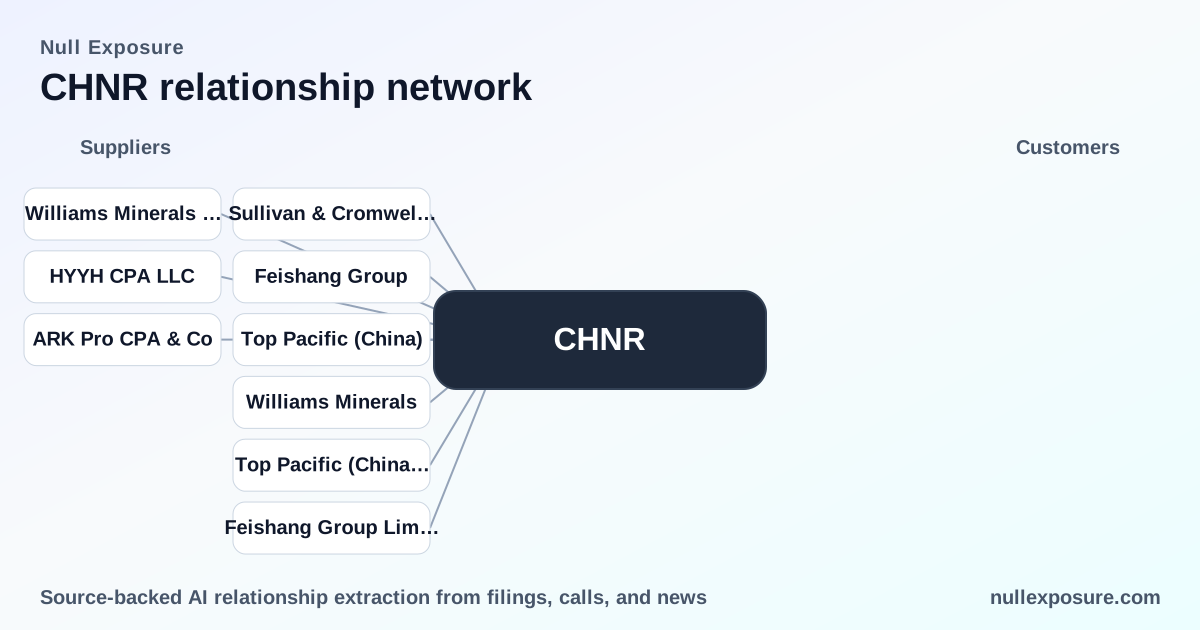
China Natural Resources (CHNR) — supplier relationships and strategic implications
China Natural Resources, Inc. operates as a metals and minerals exploration and extraction company in the People’s Republic of China and monetizes through the sale of mined commodities and strategic asset acquisitions. Revenue is driven by mineral production and the company’s opportunistic acquisitions, most notably its push into lithium via a proposed purchase of a Zimbabwean mine; operating leverage and profitability depend on successful integration of acquisitions, access to capital, and related-party arrangements with controlling shareholders. For a concise supplier-relationship risk view and ongoing monitoring tools, visit https://nullexposure.com/.
How CHNR’s supplier posture shapes its business risks and runway
CHNR’s disclosed supplier signals describe a mixed contracting posture: historical long-term supply guarantees exist in legacy documents, while much of the company’s day‑to‑day purchasing is short-term and local. That combination implies operational flexibility but potential concentration and governance risk where legacy guarantees and related-party sellers intersect with opportunistic asset purchases overseas.
- Contracting: Evidence of a 15‑year supply guarantee in older agreements coexists with statements that many purchases are made locally on cash or short open-account terms payable within 7–30 days. This points to a company that historically ran on a blend of long-term supplier guarantees and short-term procurement for retail/operational needs.
- Geography and counterparty mix: Supplier activity is concentrated in APAC for routine purchases, while strategic acquisitions and seller relationships extend to non‑core jurisdictions (e.g., Zimbabwe), increasing geopolitical and execution risk.
- Spend profile and maturity: Reported historical purchase values put typical supplier spend in the US$100k–$1m band, indicating material but not enterprise-scale procurement per counterparty; however, acquisition transactions increase exposure magnitude and complexity.
- Role diversity: Suppliers and counterparties act as sellers and service providers; the company leases office space historically from government-adjacent entities, signaling legacy operational ties that deserve governance scrutiny.
These points are company-level signals derived from contract excerpts and procurement descriptions in prior filings and releases.
All disclosed supplier and advisor relationships (what the record shows)
Sullivan & Cromwell LLP
Sullivan & Cromwell served as outside counsel for CHNR and its spun-off unit Feishang Anthracite Resources Limited, structuring a spin-off and listing-by-introduction in FY2014. According to a Harvard Law School corporate governance note, Sullivan & Cromwell represented the parent and the spun-off entity during that transaction (FY2014): https://corpgov.law.harvard.edu/2014/03/21/spin-off-and-listing-by-introduction-of-feishang-anthracite-resources-limited/.
Feishang Group / Feishang Group Limited
Feishang Group Limited is the controlling shareholder and a seller-counterparty in CHNR’s proposed Zimbabwe lithium acquisition; public reports state CHNR agreed to acquire the Williams Minerals asset from Feishang for a headline consideration up to $1.75 billion and paid a deposit via promissory notes (FY2023/FY2025). Energy Capital & Power and company press releases document Feishang’s role as seller and controlling shareholder (FY2023–FY2025): https://energycapitalpower.com/china-natural-resources-to-acquire-zimbabwean-lithium-mine-for-1-75b/ and related CHNR filings reported on StockTitan (FY2025).
Top Pacific (China) / Top Pacific (China) Limited
Top Pacific (China) Limited is reported as a co‑seller in the Williams Minerals transaction alongside Feishang Group; CHNR paid a deposit to Top Pacific as part of the acquisition process (FY2023/FY2025). News coverage identifies Top Pacific as a seller in the $1.75 billion transaction (FY2023) and StockTitan references the company in CHNR disclosures (FY2025): https://energycapitalpower.com/china-natural-resources-to-acquire-zimbabwean-lithium-mine-for-1-75b/ and https://www.stocktitan.net/news/CHNR/china-natural-resources-announces-effective-date-of-share-m5y90951k7jm.html.
Williams Minerals / Williams Minerals (Pvt) Ltd
Williams Minerals, including its Zimbabwe affiliate Williams Minerals (Pvt) Ltd, is the asset target for CHNR’s stated acquisition; public statements say the lithium mine will be acquired from Feishang and Top Pacific with CHNR completing due diligence and paying a deposit in 2023 (FY2023/FY2025). Energy Capital & Power and StockTitan detail the acquisition terms and deposit (FY2023–FY2025): https://energycapitalpower.com/china-natural-resources-to-acquire-zimbabwean-lithium-mine-for-1-75b/ and https://www.stocktitan.net/news/CHNR/china-natural-resources-completes-due-diligence-moves-forward-with-a0zh5vqbrt3u.html.
HYYH CPA LLC
CHNR replaced its prior auditor with HYYH CPA LLC as the independent registered public accounting firm for the fiscal year ending December 31, 2025; the change was disclosed in an exchange filing/press release dated January 29, 2026. The Globe and Mail syndication of the press release records HYYH’s appointment (FY2026): https://www.theglobeandmail.com/investing/markets/stocks/CHNR-Q/pressreleases/37331269/china-natural-resources-replaces-ark-pro-with-hyyh-as-auditor-for-2025/.
ARK Pro CPA & Co
ARK Pro CPA & Co was the dismissed auditor; filings note ARK Pro issued unqualified opinions for 2024 before being replaced, and the audit committee approved the change on January 29, 2026 (FY2026). The same Globe and Mail release documents the dismissal contemporaneously with HYYH’s appointment (FY2026): https://www.theglobeandmail.com/investing/markets/stocks/CHNR-Q/pressreleases/37331269/china-natural-resources-replaces-ark-pro-with-hyyh-as-auditor-for-2025/.
What these relationships mean for investors and operators
The supplier/partner record produces four actionable implications:
- Related‑party exposure is material: The controlling shareholder, Feishang Group, is both a seller and an owner; the Zimbabwe acquisition is source‑funded in part through deposits paid to Feishang and affiliated sellers, which creates counterparty concentration and governance risk (FY2023–FY2025 disclosures).
- Execution risk on large acquisitions: The Williams Minerals deal shifts CHNR from regional exploration to owning an African lithium asset; this introduces operational, country‑risk, and integration challenges far beyond the company’s historical APAC supplier footprint (FY2023).
- Audit and control signals: Replacement of ARK Pro with HYYH (PCAOB‑registered) in FY2026 is a significant governance event; investors should treat the auditor change as a prompt to review prior audit quality, restatement risk, and internal control disclosures.
- Procurement scale vs. transaction scale mismatch: Historical supplier spend bands (roughly US$100k–$1m) indicate CHNR ran modest operational procurement; the multi‑hundred‑million to billion‑dollar acquisition trajectory increases capital intensity and counterparty reliance sharply.
For a structured vendor‑risk snapshot and ongoing monitoring of CHNR partner disclosures, explore https://nullexposure.com/ — the platform centralizes supplier, advisor, and related‑party signals for investment diligence.
Practical due diligence checklist for counterparties and buyers
- Verify arm’s-length terms for asset purchases from related parties and obtain full contract economics and post‑closing obligations.
- Confirm completion milestones and cash flows for the Williams Minerals acquisition and the legal status of deposits paid (FY2023 filings).
- Review auditor transition documents, internal control comments, and any audit committee disclosures following the ARK Pro→HYYH change (FY2026).
- Stress test the Zimbabwe asset under conservative commodity and political scenarios and confirm operational control and security arrangements.
Bottom line: concentrated counterparties, elevated execution demands
CHNR’s supplier and partner record combines legacy local procurement with high‑stakes related‑party acquisition activity. That juxtaposition elevates governance and execution risk even as it offers upside if the Zimbabwe lithium asset is integrated successfully and financed prudently. Investors and operators should prioritize verification of related‑party terms, monitor auditor disclosures closely, and reassess capital and operational plans against the company’s modest historical procurement scale. For monitoring tools and deeper supplier relationship intelligence, visit https://nullexposure.com/.