Cheer Holding (CHR): Capital raises, market compliance, and the supplier landscape investors should price in
Cheer Holding, Inc. operates advertising and content production services out of Beijing and monetizes primarily through mobile internet platform services, live-stream advertising, and related e‑commerce promotion arrangements. The company funds operations and working capital through small public offerings and registered direct placements, while investor relations and transfer-agent arrangements support liquidity and corporate actions. For investors evaluating supplier exposure, the critical signals are capital-raising intermediaries, transfer-agent relationships, and the exchange compliance path that affects share fungibility and access to capital.
For a quick operational snapshot or to compare supplier concentration against peers visit the Null Exposure homepage: https://nullexposure.com/
What the transactional activity tells investors about CHR's operating stance
Cheer Holding’s recent public-market behavior shows an active dependence on capital markets intermediaries rather than long-term strategic suppliers. The company executed an $8.5 million best‑efforts public offering and a $15 million registered direct offering in late 2025, both placed by the same boutique placement agent, which indicates a financing posture focused on short-term liquidity through equity issuance. Those raises coincide with a Nasdaq low‑price compliance notice and a share consolidation, which together changed the stock’s float dynamics and investor communications needs.
The firm-level constraints uncovered provide additional context: evidence of short-term convertible financing, distributor relationships in e‑commerce channels, and supplier spend concentrated in the $100k–$10m bands. These characteristics speak to a company that sources advertising and production services on an operationally tactical, rather than multi-year strategic, footing—making supplier disruption and placement-agent continuity higher-consequence events for near‑term performance.
Explore this supplier intelligence in more depth at Null Exposure: https://nullexposure.com/
How the capital-raising and market relationships map to operational risk
- Concentration around a single placement agent for multiple transactions increases execution risk if that intermediary withdraws support or repositions. Univest Securities executed both the $8.5m and $15m financings, functioning as sole placement agent in each case (press releases Oct–Nov 2025).
- Transfer-agent dependence is procedural but critical during corporate actions; Continental Stock Transfer & Trust Company handled investor queries related to the December 2025 share consolidation. That relationship affects shareholder communications, timely record updates, and proxy/transfer logistics.
- Exchange oversight imposes conditional operational constraints. Nasdaq’s low-priced stock notice (Nov 18, 2025) triggered remedial steps including a share consolidation that adjusted trading and tick parameters—an outcome that directly impacts liquidity and the company’s future ability to raise capital on current terms.
Relationship-by-relationship: concise summaries every investor needs
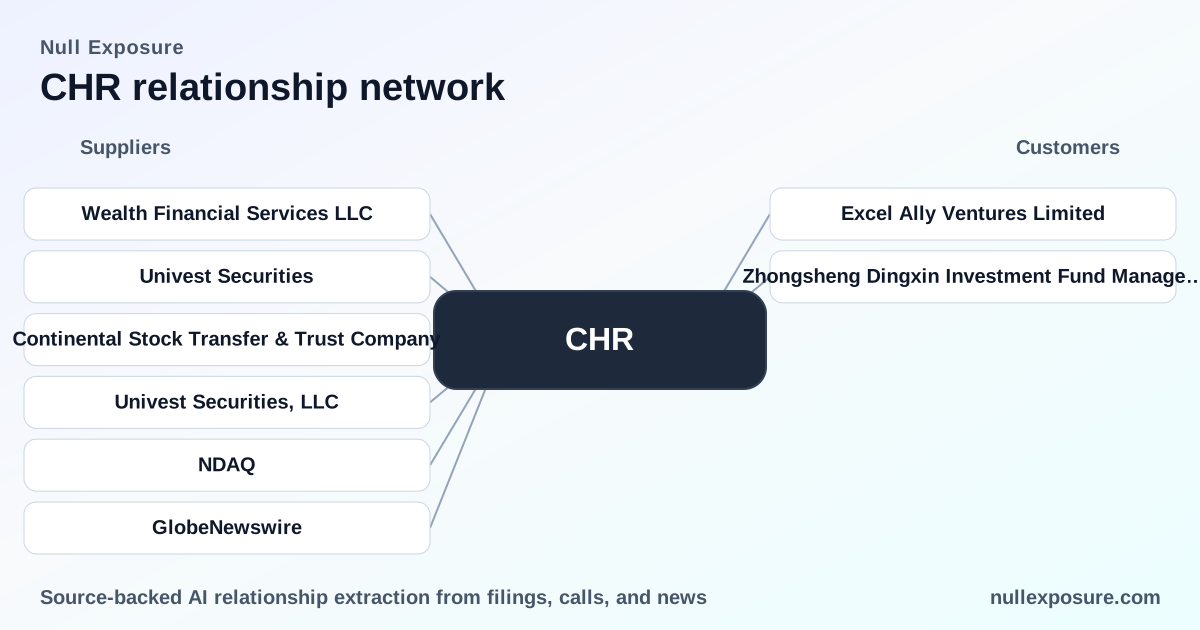
The list below covers every supplier or intermediary referenced in the public results.
Univest Securities, LLC
Univest acted as sole placement agent for Cheer Holding’s public and direct offerings totaling roughly $23.5 million across Oct–Nov 2025, positioning itself as the primary capital markets intermediary for CHR’s 2025 financing wave (GlobeNewswire, Oct–Nov 2025; FinancialContent). This concentration makes Univest a de facto strategic counterparty for near-term equity funding.
Sources: GlobeNewswire announcements of the $15M registered direct (Nov 5, 2025) and the $8.5M public offering (Oct 3, 2025); FinancialContent/Yahoo Finance coverage.
Wealth Financial Services LLC
Wealth Financial Services LLC is listed as the company’s investor and media contact on multiple press releases and coverage of the Nasdaq compliance and share consolidation events in late 2025, indicating its role as the external PR/investor‑relations conduit for China‑facing communications (Futunn; QuiverQuant; ManilaTimes coverage of GlobeNewswire distribution). This relationship shapes how CHR communicates sensitive exchange and financing developments to investors.
Sources: Company press releases and related coverage citing Wealth Financial Services LLC for investor/media inquiries (Dec 2025; Nov 2025).
Continental Stock Transfer & Trust Company
Continental Stock Transfer & Trust Company is the transfer agent for Cheer Holding and was named as the point of contact for shareholder questions about the December 2025 share consolidation, a procedural yet operationally critical role in supporting recordkeeping and corporate action flows. Transfer‑agent functionality directly affects shareholder remedies and administrative timelines during consolidation and corporate actions.
Sources: Company share-consolidation notices and distribution via Futunn/ManilaTimes referencing Continental Stock Transfer & Trust Company (Dec 19, 2025).
The NASDAQ Stock Market LLC (Nasdaq)
Nasdaq issued a notice to Cheer Holding on November 18, 2025, for non‑compliance with the Low Priced Stocks Rule after CHR traded below $0.10 for ten consecutive trading days; the exchange oversight precipitated the company’s consolidation and compliance filings and thus materially affected tradability and short-term capital access. Exchange enforcement here is a direct governance lever that influences CHR’s public‑market mechanics.
Sources: StockTitan and related coverage summarizing the Nasdaq notice and timeline (Nov 18, 2025).
GlobeNewswire
GlobeNewswire distributed multiple official Cheer Holding press releases concerning the offerings, the closing of financings, and the share consolidation between October and December 2025, acting as the company’s primary press distribution channel for market notices. That distribution amplifies investor visibility and anchors the timing of public disclosures.
Sources: GlobeNewswire releases announcing the closings of the $8.5M and $15M offerings and the consolidation details (Oct–Nov 2025).
Company-level constraint signals and what they imply for suppliers and investors
The extracted constraint evidence produces practical operational signals for relationship diligence:
- Short‑term contract posture. The existence of a one‑year convertible note with a conversion floor and time-limited terms signals Cheer Holding favors short-duration financing instruments to bridge liquidity gaps rather than multi-year secured financing. This increases refinancing frequency and dependence on capital markets partners.
- Distributor role in operations. Cheer explicitly references e‑commerce suppliers and distributors participating in its e‑Mall and live‑stream advertising ecosystem, indicating supplier ties are transactional and revenue‑linked rather than long-term vendor partnerships.
- Spend-band dispersion. Historical fee and lease data imply supplier spend predominantly in the $100k–$1m band with some obligations in the $1m–$10m band, consistent with a business that outsources production, rents multiple facilities, and employs episodic marketing spend rather than capital‑intensive supplier contracts.
These signals combine into an operational profile where supplier continuity and placement‑agent stability are high‑impact variables for near-term cash flow and market confidence.
For a comparative supplier-risk scorecard or to map these relationships into procurement exposure, see our analyst portal: https://nullexposure.com/
Bottom line and investor action points
- Capital-raising concentration (Univest) and transfer‑agent dependence (Continental) are the immediate operational levers to monitor. Both affect CHR’s ability to preserve trading status and raise follow‑on capital.
- Exchange compliance events are material operations triggers. Nasdaq’s low‑price notice and subsequent share consolidation changed float and liquidity characteristics—investors should price that into any valuation or short‑term trading thesis.
- Supplier spending is transactional and short-term oriented. Expect continued reliance on placement agents and distributor partners rather than long-term supplier commitments.
If you are modeling CHR exposure or building counterparty limits, consolidate these relationship details into your risk framework and revisit placement‑agent dependency as a top-tier counterparty risk. Learn more about mapping counterparty exposure and supplier concentration at Null Exposure: https://nullexposure.com/