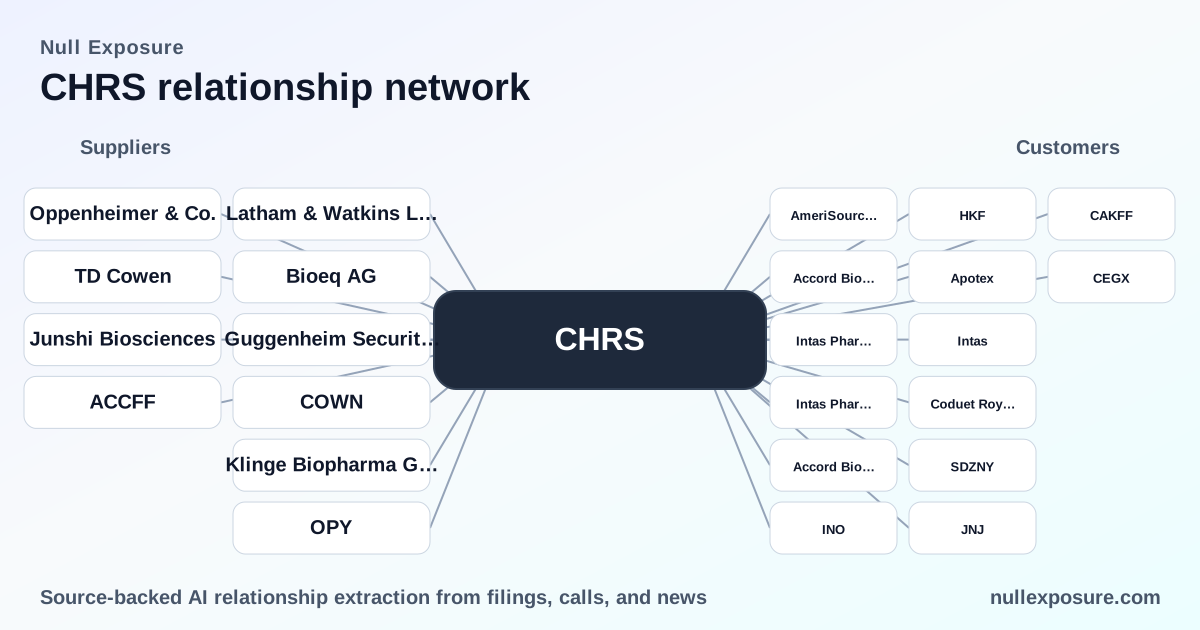
Coherus BioSciences (CHRS): Supplier relationships that shape commercial optionality and operational risk
Thesis: Coherus BioSciences monetizes through commercialization of biosimilars and immuno-oncology assets in the United States, outsourcing manufacturing, clinical operations, and certain commercialization rights while funding growth through capital markets and milestone-driven partner payments. Revenue is concentrated in a small number of commercial products (notably UDENYCA historically) and in-licensing/commercialization deals, while the operating model is dependent on third-party manufacturers, CROs and capital markets to execute scale. Learn more about supplier intelligence at NullExposure: https://nullexposure.com/
Why supplier relationships matter to investors
Coherus operates as a partner-centric commercial biotech rather than an integrated manufacturer. The company outsources critical manufacturing and clinical functions, licenses assets from third parties for U.S. commercialization, and uses investment banks for equity financing. That structure accelerates go-to-market timing and conserves capital, but it concentrates execution risk with external providers. Investors should value upside from successful launches and licensing deals against execution risk tied to CMOs, CROs and capital markets access.
Visit the NullExposure homepage for deeper supplier profiles and alerts: https://nullexposure.com/
The full set of supplier and advisor relationships (one-by-one)
This section lists every relationship surfaced in the results and gives a plain-English investor summary with a source reference.
-
Latham & Watkins LLP — Coherus retained Latham & Watkins as legal counsel in connection with obtaining CFIUS clearance on a transaction in FY2025, reflecting the company’s use of large external law firms for regulatory and transaction work. (Source: Latham & Watkins news item, FY2025.)
-
Bioeq AG — Coherus licensed CIMERLI (ranibizumab) from Bioeq AG, a joint venture between Polpharma Biologics and Formycon, representing a product-license relationship that expands Coherus’s ophthalmology footprint and revenue base. (Source: GlobeNewswire release, October 2023.)
-
Klinge Biopharma GmbH — Coherus executed a binding term sheet to acquire exclusive U.S. commercial rights to FYB203 (an Eylea biosimilar), reinforcing the company’s strategy of securing U.S. commercialization rights to third-party-developed biosimilars. (Source: GlobeNewswire release, January 9, 2023.)
-
TD Cowen — TD Cowen acted as a joint bookrunner for a proposed public offering in FY2026, indicating Coherus’s reliance on sell-side syndicates for equity financing and market access. (Source: StockTitan news report on the proposed offering, FY2026.)
-
Guggenheim Securities — Guggenheim served as a joint bookrunner on the same FY2026 offering and priced follow-on transactions, highlighting repeated engagement with mid-market investment banks for capital raises. (Source: StockTitan and GlobeNewswire pricing release, FY2026.)
-
Oppenheimer & Co. — Oppenheimer participated as a joint bookrunner on Coherus Oncology’s FY2026 equity offering, demonstrating diversified placement with multiple underwriters to distribute new shares. (Source: StockTitan and GlobeNewswire pricing release, FY2026.)
-
Junshi Biosciences — Coherus recorded a milestone payment to Junshi Biosciences in Q1 2025, signaling active milestone-based external collaborations in the company’s pipeline development and revenue recognition cadence. (Source: Coherus Q1 2025 financial results press release, May 12, 2025.)
-
Accord (Intas designation) — In FY2024 filings Coherus disclosed that Intas designated Accord to purchase physical assets, including product inventory, under a transaction structure described in the 10‑K; this indicates inventory disposition or supply reallocation through established pharmaceutical distributors or purchasers. (Source: Coherus 2024 Form 10‑K, FY2024.)
What the supplier mix signals about operating posture and maturity
The relationship set and filing excerpts produce a consistent portrait of Coherus’s operating model:
-
Contracting posture: Coherus operates with an outsourcing-first posture — the company relies on CMOs for commercial and clinical manufacturing, CROs for trials, and third-party partners for licensing and commercialization. This reduces fixed capital intensity but increases dependency on external performance and contract terms. (Company filings and disclosures.)
-
Concentration and criticality: The company disclosed that a single third‑party labeling and packaging CMO interruption removed its ability to sell UDENYCA for a material period, describing that product as a large percentage of total revenue. That admission classifies certain suppliers as critical to near-term revenue and therefore material to valuation and downside risk. (Company 2024 disclosure on CMO delays.)
-
Spend and scale signals: Prepayments to CMOs were reported in the $1–10 million band (prepaid manufacturing of $11.6 million, including $5.3 million to CMOs), showing material but not outsized supplier spend relative to commercial peers, and implying manageable single‑relationship spend levels but meaningful working capital reliance. (Coherus FY2024 disclosures.)
-
Maturity and capability gap: Coherus explicitly lacks internal commercial-scale manufacturing capability and relies on CROs/CMOs for clinical and commercial supply, which is a structural constraint on direct control of production and timing and increases the bargaining leverage of manufacturing partners. (Company 10‑K excerpts.)
-
Capital-market dependence: Repeated use of joint bookrunners (TD Cowen, Guggenheim, Oppenheimer) for FY2026 offerings indicates recurring equity financing as a core element of the corporate funding plan, making investment-banking relationships strategically important for liquidity and dilution management. (GlobeNewswire and market reports, FY2026.)
Investment implications — what to watch next
-
Operational risk is concentrated: any future CMO disruption can meaningfully reduce product revenues; underwriters and legal counsel help manage capital and deal execution but do not hedge production risk. Monitor CMO capacity, contingency plans and insurances.
-
Licensing lifts optionality: the Klinge and Bioeq relationships expand the commercial product pipeline and diversify revenue streams away from legacy UDENYCA exposure. Track regulatory milestones and launch timing for FYB203 and CIMERLI.
-
Funding cadence matters: the FY2026 underwriting syndicate activity shows active capital raises; model potential dilution and the impact on runway if milestones or launches slip.
For more detailed supplier risk scoring and alerting on CMOs and underwriters, go to https://nullexposure.com/ — the platform centralizes supplier signals, filings and news for institutional users.
Bottom line and recommended monitoring
Coherus’s business model is commercial upside paired with operational concentration. Licensing deals and milestone receipts create upside, but the company’s outsized reliance on third-party manufacturers and ongoing equity raises are persistent risk vectors. Investors should prioritize monitoring: (1) CMO performance and backup capacity, (2) regulatory progress and launch timing for licensed biosimilars, and (3) upcoming financing terms from bookrunners to understand dilution and runway.
If you evaluate or operate supplier relationships, NullExposure consolidates these signals and helps translate them into investor-grade risk actions — see https://nullexposure.com/ for subscriptions and reports.