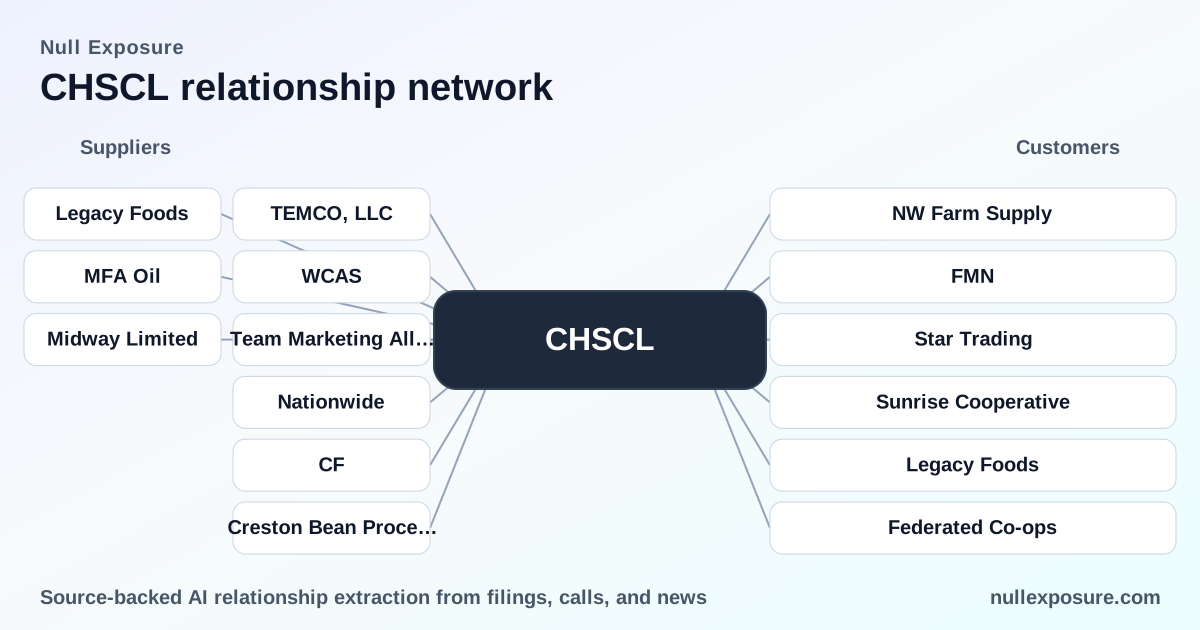
CHSCL supplier relationships: what investors and operators should take from CHS’s procurement footprint
CHS Inc. monetizes an integrated agricultural platform by buying, processing and reselling grain, food and energy products and by operating joint ventures and processing assets that capture margin across the value chain. The company’s commercial model is a mix of trading, long‑term supply commitments, and localized service relationships with producers and cooperatives; that structure produces large topline scale (Revenue TTM: $35.03B) and thin but positive operating margins (1.37% operating margin, 1.75% profit margin). For investment and operational due diligence, supplier relationships matter because they reveal CHS’s contracting posture, exposure to regional feedstocks and the mix of owned versus partner assets. Learn more about how we track supplier footprints at the CHS level: https://nullexposure.com/.
The operating posture investors should internalize
CHS runs a hybrid procurement model: it is a buyer in commodity markets and a service provider to local agriculture networks. Company filings document multi‑decade supply commitments that lock in volumes for fertilizer and other inputs, as well as a persistent dependence on North American feedstock for refining operations. The implication for investors is twofold: revenue stability through contracted volumes and concentration risks tied to regional sourcing and cooperative customers. The 10‑K and public releases show CHS both acquires local cooperatives and enters joint ventures to expand logistics and export capacity, which supports growth but increases integration complexity.
Disclosed supplier and partner relationships — what each means
Below are the relationships disclosed in CHS materials and news mentions, with a concise plain‑English take and the source context.
TEMCO, LLC
CHS purchases and sells grain and other agricultural commodity products with TEMCO as an equity investee partner, indicating TEMCO functions as both a supplier and a market counterparty within CHS’s grain flows. This relationship is documented in CHS’s 10‑K for fiscal 2025 (filed August 2025).
WCAS
On January 2, 2025 CHS completed the acquisition of WCAS, a cooperative in Ulen, Minnesota, expanding CHS’s regional grain and agronomy services footprint in west‑central Minnesota and internalizing previously external supply/service flows. The transaction is described in the CHS 10‑K (FY2025).
Team Marketing Alliance / Producer Ag (Sumner County facility)
CHS operates Producer Ag as an LLC jointly owned with MKC and has Producer Ag participate in Team Marketing Alliance for grain marketing services, showing CHS uses joint ventures and industry marketing consortia for regional terminal operations. This detail was reported by SumnerNewscow regarding a Milan grain terminal project (news item, FY2016).
Nationwide (insurance partnership)
CHS provides farm and ranch insurance in partnership with Nationwide, indicating CHS leverages third‑party insurers to offer financial and risk‑management services to its cooperative customer base. The relationship was noted in Insurance Journal coverage of CHS’s insurance offerings (FY2018).
CF Industries
CHS has a public partnership with CF Industries to accelerate production and distribution of low‑carbon nitrogen fertilizer, reflecting a strategic supply and sustainability collaboration on fertilizer sourcing and distribution. CHS’s announcement and commentary are available on CHS’s corporate site (news release, FY2023).
Creston Bean Processing
CHS acquired the Creston processing facility from Creston Bean Processing in 2011, and the facility’s later closure was reported as part of CHS’s network rationalization; this shows CHS’s active portfolio management of processing assets. Food Business News reported the facility history and closure actions (FY2017).
Legacy Foods (Hutchinson facility)
CHS acquired the Hutchinson facility from Legacy Foods in April 2008, an acquisition that fed CHS’s processing and local supply operations and is discussed in coverage of facility changes. Food Business News covered the acquisition context and subsequent operational decisions (FY2017).
MFA Oil
CHS executed a staged buy‑out of MFA Oil with an incremental purchase schedule concluding in 2015, illustrating CHS’s strategy of rolling acquisitions of regional oil and fuel distributors to consolidate downstream distribution. This was described in local press coverage and CHS communications (Columbia Tribune, FY2012).
Midway Limited (land sale / export terminal)
A land sale agreement between CHS Broadbent (a CHS/Broadbent JV) and Midway Limited supported plans to develop an 80,000 MT bulk grain export terminal near Geelong, Australia, demonstrating CHS’s active pursuit of export logistics through joint ventures and land deals. CHS’s own news release discussed the development and sale agreement (CHS news, FY2023).
What the disclosed constraints and operating signals tell investors
Company filings and evidence produce several clear, company‑level signals about how CHS runs procurement and supplier relationships:
- Long‑term contracting posture is baked into the model. CHS documents include explicit long‑term supply agreements for fertilizer volumes that extend decades, which anchors procurement volumes and supports revenue predictability. For example, the 10‑K references a supply arrangement that entitles CHS to purchase large annual volumes through fiscal 2096 (company 10‑K excerpts).
- CHS acts primarily as a buyer across categories. Filings describe CHS buying refined petroleum products when needed and generally sourcing commodities from individual producers and cooperatives, which positions CHS as a principal buyer and risk manager for commodity inputs (10‑K language).
- Geographic concentration in North America for critical feedstocks. CHS’s Laurel refinery sources roughly 96% of its crude from Canada, signaling regional sourcing concentration that translates into geopolitical and logistics exposure (10‑K excerpt).
- Counterparty mix skews toward individual producers and local cooperatives. The company explicitly purchases from individual agricultural producers and local co‑ops, making the supplier base broad but operationally fragmented—this reduces single‑vendor risk but raises operational complexity.
- Spend and balance sheet posture imply material recurring obligations. Purchase obligations and finance lease disclosures indicate multi‑million dollar commitments at scale, consistent with the company’s reported purchase obligations figures in the filings.
Collectively, these signals point to stable contracted flows plus operational concentration risks tied to regional feedstocks and JV land/terminal investments. That combination supports consistent revenue but elevates exposure to commodity cycles and localized logistical disruptions.
If you are evaluating CHS as a counterparty or supplier, use our portal for deeper relationship mapping and exposure scoring: https://nullexposure.com/.
Investment and operational implications — what to watch next
- Monitor CF Industry partnerships and long‑dated fertilizer commitments for margin pressure or advantage as fertilizer pricing and regulatory regimes evolve. Long contracts protect volumes but lock cost exposure.
- Watch North American crude sourcing and export terminal developments for logistic risk and capacity leverage; logistics investments (terminals, JVs) directly change CHS’s bargaining power with farmers and global buyers.
- Track integration outcomes from acquisitions like WCAS for execution risk and local margin improvement; acquisitions convert supplier relationships into internal flows but require operational harmonization.
For a structured supplier risk assessment and to map CHS relationships across counterparties, joint ventures and terminals, visit our platform: https://nullexposure.com/.
Final takeaway: CHS’s supplier footprint is deliberately hybrid—anchored by long‑term supply contracts and strengthened through acquisitions and joint ventures—which delivers scale and revenue stability while concentrating certain logistical and regional sourcing risks that investors and operators must actively monitor.