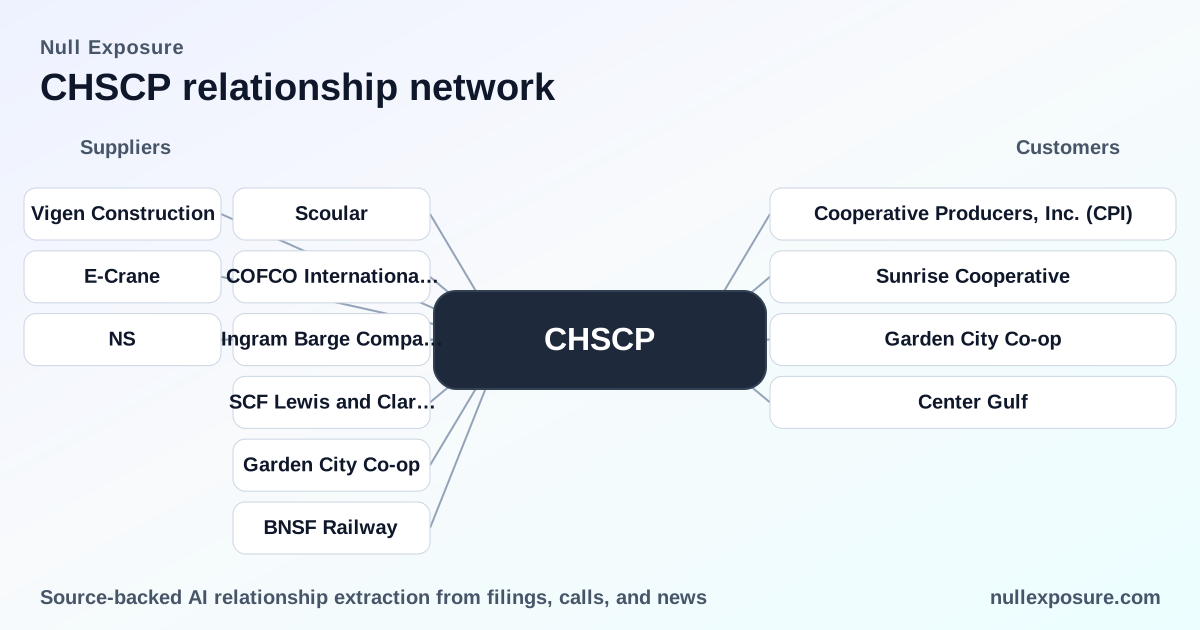
CHSCP (CHS Inc CP Pref) — partner map and operational constraints investors should price in
CHS Inc. operates as an integrated, farmer‑owned agribusiness that monetizes through grain origination, commodity merchandising, fertilizer and energy distribution, and logistics services, capturing margin across physical flows and associated transport. The company combines long-term supply commitments, structured receivables financing and short-term commodity purchases to manage working capital and secure feedstocks — an operating model that rewards scale in logistics and volume contracts while exposing investors to counterparty and infrastructure execution risk. For a concise vendor-relationship view and risk-first diligence, visit https://nullexposure.com/.
How CHS turns agricultural flow into steady cash returns
CHS captures revenue both as a commodity merchant and a logistics operator: it sources grain and inputs from cooperatives and producers, markets and transports product domestically and internationally, and sells refined fuel and fertilizer products to downstream customers. Profitability hinges on volume throughput, transport access (rail, barge, terminal capacity) and the ability to lock input costs via long-term purchase agreements or structured financing. Recent public filings show mid-single-digit operating margins on a multibillion-dollar revenue base, underscoring a low-margin, high-volume playbook.
Supplier and partner relationships you need to know (complete list)
Below is a concise, plain‑English rundown of every partner relationship captured in public reporting and news items tied to CHS's supplier footprint.
-
Scoular — CHS agreed to purchase the Scoular grain facility in Holdrege, Nebraska, expanding its origination footprint and storage capacity in the Plains. According to CHS’s Aug. 14, 2025 press release, the transaction increases CHS’s physical grain handling network (FY2025). Source: CHS press release (2025-08-14).
-
COFCO International Ltd. (lease) — CHS is leasing a grain terminal from COFCO near St. Louis rather than buying it, securing operating control without capital ownership. Brownfield Ag News reported the lease arrangement in FY2026 that positions CHS to run throughput operations while COFCO retains ownership (FY2026). Source: Brownfield Ag News (article on COFCO lease).
-
COFCO International Ltd. (operations in Cahokia) — CHS will assume operations of a COFCO‑owned grain facility in Cahokia, Illinois, effective Jan. 31, 2026, expanding CHS’s center‑Gulf supply chain presence and export capability. Reported by Heartland Producer Journal in Jan. 2026 and reflected in CHS communications (FY2026). Source: HPJ / CHS coverage (Jan. 2026).
-
Ingram Barge Company — CHS secured exclusive fertilizer throughput and transport services rights at Ingram’s Municipal River Terminal in St. Louis through an agreement, ensuring prioritized river access for fertilizer volumes. CHS’s Jan. 3, 2025 announcement describes the exclusive throughput and transport arrangement (FY2025). Source: CHS press release (2025-01-03).
-
SCF Lewis and Clark Terminals LLC — Through Ingram’s subsidiary SCF Lewis and Clark Terminals LLC CHS gained exclusive fertilizer throughput at the Municipal River Terminal, reinforcing barge logistics control for key fertilizer flows. CHS’s Jan. 3, 2025 release details the subsidiary-level agreement (FY2025). Source: CHS press release (2025-01-03).
-
Garden City Co‑op — CHS and Garden City Co‑op formalized a partnership where CHS leads marketing and transportation logistics on grain CHS purchases from Garden City, intending to grow joint grain volumes and marketing reach. CHS described the marketing and logistics role in a June 18, 2025 partnership announcement (FY2025). Source: CHS press release (2025-06-18).
-
BNSF Railway — The Garden City terminal is served by BNSF, and CHS is identified as one of BNSF’s largest freight customers, reflecting high dependence on Class I rail for inland movement. CHS noted BNSF service and its customer status in the June 2025 terminal coverage piece (FY2025). Source: CHS press release (2025-06-18).
-
Vigen Construction — Vigen Construction is the contractor overseeing construction of a CHS grain facility in northwestern Minnesota, indicating CHS’s continued capital investment in terminal infrastructure and local contractor reliance. Local reporting on the project cited Vigen as the general contractor (FY2022). Source: KNSI Radio (2022-06-14).
-
E‑Crane — CHS installed a permanent E‑Crane at its Myrtle Grove, Louisiana terminal as part of modernization to speed grain exports; this is the first permanent E‑Crane dedicated exclusively to U.S. grain export at that facility. CHS documented the equipment installation and terminal upgrade on May 6, 2025 (FY2025). Source: CHS press release (2025-05-06).
-
Nustar (terminals for E15) — CHS plans to offer higher‑blend ethanol (E15) at multiple Nustar terminals across the central U.S., expanding CHS’s retail fuel proposition into higher‑ethanol products. CHS disclosed the terminal access initiative in a corporate announcement dated March 29, 2021 (FY2021). Source: CHS press release (2021-03-29).
Contracting posture and financial constraints — what investors should read into them
CHS combines long-term, framework and short-term contracting in ways that influence counterparty and liquidity risk.
-
Long-term supply commitments are material and extremely long‑dated. CHS’s investment in CF Nitrogen carries a supply agreement that entitles CHS to purchase up to 1.1 million tons of granular urea and 580,000 tons of UAN annually through fiscal 2096, reflecting a multi‑decade feedstock security posture and very long contract maturity (evidence in company disclosures).
-
Structured funding via receivables securitization underpins working capital. CHS operates a Securitization Facility with a committed portion of $850 million and an uncommitted portion of $250 million, showing reliance on receivable sales to maintain liquidity and finance seasonal cycles (company filing excerpt).
-
Operational flexibility through short‑term sourcing exists for energy products. CHS supplements refinery output with third‑party refined petroleum purchases “as the need arises,” indicating tactical short-term procurement layered on top of its longer contracts.
-
Role mix skews buyer and commercial manager. CHS is a principal buyer of fertilizer and grain (high confidence) and uses its FCM and derivative instruments as service providers to manage commodity risk (service provider signal).
Taken together, these constraints point to an operating model that is capital‑intensive, logistics‑dependent, and hedged through contractual volume certainty and receivables financing.
Visit https://nullexposure.com/ for deeper vendor exposure analysis that translates these signals into counterparty risk scores.
Investment implications — what to watch and how to price risk
-
Operational criticality is high. Exclusive throughput agreements and terminal leases/operations materially reduce logistics bottlenecks and support volume stability — a positive for volume-driven margins. However, dependency on rail and barge partners (BNSF, Ingram) concentrates execution risk.
-
Counterparty and contract tenor risk are real. The CF Nitrogen long-term supply position locks volumes far into the future, which protects feedstock availability but increases exposure to structural commodity and regulatory shifts over decades.
-
Liquidity management deserves attention. The securitization facility’s committed capacity is meaningful but not infinite; stress scenarios in agricultural downturns could pressure receivables and the availability of creditor funding.
-
CapEx and contractor execution matter. Investments in terminal upgrades (E‑Crane, new facilities) and reliance on contractors like Vigen affect throughput ramp timelines and cost control.
Next steps for investors
- For modelers: stress test CHS cashflows under adverse rail/barge outages and tighter securitization availability.
- For operators and procurement teams: prioritize due diligence on terminal operating agreements and exclusive throughput clauses — these are value drivers.
- For governance: monitor long-dated supply agreements for embedded price adjustment mechanisms and regulatory exposure.
Deepen your counterparty diligence and see how these relationships map to supplier risk at https://nullexposure.com/. For tailored supplier exposure reports and operator-level playbooks, start at https://nullexposure.com/ — analysts and portfolio managers will find immediate, actionable value.