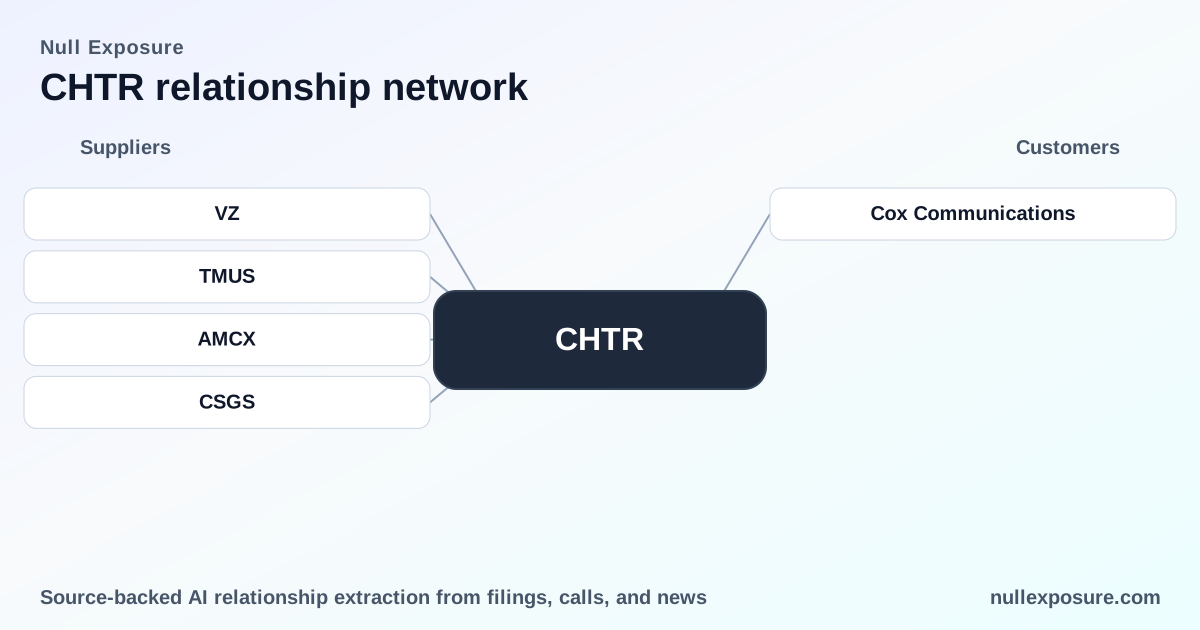
Charter Communications (CHTR): supplier map and what investors should price in
Charter Communications runs a high-margin broadband and video distribution business under the Spectrum brand and monetizes primarily through recurring monthly services, carriage and content licensing, and wholesale mobile reselling. The company functions as a large-scale buyer of programming and services, a reseller of mobile connectivity through MVNO arrangements, and a platform that bundles third-party streaming content into its video package to drive subscriber retention and modest video growth. For investors and operators evaluating supplier relationships, the relevant read is simple: Charter extracts distribution economics while carrying material variable and contract-driven supplier costs that influence margin sensitivity and capital allocation.
If you want a concise supplier intelligence briefing, visit https://nullexposure.com/ for a deeper supplier network view.
How Charter structures supplier relationships in practice
Charter's operating model reflects an asset-light distribution posture: it licenses content, resells third-party network capacity to serve mobile customers, and contracts out specialized services. Licensing relationships create a large, variable cost base that scales with subscribers, and reselling agreements convert network capacity into recurring revenue streams without the capital intensity of owning wireless infrastructure. The company also implements supplier financing mechanics and outsources specialized functions like cybersecurity assessments.
- Contracting posture: Charter acts primarily as a buyer of content and services under written contracts; licensing fees are typically tied to customer counts, giving suppliers revenue visibility but exposing Charter to variable programming expense.
- Spend concentration and scale: Multiple data points point to supplier spend in the >$100 million band, indicating both bargaining leverage and exposure to a small set of large vendors.
- Criticality and maturity: Core relationships (content licensors, billing/service providers, wireless resellers) are strategic and long-tenured; extensions and renewals are treated as material to operating results.
- Commercial mechanics: The company runs a supply-chain finance program and has extended vendor payment terms, which improves working capital but concentrates counterparty and financing risks.
Supplier relationships: what the public record shows
Below I cover every supplier relationship surfaced in public reporting and media mentions in the review window. Each entry is a plain-English summary with a source pointer.
Verizon — strategic mobile reselling partner
Charter maintains a structural and strategic mobile reselling agreement with Verizon that underpins Charter’s mobile product offering and ensures its MVNO customers ride on Verizon’s network infrastructure. According to Charter’s 2025 Q4 earnings call, that mobile reselling arrangement is treated as a long-term strategic partnership; separate reporting also noted Verizon renewed MVNO arrangements covering Charter (and Comcast) in the FY2026 period. (Source: Charter 2025 Q4 earnings call; corroborating FY2026 coverage in industry reporting.)
T‑Mobile — expanding MVNO for business customers
Charter announced it will launch an additional MVNO focused on business customers with T‑Mobile within six months, extending its multi-carrier reselling strategy to capture enterprise wireless revenue without building network assets. (Source: Charter 2025 Q4 earnings call.)
AMC Networks — bundled streaming content driving video activation
Charter has bundled the ad-supported version of AMC+ into Spectrum TV, and over 1.1 million Spectrum TV customers have activated the service since launch—an example of Charter using third-party streaming content as a retention and up-sell lever that contributed to net video subscriber growth for the first time in nearly six years. (Source: AMC Networks FY2026 reports and related press coverage reporting activation metrics and bundling strategy.)
CSG Systems International — core billing and services vendor with material revenue exposure
CSG Systems extended a core services agreement with Charter, and Charter was a material customer for CSG—representing roughly 19% of CSG’s revenue in a recent quarter—highlighting the criticality of billing/OSS providers to Spectrum’s customer operations. (Source: CSG-related FY2026 filings and news summaries citing contribution percentages and contract extension.)
What these relationships mean for investors and operators
Charter’s supplier map yields several actionable implications for valuation and operational oversight:
- Earnings sensitivity to programming and MVNO economics: Because licensing is often priced per-subscriber, programming expenses scale with customer counts and directly compress margins when bundled content is offered at no incremental price to customers. That dynamic explains the strong focus on subscriber economics when assessing content deals.
- Diversified reselling strategy reduces single-network dependency but increases commercial complexity: Operating MVNO agreements with both Verizon and T‑Mobile spreads network risk and improves negotiating leverage, but requires investment in product integration and sales channels. The Verizon renewal signals stability on one leg of that strategy.
- Vendor concentration is a counterparty risk: Large vendors such as CSG account for material portions of supplier revenue in their own filings; operational outages or contract disputes with these vendors would have outsized effects on Charter’s customer billing and service delivery.
- Working capital mechanics alter supplier economics: Charter’s use of a supply-chain finance program and extended payment terms is a deliberate lever to optimize cash flow, but it transfers credit exposure to participating financial institutions and can create stress points under tighter market liquidity.
If you want to cross-check contract types and spend bands against Charter’s supplier footprint, browse more supplier-level intelligence at https://nullexposure.com/.
Risk checklist for supplier exposure
Consider these high-priority risk items when modeling Charter or negotiating with the company:
- Programming cost inflation due to per-subscriber licensing formulas.
- Operational concentration in billing/service vendors that handle customer care and revenue management.
- Commercial renewal risk for MVNO agreements, which are strategic revenue conduits and affect gross adds/ARPU.
- Financing and counterparty risk introduced by supply-chain finance programs and extended payment terms.
Bottom line and recommended next steps
Charter leverages third-party content and network partnerships to grow and retain subscribers while keeping capital intensity relatively low. The investment thesis should weigh stable distribution economics against variable supplier costs and concentrated vendor dependencies. For operator negotiations, emphasize SLAs and contingency plans with billing and content partners; for investors, stress-test margins under higher licensing rates and rolling MVNO renewals.
Explore a full supplier risk map and model-ready exposures at https://nullexposure.com/ — it’s the fastest way to turn the supplier narrative into actionable investment signals.