Chewy (CHWY): Supplier relationships that drive scale — and concentration risk
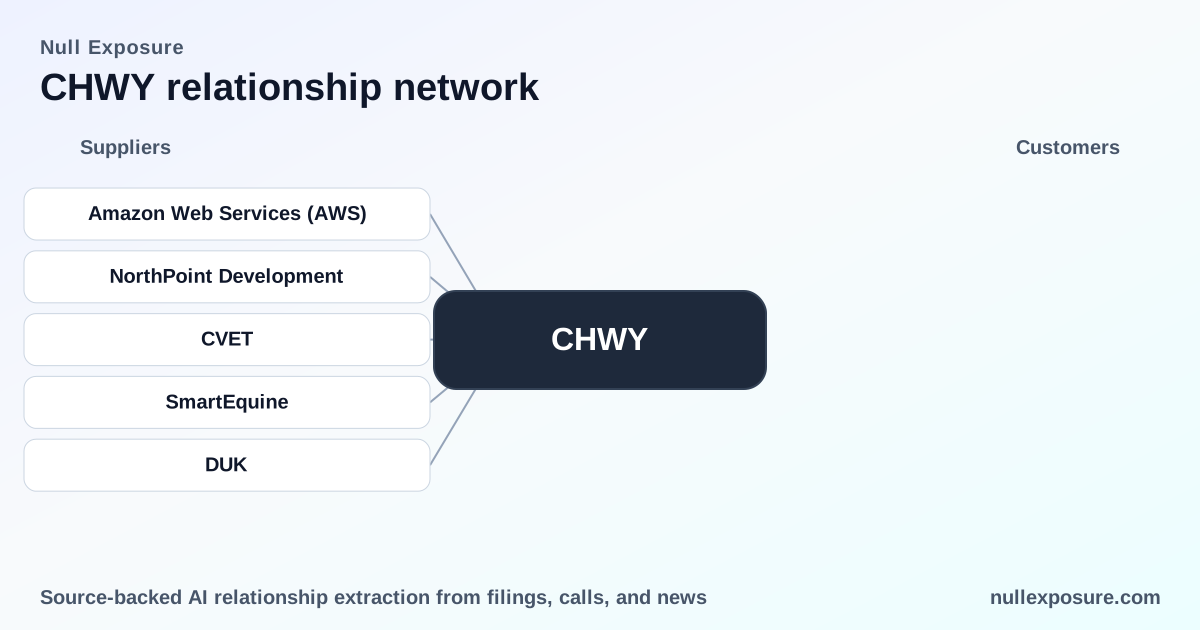
Chewy operates as a U.S.-focused pure-play e-commerce retailer for pet products, generating revenue through online merchandise sales and private‑brand assortments across a broad set of categories; its economics are driven by repeat purchase behavior, fulfillment scale, and control of private-label supply chains. For investors evaluating counterparty risk and operators assessing continuity plans, the supplier profile reveals a mix of large cloud and infrastructure providers, real‑estate and development partners, and acquisitive moves into specialty suppliers — a structure that delivers operational scale but concentrates key risks.
Explore a structured supplier view and model implications at https://nullexposure.com/.
The short list — who Chewy contracts with and why it matters
Below are the supplier relationships identified in public filings and press coverage. Each entry is a plain-English summary with the original source noted.
Amazon Web Services (AWS) — cloud infrastructure backbone
Chewy relies on third‑party cloud service providers, including Amazon Web Services, to run portions of its online commerce and operational systems, making AWS a critical technology provider for Chewy’s platform operations. This reliance is documented in Chewy’s FY2025 Form 10‑K.
Source: According to the company’s FY2025 10‑K filing.
NorthPoint Development — fulfillment center developer and builder
NorthPoint Development has built multiple fulfillment centers for Chewy, partnering on the physical logistics footprint that supports rapid delivery and scale of operations. This relationship surfaced in coverage of Chewy’s fulfillment center expansion.
Source: BusinessFacilities coverage of Chewy’s fulfillment center decision (2019).
Covetrus, Inc. (CVET) — M&A counterparty on specialty products
Chewy entered into a definitive agreement to acquire SmartEquine from Covetrus, indicating strategic supplier-to-own transformation as Chewy internalizes specialty pet‑care inventory and expertise. The transaction was reported in market overviews in FY2025.
Source: StockTitan overview reporting on FY2025 acquisition activity.
SmartEquine (former SmartPak Equine) — specialty product supplier turned acquisition target
SmartEquine, previously known as SmartPak Equine, is the specialty equine business that Chewy agreed to buy from Covetrus, bringing a niche supplier and brand into Chewy’s ownership to bolster specialty catalog and margin profile.
Source: StockTitan overview reporting on FY2025 acquisition activity.
Duke Energy — project funding partner for fulfillment infrastructure
Duke Energy provided project funding through its Carolinas Investment Fund in connection with Chewy’s fulfillment center development, demonstrating energy and financing partners are part of the capital stack for large logistics projects. This funding was noted in press coverage of the facility build.
Source: BusinessFacilities coverage of Chewy’s 2019 fulfillment center and related funding.
What the supplier list says about Chewy’s operating model and constraints
Chewy’s publicly disclosed supplier language and press coverage create a coherent signal about contracting posture, concentration, criticality, and maturity:
-
Contracting posture — long‑term property and service commitments. The company reports significant operating and real‑estate lease obligations (legally binding minimum lease payments of $850.8 million as of February 2, 2025), indicating multi‑year capacity commitments that lock in logistics footprint and fixed cost exposure. This shows a preference for scale via owned/leased fulfillment infrastructure and large‑vendor service contracts rather than purely variable spend.
-
Concentration — materially concentrated vendor spend. Chewy reports that products from its three largest vendors represented approximately 39% of net sales in each of FY2022–FY2024, a persistent concentration that creates vendor negotiation leverage but also single‑counterparty disruption risk for procurement and margins.
-
Supply geography and sourcing risk — dual footprints. The company leases properties across North America to support operations while simultaneously relying on suppliers located in China for private‑brand manufacturing and assembly — a two‑geography sourcing profile that combines domestic logistics scale with overseas manufacturing dependence.
-
Role diversity — service provider to manufacturer to buyer. Public excerpts describe Chewy engaging third‑party assessors for information security, outsourcing manufacturing for private brands, and operating fulfillment centers that receive vendor product and handle returns — indicating a complex supplier universe spanning professional services, manufacturing partners, and real‑estate/development firms.
-
Spend maturity and scale — large capital and operating commitments. The scale of lease obligations and project funding relationships point to mature, capital‑intensive operations where supplier continuity is mission critical and replacement lead times are long.
None of these company‑level constraints is isolated to a single named supplier in the filing language; they are structural signals about Chewy’s supply and contracting environment.
Explore supplier risk profiles and supplier-backed infrastructure analysis at https://nullexposure.com/.
Investor and operator implications — where to focus diligence
-
Concentration is the headline risk. With the top three vendors representing roughly 39% of net sales each year, a disruption or pricing shock at those suppliers would transmit directly to revenue and gross margin. Active contract terms, diversification plans, and contingency sourcing should be a primary focus in due diligence.
-
Cloud dependency is operationally critical. Reliance on AWS and similar providers places availability, security, and cost risk squarely in third‑party cloud contracts and SLAs; investors should scrutinize uptime history, disaster recovery, and contract termination clauses.
-
Manufacturing and private brands are exposed to APAC cycles. A significant portion of private‑brand manufacturing is located in China; procurement resilience requires multi‑tier supplier mapping, alternative sourcing and inventory buffers to mitigate geopolitical or logistics shocks.
-
Real estate and capital partners matter for scale economics. The combination of substantial lease obligations and project funding (e.g., Duke Energy’s Carolinas Investment Fund involvement and NorthPoint’s development role) means capital structure and landlord/developer relationships impact capacity growth plans and breakeven economics.
Key takeaways for risk-managed exposure
- Concentration of suppliers equals concentrated operational risk. Top‑vendor dependence requires active contract negotiations, inventory strategy, and scenario planning.
- Infrastructure partnerships (AWS, NorthPoint, Duke) are strategic and critical. These are not replaceable overnight and deserve operator‑level contingency planning.
- Acquisitions of specialty suppliers (SmartEquine via Covetrus) are used to internalize capability and reduce external dependency, but they create integration risk and new supplier roles.
If you need a deeper counterparty map or to model supplier disruption scenarios for CHWY, start with the company filing disclosures and partner announcements at https://nullexposure.com/.
Next steps for analysts and operators
For investors: prioritize supplier concentration stress testing and cloud‑service SLA reviews in your investment memo. For operators: codify alternate sourcing for private brands and ensure fulfillment‑to‑vendor order visibility across leased sites.
Learn how supplier intelligence improves underwriting and operational resilience at https://nullexposure.com/.