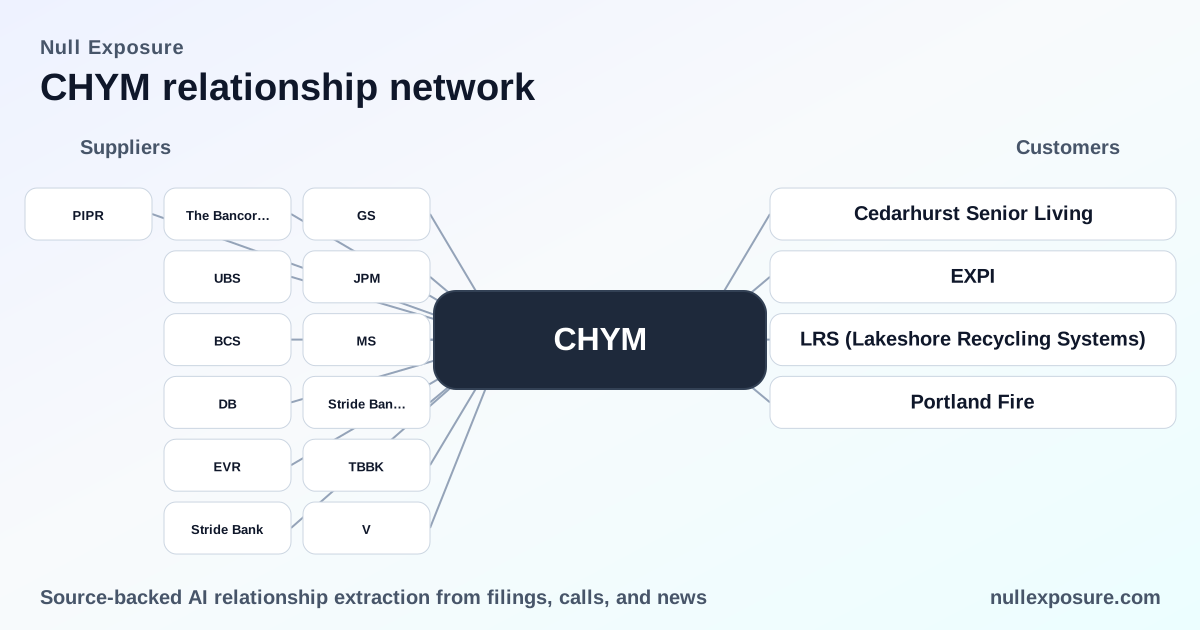
Chime (CHYM) — Partner map and commercial footprint investors need to know
Chime Financial operates as a mobile-first consumer bank and payments platform that sells branded banking and card products while outsourcing deposit-taking and card issuance to regulated partners. The company monetizes through its consumer banking and payment services — including card programs and credit products — and scales via distribution and brand-led customer acquisition. Its business model depends on a small set of bank and network partners for core banking functions and an institutional underwriting ecosystem when accessing capital markets.
If you want a concise, transaction-level view of CHYM’s supplier relationships and what they imply for commercial risk, start here and then explore deeper at https://nullexposure.com/.
Quick takeaways investors should put on the desk
- Core banking is outsourced. Chime relies on FDIC-insured partner banks to hold customer deposits and process transactions, which keeps Chime asset-light but creates counterparty concentration risk.
- Card network dependency is material. Visa’s licensing for Chime-branded cards is central to Chime’s payments revenue stream.
- Capital markets access is institutional-grade. A heavyweight underwriting syndicate underpins Chime’s market access during the IPO process, lowering near-term financing execution risk.
- Financials show scale with unprofitable operations. Trailing revenue is sizable (~$2.19B) while EBITDA is negative, indicating growth-focused reinvestment rather than margin stability.
Learn more about supplier risk in public and private finance workflows at https://nullexposure.com/.
All identified relationships and what each means for investors
-
Goldman Sachs & Co. LLC — Goldman Sachs is listed as one of Chime’s book-running managers for the IPO, signaling institutional confidence and placement capability for the offering. Source: SiliconANGLE, May 13, 2025; TradingCalendar (2025).
-
J.P. Morgan — J.P. Morgan is another book-running manager on Chime’s IPO syndicate, providing distribution and underwriting capacity that supports capital-market execution. Source: SiliconANGLE, May 13, 2025; TradingCalendar (2025).
-
Morgan Stanley — Morgan Stanley serves as a lead underwriter and book-runner, anchoring the IPO execution team and institutional outreach. Source: SiliconANGLE, May 13, 2025; TradingCalendar (2025).
-
Barclays — Barclays is named among the underwriting group, broadening tranche placement and international distribution options for equity issuance. Source: TradingCalendar (2025).
-
Evercore ISI — Evercore ISI’s inclusion expands sell-side research and placement support for the IPO, useful for building institutional demand. Source: TradingCalendar (2025).
-
UBS — UBS appears in the syndicate lineup, adding wealth-management and European distribution channels to the offering. Source: TradingCalendar (2025).
-
Deutsche Bank — Deutsche Bank’s participation augments the syndicate’s global footprint and institutional reach. Source: TradingCalendar (2025).
-
Piper Sandler — Piper Sandler is part of the broader underwriting group, contributing mid‑market institutional relationships. Source: TradingCalendar (2025).
-
The Bancorp Bank, N.A. — The Bancorp is a primary FDIC-insured partner that holds customer deposits and participates in card issuance arrangements for Chime’s consumer products. This creates a critical operational dependency for deposit custody and payment rails. Source: MarketBeat instant alert (Oct 14, 2025); SiliconANGLE (May 13, 2025); SahmCapital (Jan–Feb 2026).
-
Stride Bank, N.A. (Stride Bank / Stride Bank) — Stride Bank is the other principal banking partner named as an FDIC-insured custodian and issuer partner for Chime’s accounts and card programs; having two bank partners reduces absolute single-bank concentration but leaves material partner reliance in place. Source: MarketBeat instant alert (Oct 14, 2025); SahmCapital (Jan–Feb 2026); TradingCalendar (2025).
-
Visa U.S.A. Inc. — Visa provides the card network licensing for the secured Chime Visa® Credit Card and enables card routing and interchange — a functional dependency for Chime’s payments revenue. Source: SahmCapital, Jan 29, 2026.
Each relationship above is drawn from public news and industry coverage; together they form the operational backbone for Chime’s consumer-facing services.
What the supplier map implies for commercial posture and risk
Chime’s operating model is that of a platform-led fintech with outsourced core banking. That posture reduces capital intensity but transfers operational and regulatory dependencies to partners — a deliberate contracting choice that accelerates growth but concentrates counterparty risk. From the relationships reviewed:
- Concentration: Primary banking services flow through The Bancorp Bank and Stride Bank, placing material deposit custody and settlement functions with two counterparties rather than in-house infrastructure. This creates a concentration vector investors must monitor for contract renewals, regulatory change, or reputational contagion.
- Criticality: Card network licensing (Visa) and bank issuance are functionally critical; interruptions or adverse contract terms would directly impair product delivery and interchange revenue.
- Contracting posture: Chime operates under partner banking and card-licensing agreements rather than holding a full banking license, so commercial control sits with Chime for UX and product design while regulatory control resides with its partner banks.
- Maturity signal: Institutional underwriters (Morgan Stanley, Goldman, J.P. Morgan, Barclays, UBS, Deutsche, Evercore, Piper Sandler) point to market confidence in execution capacity and IPO readiness, which reduces short-term capital-market execution risk relative to a non‑syndicated approach.
Financials reinforce the operational profile: Chime reports TTM revenue of roughly $2.19B alongside negative EBITDA (~$623M) and persistent net losses, indicating scale and growth investment but not yet margin stability (company filings, latest quarter ended 2025-12-31).
If you track counterparty exposure across the platform, service-level terms and regulatory filings will be the next things to read — our platform summarizes those linkages in a single view at https://nullexposure.com/.
What investors should watch next
- Contract renewal timelines and disclosed service-level terms with The Bancorp and Stride Bank; any change shifts operational risk.
- Visa relationship terms and any material changes in card-routing or licensing fees.
- IPO execution progress and whether the underwriter syndicate translates to durable institutional ownership.
Bottom line: Chime’s supplier map reflects a classic fintech trade-off — rapid product innovation and brand-driven growth in exchange for concentrated operational dependencies on bank partners and card networks. Institutional underwriting depth reduces financing friction, but operational concentration and an unprofitable P&L are the core risk vectors for investors to monitor.
For a tailored assessment of Chime’s counterparty concentration and to compare supplier exposure across fintech peers, visit https://nullexposure.com/ — our research tools surface supplier-level signals that matter to buy‑side and operating teams.