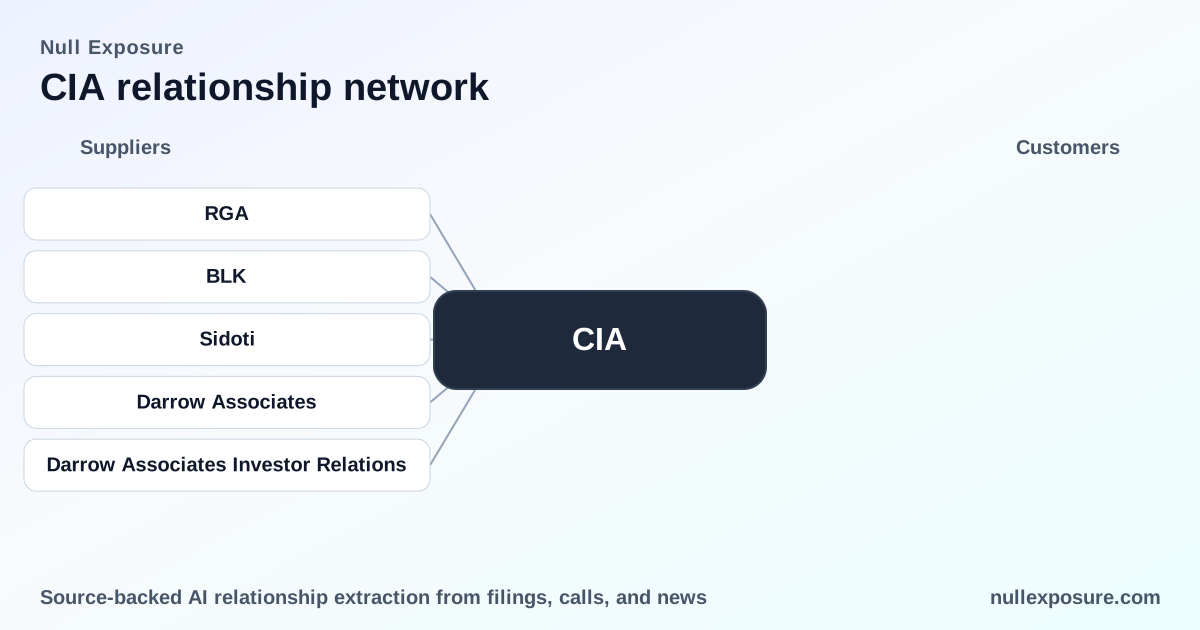
Citizens Inc (CIA) — supplier relationships, capital posture, and operational constraints
Citizens Inc operates as a life-insurance underwriter that monetizes through underwriting premiums and investment income, while actively using reinsurance and third‑party investment vehicles to manage risk and capital. The company's revenue base is complemented by targeted coinsurance arrangements that shift commission expense and liability, and by minority allocations to external funds that concentrate exposure in alternative assets. Investors evaluating supplier and counterparty risk should read Citizens as an insurer that runs a hybrid operating model: retained underwriting supported by reinsurance, with an investment program that uses external managers for renewable-power and ESG strategies.
Explore deeper supplier signals and relationship context at the Null Exposure homepage: https://nullexposure.com/
Who sits on Citizens' supplier roster — concise relationship snapshots
Below are plain-English takeaways for every supplier relationship surfaced in public releases and investor notices.
RGA Reinsurance Company
Citizens disclosed a coinsurance agreement in which RGA shares in commission expenses, reducing Citizens' commission outflows as certain blocks are ceded. This is an active reinsurance counterparty relationship implicated in the company’s third‑quarter 2025 results. (Source: Citizens Inc. Q3 2025 financial results press release, Newsfile, first reported March 2026.)
BlackRock, Inc.
Citizens reported unrealized investment losses tied to BlackRock-managed funds, including an ESG investment in Q3 2025 and a Global Renewable Power Fund III loss reported in Q4 2024; these unrealized marks drove the bulk of small investment-related losses disclosed across those periods. Citizens’ exposure is through fund investments rather than direct operating partnerships. (Sources: Citizens Q3 2025 results press release and Full-Year/Q4 2024 results press release, Newsfile; disclosed Q4 2024 and Q3 2025.)
Sidoti
Citizens management scheduled investor meetings at the Sidoti Virtual Conference (December 10–11, 2025), indicating a direction of active retail/institutional outreach and engagement rather than a supplier relationship in the procurement sense. This is a visibility and IR engagement channel used by management. (Source: Marketscreener report on investor conference participation, December 2025.)
Darrow Associates
Darrow Associates is listed repeatedly as Citizens’ investor relations advisor, with named contacts (Jeff Christensen and Matt Kreps) and a direct IR email and phone contacts included in multiple company releases. Darrow handles outreach and investor communications across event periods and financial releases. (Sources: Newsfile press releases and a Yahoo Finance syndicated release listing investor relations contacts; first seen in 2026 press materials.)
Darrow Associates Investor Relations
A variant listing in Citizens’ releases confirms the same IR function under the full label Darrow Associates Investor Relations, reinforcing that investor communications are outsourced to the same firm and contacts cited in Citizens’ press materials. (Sources: MarketScreener and Newsfile investor announcement entries, 2025–2026.)
Reading the constraints — what the disclosures tell operators and counterparty risk managers
The company-level constraint signals in Citizens’ filings reveal a clear picture of contracting patterns and counterparty characteristics.
- Contract maturity profile is mixed: Citizens maintains a three‑year senior secured revolving credit facility that allows borrowings up to $20 million and matures on May 5, 2027, showing a deliberate multi‑year liquidity buffer under active management. (Disclosure evidence: credit facility renewal language in company filings.)
- Reinsurance posture blends long and short tenors: Citizens uses both coinsurance (longer-term block transfers) and yearly renewable term arrangements, which means counterparty exposure is both structural and periodically renegotiated rather than static. This creates rolling renewal risk for certain blocks while locking other exposures behind coinsurance arrangements. (Disclosure evidence: reinsurance agreement descriptions in company filings.)
- Counterparties are large and rated: Citizens explicitly describes its primary reinsurers as large, well‑capitalized entities with A‑ to A+ A.M. Best ratings, indicating a high degree of counterparty credit quality in core reinsurance relationships. Treat this as a mitigation to concentration risk but not a cancellation of it. (Disclosure evidence: reinsurer rating descriptions.)
- Service-provider role is explicit: Reinsurers act as service providers that indemnify portions of policy liabilities; Citizens monitors concentration and financial strength of these providers as part of routine risk management. This indicates an operational model that relies on third-party indemnity rather than wholesale retention of all liabilities. (Disclosure evidence: reinsurance transaction descriptions.)
- Economic scale of recoverables and spend: The company reported $6.9 million recoverable from reinsurers as of December 31, 2024, and other operating liabilities consistent with modest mid‑market scale; these figures place reinsurance recoverables in a low‑to‑mid millions band, consistent with a spend band signal between $1M and $10M. (Disclosure evidence: receivable and lease liability excerpts.)
- Relationship stage: active: The credit facility renewal, ongoing reinsurance arrangements, and recurring IR engagement indicate active, managed supplier relationships rather than legacy or dormant contracts. (Disclosure evidence: renewal language and active engagement items in company filings.)
These constraints combine into a coherent operating model: Citizens runs a capital-light, reinsurance-supported underwriting franchise with active liquidity management and selective alternative-investment exposure via external managers.
Investment and operational implications — what investors and operators should focus on
- Concentration vs. quality: Citizens’ reinsurance partners are described as highly rated, which reduces single‑counterparty credit risk, but the use of coinsurance and yearly renewables creates both locked and renewal-dependent exposures — investors should monitor renewal windows and commission-sharing terms that materially affect margins.
- Investment-exposure volatility: The BlackRock fund unrealized losses highlighted in filings signal that external fund allocations can introduce mark‑to‑market volatility into an otherwise stable premium-based income statement. Treat these allocations as a vector for quarterly earnings variability.
- Supplier criticality: RGA’s coinsurance arrangement directly reduces Citizens’ commission expense and therefore has high operational importance; disruptions or contract re-pricing at renewal would have an immediate earnings impact. Darrow’s IR role is lower operational risk but higher disclosure importance.
- Liquidity buffer and covenant posture: The $20M revolving facility provides a finite, well-defined liquidity backstop through mid‑2027; active monitoring of covenant metrics relative to underwriting cycles is required.
Key action points for stakeholders:
- Monitor reinsurance renewal schedules and commission-sharing mechanics.
- Track net unrealized positions in third‑party funds and any changes in allocation policy.
- Watch covenant metrics against the May 5, 2027 credit facility maturity timetable.
Take a closer, structured look at supplier and counterparty risk with tailored intelligence on Citizens: https://nullexposure.com/
Conclusion — concise verdict and next steps
Citizens is a small-cap life insurer that leverages coinsurance and yearly renewable reinsurance to manage capital and commissions, while accepting targeted investment exposure to external funds that introduce episodic mark‑to‑market risk. Primary reinsurers are large and rated, diminishing counterparty credit concerns, but the mixed tenor of reinsurance contracts creates active renewal risk. Investors and operators should prioritize oversight of reinsurance renewals, commission-sharing terms, and the transparency of alternative investment positions.
For ongoing monitoring and supplier‑risk scoring on Citizens Inc and peer insurers, visit Null Exposure: https://nullexposure.com/