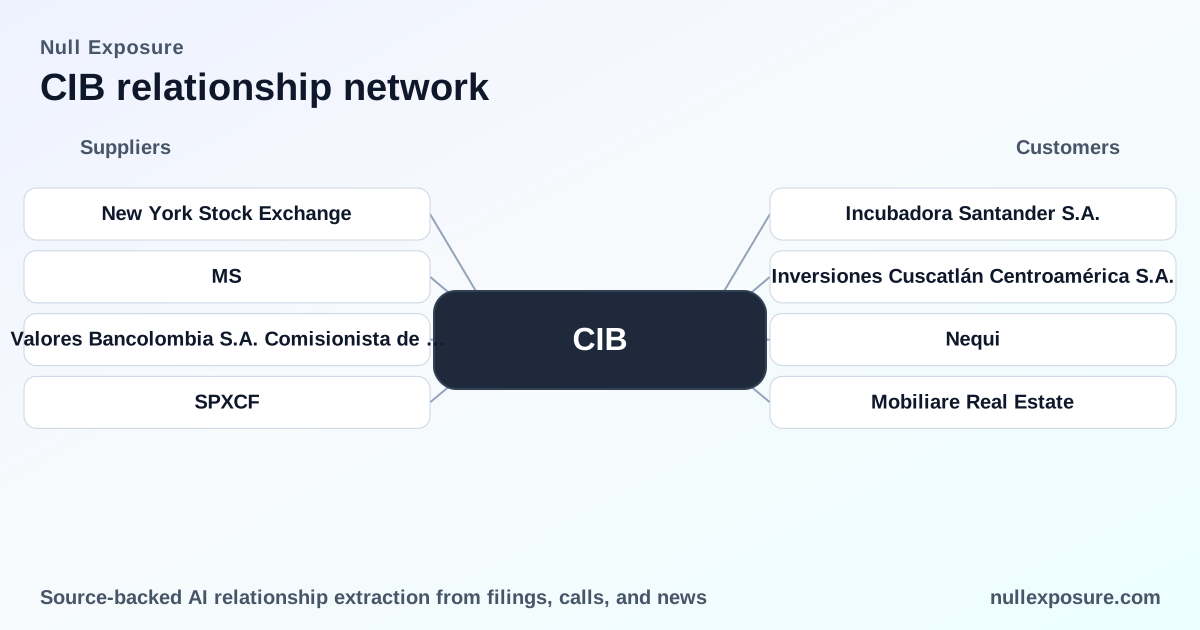
Grupo Cibest (CIB): how capital markets moves are reshaping the supplier map
Grupo Cibest operates as a regional financial-services group that generates revenue from net interest income, fees and trading/investment activities, and it manages capital structure proactively to optimize shareholder returns. Recent actions — note delistings, a planned relisting on a different exchange, and a simultaneous share repurchase program executed across Colombia and the United States — demonstrate an active capital markets strategy that influences counterparty exposure and liquidity for providers. Investors should treat CIB as a bank with active balance-sheet management and multi-venue market engagement.
Explore deeper supplier and market signals at https://nullexposure.com/.
Why the recent moves matter to investors and operators
CIB’s decisions change where its debt trades, who executes its equity buybacks, and which market venues intermediaries must support. These are not back-office details: they alter settlement flows, custody, and the distribution of counterparty risk across exchanges and brokerage partners. For investors evaluating supplier relationships, the key is whether providers align with CIB’s multi-jurisdictional posture and can scale for cross-border execution and liquidity management.
Visit https://nullexposure.com/ to get a complete supplier portrait and tracking alerts.
How CIB is working with exchanges and brokers — the relationships
New York Stock Exchange — voluntary delisting of subordinated notes
CIB announced a voluntary delisting of its 4.875% Subordinated Notes due 2027 and 8.625% Subordinated Notes due 2034 from the New York Stock Exchange, removing those securities from NYSE market infrastructure and trading. According to a Globe and Mail press release covering the FY2025 action, this is a deliberate reallocation of where those fixed-income instruments trade (Globe and Mail, March 9, 2026 — https://www.theglobeandmail.com/investing/markets/stocks/CIB/pressreleases/33598012/bancolombia-to-delist-notes-from-nyse-and-list-on-sgx/).
Singapore Exchange — planned relisting of the same notes
CIB plans to list the delisted subordinated notes on the Singapore Exchange (SGX), shifting venue liquidity to a major Asian fixed-income market and changing the primary market microstructure for those bonds. The company’s FY2025 notice indicates the relocation to SGX as the intended next listing venue (Globe and Mail, March 9, 2026 — https://www.theglobeandmail.com/investing/markets/stocks/CIB/pressreleases/33598012/bancolombia-to-delist-notes-from-nyse-and-list-on-sgx/).
Morgan Stanley & Co. LLC — executing the US leg of the buyback
CIB’s announced share repurchase program in FY2025 will be executed in the United States via an “Enhanced Open Market Repurchase” carried out by Morgan Stanley & Co. LLC, assigning US execution and liquidity provision to a large global broker-dealer. La República’s coverage of the buyback details Morgan Stanley’s role in the US portion of the program (La República, March 9, 2026 — https://www.larepublica.co/finanzas/inicio-de-programa-de-readquisicion-de-acciones-del-grupo-cibest-4182032).
Valores Bancolombia S.A. Comisionista de Bolsa — executing the Colombian leg
The Colombian execution of the repurchase program will occur on the Bolsa de Valores de Colombia through Valores Bancolombia S.A. Comisionista de Bolsa, ensuring local market handling and onshore settlement for the domestic tranche. La República reported that Valores Bancolombia will operate the Colombian execution channels for the buyback (La República, March 9, 2026 — https://www.larepublica.co/finanzas/inicio-de-programa-de-readquisicion-de-acciones-del-grupo-cibest-4182032).
What these supplier choices reveal about CIB’s operating model
At the company level, the recent actions give clear signals about CIB’s contracting posture, concentration, criticality, and maturity as a counterparty:
- Contracting posture — proactive and market-driven. CIB is choosing where its securities live and who executes capital returns rather than accepting legacy venues; that reflects an assertive approach to optimizing liquidity and investor reach.
- Counterparty concentration — diversified across global and local providers. Using Morgan Stanley in the US and Valores Bancolombia domestically reduces execution concentration risk while exposing CIB to the operational interfaces of both global and local systems.
- Criticality to counterparties — medium-high for selected providers. Brokers and exchanges that handle subordinated notes or equity buybacks take on short-term liquidity and settlement risk that becomes critical during market stress.
- Maturity of relationships — transactional with strategic elements. Listing moves and buyback execution indicate relationships that are both operational (execution) and strategic (venue choice and investor targeting).
These company-level signals matter to suppliers evaluating exposure: CIB will require rigorous cross-border settlement capabilities, regulatory coordination, and robust liquidity provision from partners.
Investment implications — risks and opportunities
CIB’s market moves reshuffle liquidity venues and execution counterparts, creating both operational friction and potential valuation upside.
- Opportunities: relocating debt to SGX broadens investor reach in Asia and could compress spreads if demand there exceeds supply; the share buyback program signals management’s focus on return of capital, which supports earnings-per-share dynamics.
- Risks: cross-border settlement and matching requirements increase operational complexity, and execution across multiple brokers introduces basis and timing risk during volatile markets.
Financial profile context: CIB trades with a market capitalization near USD 17.8 billion and a trailing P/E of 8.88, with return on equity of 16.2% and a noticeable analyst consensus skew toward Hold/Hold-Sell in FY2025 coverage, underscoring the need to weigh capital actions against valuation and macro sensitivity.
Practical considerations for suppliers and operators
- Custodians and settlement agents must confirm SGX connectivity and local custody arrangements for the transferred notes.
- Brokers should expect coordinated instructions across Bolsa de Valores de Colombia and US trading platforms for staged buyback execution.
- Risk teams must map the timing mismatch between delisting, relisting, and repurchase windows to avoid settlement fails or regulatory friction.
If you evaluate counterparty relationships or run trading/settlement operations for financial suppliers, get a complete supplier risk matrix and relationship timeline at https://nullexposure.com/.
Bottom line and next steps
CIB is actively reshaping where its liabilities and equity transactions clear and who executes them; that changes counterparty exposure and operational requirements for brokers, exchanges, and custodians. For investors, the combination of capital management (buybacks) and venue migration (NYSE → SGX for subordinated notes) is a deliberate strategy to manage investor base and liquidity.
For a consolidated, actionable view of how these supplier ties affect exposure and operations, visit https://nullexposure.com/ and subscribe for alerts and relationship analytics.