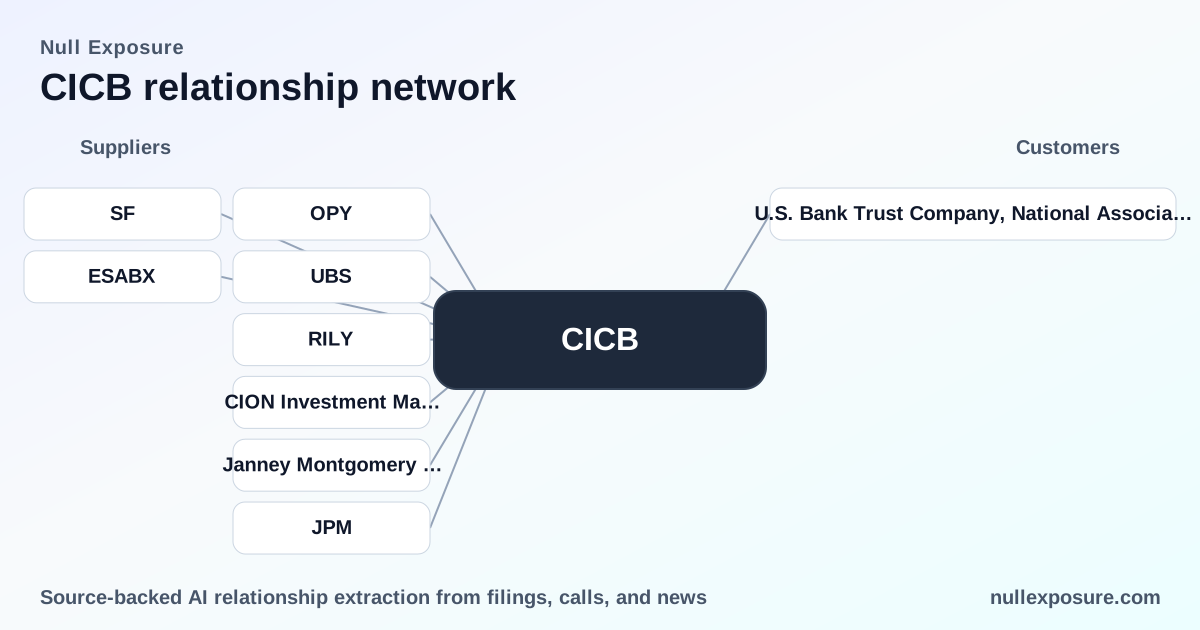
CION Investment Corporation (CICB): supplier relationships, funding partners, and operational constraints investors should track
CION Investment Corporation is a publicly traded closed-end investment company that earns returns by originating and acquiring secured debt and selective equity positions in U.S. middle‑market companies, then levering its balance sheet and credit lines to amplify yield for shareholders. The firm monetizes through interest and fee income from its lending portfolio, dividend distributions to stockholders, and selective capital markets transactions (notes and credit facility activity) to optimize its funding mix. For investors evaluating counterparty exposure and operational resiliency, the supplier map is concentrated around its adviser/administrator, a small set of capital providers, and a recurring syndicate of underwriters.
Discover more supplier and counterparty intelligence at https://nullexposure.com/.
Why supplier relationships matter for a BDC-style vehicle
CICB’s business model depends less on scale of retail distribution and more on the stability and terms of its service and funding counterparties. Two structural features stand out:
- Short-term contracting posture with its adviser/administrator creates annual renegotiation windows that govern fees and operational continuity; that is both a governance lever and a renewal risk.
- Concentrated funding relationships (bank credit facilities, repurchase lines and note underwriters) make liquidity management sensitive to a handful of counterparties and market access events.
These characteristics combine into an operational profile where adviser continuity and bank funding terms are first-order drivers of earnings sustainability and downside protection.
Vendor-by-vendor read: what each relationship means for investors
Oppenheimer & Co. Inc.
Oppenheimer acted as a joint book‑running manager on CICB’s unsecured notes offering, supporting capital markets execution and distribution to investors in the deal. (Press release, Sept 26, 2024 via Business Wire / FinancialContent.)
B. Riley Securities, Inc.
B. Riley served as one of the joint book‑running managers on the same unsecured notes transaction, indicating its role in CICB’s capital‑markets placement strategy. (Press release, Sept 26, 2024 via Business Wire / FinancialContent.)
Janney Montgomery Scott LLC
Janney participated as a joint book‑running manager on CICB’s 2029 note issuance, contributing to distribution and syndication resources for the offering. (Press release, Sept 26, 2024 via Business Wire / FinancialContent.)
Keefe, Bruyette & Woods, Inc. (a Stifel Company)
Keefe Bruyette & Woods acted as a joint book‑running manager on the unsecured notes deal, reinforcing CICB’s reliance on a repeat syndicate of specialty underwriters for debt issuance. (Press release, Sept 26, 2024 via Business Wire / FinancialContent.)
JPMorgan Chase Bank, National Association
CICB intends to use proceeds from the unsecured notes offering to pay down borrowings under its senior secured credit facility with JPMorgan, highlighting JPMorgan’s role as a primary funding counterparty and lender. (Press release, Sept 26, 2024 via Business Wire / FinancialContent.)
UBS
UBS was a counterparty in a repurchase-style facility related to Murray Hill Funding and later was party to a termination agreement referenced in CICB’s FY2024 filings, implying a transactional funding relationship that has evolved across 2017–2024. (FY2024 Form 10‑K, filed Dec 31, 2024.)
CION Investment Management, LLC (CIM)
CICB is managed and administered by CION Investment Management, LLC; CIM provides investment advisory and administrative services under agreements that the board renewed for twelve‑month terms in August 2024, making CIM the operational and investment decision engine for the company. (Press release, Sept 26, 2024; FY2024 Form 10‑K, filed Dec 31, 2024.)
Wells Fargo
CICB entered into a new trading plan with an independent broker, Wells Fargo, under Rule 10b5‑1, signaling Wells Fargo’s role as an execution counterparty for insider or company share transactions under an approved plan. (FY2024 Form 10‑K, filed Dec 31, 2024.)
Constraints and what they reveal about CICB’s operating model
CICB’s public filings and related materials reveal several consistent constraints that shape operational risk and strategy:
-
Short-term advisory/administration contracts. The board approved renewals of the administration and investment advisory agreements with CIM on an annual basis (commencing August 9, 2024), which creates recurring renegotiation points for fees and services and concentrates operational dependence on CIM. This is a relationship-specific constraint tied directly to the CIM agreement (FY2024 Form 10‑K, Aug 2024 filings).
-
EMEA funding links. The company executed unsecured term loan facilities with an Israeli institutional investor in 2022 and again in 2024, reflecting non‑U.S. wholesale funding channels and geographic diversification of lenders. This is a company-level signal that CICB taps international institutional capital (FY2024 Form 10‑K, April & Sept filings).
-
Service-provider reliance and legacy servicing arrangements. Multiple excerpts name third‑party service providers—Apollo/AIA historically provided loan and trading support and continued services for CIM, and Murray Hill/UBS repurchase transactions reflect structured funding and sell/repurchase activity. These facts point to a multi‑tiered service model where CICB relies on both its adviser and specialist third parties for trade support, valuations and reconciliation (FY2024 Form 10‑K).
-
Active funding-document amendments. Recent amendments to loan and security agreements with 34th Street Funding and JPMorgan indicate ongoing, active management of credit facility terms, which is consistent with a BDC managing leverage and liquidity on a rolling basis (FY2024 Form 10‑K).
Taken together, these constraints imply a business that is operationally concentrated around CIM, dependent on a short‑term contracting rhythm for advisory services, and sensitive to its focused set of funding counterparties. That profile supports agility in fee negotiation but elevates counterparty and renewal risk.
What investors should watch next
- Monitor annual renewal notices and fee disclosures for the CIM administration/advisory agreements—those terms directly affect net yield and operational continuity.
- Track CICB’s use of bank facilities with JPMorgan and any further UBS repurchase arrangements, since tightening bank terms would compress economic returns quickly.
- Observe future capital markets activity and the composition of underwriters on note offerings for signs of broader syndicate depth or narrowing distribution capacity.
Key takeaways:
- CIM is the single most critical supplier; its annual contract cadence is a governance lever and risk factor.
- Funding concentration with JPMorgan, UBS-related facilities and niche underwriters leaves liquidity management as the core operational risk.
- International lenders (Israeli institutional investors) give CICB optionality in wholesale funding but introduce regional funding exposures.
Learn more about CICB’s counterparty map and next‑level supplier risk analysis at https://nullexposure.com/.
CICB is a yield‑oriented, adviser‑dependent vehicle where counterparty terms—not product demand—drive near‑term performance; investors should prioritize governance disclosures and funding documentation in upcoming filings. For a deeper supplier and counterparty breakdown, visit https://nullexposure.com/.