Ciena’s supplier posture: concentrated manufacturing, foundry dependence, and a BEAD-era edge
Thesis: Ciena designs and sells optical networking systems while outsourcing the bulk of physical manufacturing and component procurement to third-party contract manufacturers and high-end foundries; the company monetizes through hardware and systems sales to service providers and enterprises, supported by long lead-time purchase commitments and strategic manufacturing partnerships that both deepen revenue runway and concentrate supply-chain risk. For investors evaluating supplier relationships, the mix is clear: manufacturing is outsourced and mission-critical, and premium foundry access is a gating factor for product roadmaps and delivery.
Explore deeper supplier intelligence at https://nullexposure.com/ for deal teams and risk managers.
Why suppliers matter to Ciena’s P&L and go-to-market
Ciena’s operating model leans on design and integration while relying on a small set of external manufacturers and component distributors to convert designs into shippable systems. Company disclosures show multi-national contract manufacturing footprints and very large purchase order commitments, which translate into both predictability of supply and a concentration of counterparty risk. The practical effect: Ciena’s sales cycles and fulfillment depend less on internal factories and more on its ability to secure capacity, components and foundry nodes from external partners.
The supplier lineup investors should know
Below I cover every supplier relationship surfaced in the available signals and explain what each implies for Ciena’s operational risk and strategic positioning.
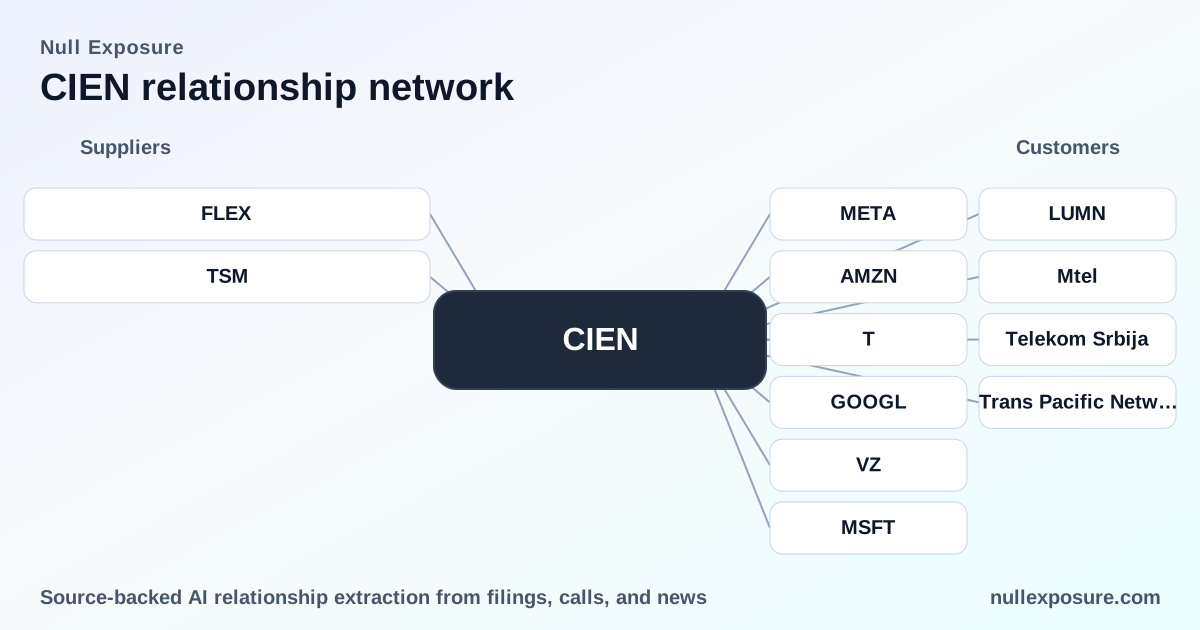
Flex — U.S. manufacturing tie that unlocks BEAD demand
Ciena partners with Flex to manufacture equipment in the United States, a relationship that delivers Build America, Buy America compliance and positions Ciena as a preferred vendor for the $42 billion BEAD broadband program. This U.S. manufacturing linkage materially improves Ciena’s addressable public-sector backlog and procurement eligibility for American infrastructure spending. (FinancialContent, February 9, 2026)
TSMC — critical foundry dependence for advanced nodes
Ciena remains dependent on high-end foundry capacity—specifically TSMC’s 3nm nodes—for advanced components used in its optical systems, making foundry access a direct constraint on product availability and performance upgrades. When chip supply tightens at the 3nm level, Ciena’s product cadence and delivery schedules are the first to feel the impact. (FinancialContent, February 9, 2026)
Company-level constraints that shape supplier strategy
Ciena’s public disclosures and contextual reporting point to a compact set of company-level signals that explain contracting posture, concentration, and criticality:
- Global manufacturing footprint: The company relies on third-party contract manufacturers with facilities in Canada, Mexico, Thailand, Vietnam and the United States, which gives geographic diversity but requires robust logistics and supplier governance. This is a company-level signal drawn from corporate disclosures.
- Outsourced manufacturer and distributor roles: Ciena characterizes its external partners as both manufacturers and component distribution partners, indicating that a single partner can carry multiple procurement and assembly responsibilities.
- Manufacturing segment concentration: Ciena depends on a small number of contract manufacturers for the majority of its product manufacturing, which creates supplier concentration risk even as it simplifies operational coordination.
- Large committed spend: As of November 1, 2025, Ciena reported $2.1 billion in outstanding purchase order commitments to contract manufacturers and component suppliers—placing the company comfortably in a $100M+ annual spend band with concentrated counterparties.
These constraints imply a contracting posture that is heavy on long-term purchase commitments and focused vendor relationships, a concentration profile that elevates counterparty and capacity risk, and a maturity profile consistent with established supplier arrangements (multi-year purchase orders and strategic manufacturing partnerships).
What this means for investors and operators
Ciena’s supplier architecture produces a clear trade-off: scale and procurement leverage versus single-point supply risk. The Flex relationship delivers a near-term commercial runway into U.S. federal and state broadband spend, improving tender eligibility and potentially shortening procurement cycles for BEAD-funded projects. Conversely, dependency on advanced foundry capacity at TSMC makes product roadmaps sensitive to global semiconductor cycle dynamics.
Key operational takeaways:
- Risk: Foundry concentration. Advanced nodes at TSMC are mission-critical for next-generation product releases—capacity constraints would directly slow shipments and upgrades.
- Opportunity: BEAD eligibility via domestic manufacturing. U.S.-based manufacturing through Flex materially increases Ciena’s addressable market in public broadband funding.
- Balance of power: committed spend equals negotiating leverage but also lock-in. The $2.1 billion in purchase order commitments signals strong supplier commitments but also increases exposure to supplier execution failures or market price moves.
For teams modeling supplier risk into revenue forecasts, assume higher fulfillment certainty for BEAD-eligible U.S. orders where Flex capacity is prioritized, and greater volatility in release timing for products dependent on 3nm chips.
Explore how supplier intelligence changes valuation and risk models at https://nullexposure.com/.
Tactical implications for procurement, risk and investors
Operators should prioritize contingency planning around two vectors: alternative foundry strategies (allocation hedges, multi-node designs) and supplier performance monitoring for the small set of contract manufacturers that handle the majority of assembly. Investors should read purchase order commitments as both a signal of backlog visibility and a levered exposure to supplier delivery performance.
- Maintain active monitoring of foundry allocations for 3nm nodes within competitive supplier sets.
- Reassess contract terms and escalation clauses that protect delivery timelines in the event of capacity shortfalls.
- Use BEAD program timelines to model near-term upside where U.S.-manufactured equipment is contractually advantaged.
Bottom line and next steps
Ciena’s model—design-focused, outsource-heavy manufacturing, and strategic foundry dependence—creates a distinct investor profile: strong product-market fit and procurement leverage offset by concentrated execution risk. The Flex tie gives Ciena a material commercial advantage in U.S. broadband programs, while TSMC dependence is the single largest operational constraint to watch.
If you need supplier-level diligence on Ciena or comparable networking suppliers, start here: https://nullexposure.com/. For customized supplier risk scoring and contract-level analysis, visit https://nullexposure.com/ and contact the team to convert these signals into actionable diligence for investment and operational decisions.