Cipher Mining (CIFR) – supplier relationships, constraints, and what investors should price in
Cipher Mining is a capital-intensive bitcoin miner that monetizes by acquiring mining sites and operating ASIC fleets to convert low-cost electricity into mined bitcoin. Revenue flows from mined coins and any strategic asset sales or site conversions; costs are driven by hardware purchases, power contracts, and site infrastructure. For investors, the supplier map is a direct read on capital commitment, operational risk, and future production visibility. Read more company and supplier intelligence at https://nullexposure.com/.
The supplier roster you need to know now
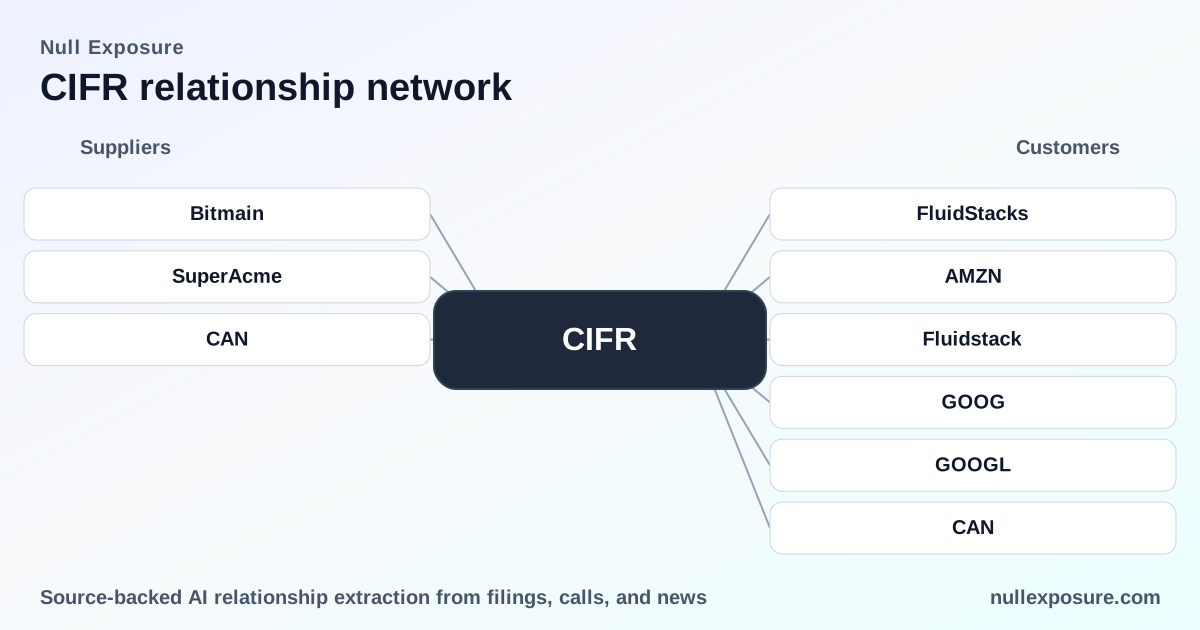
Cipher’s public filings and recent market reports identify three supplier relationships relevant to hardware procurement and site disposition: Bitmain, SuperAcme, and Canaan. Each relationship has a distinct operational footprint and strategic implication.
- Bitmain — Cipher discloses purchases of miners from Bitmain in its 2024 Form 10‑K, which the company lists alongside other manufacturers as sources of its deployed rigs. This is the primary documentary confirmation that Bitmain is a hardware vendor for Cipher (Cipher 2024 Form 10‑K).
- SuperAcme — The 2024 Form 10‑K also records purchases from SuperAcme, indicating SuperAcme supplies miners to Cipher alongside larger OEMs (Cipher 2024 Form 10‑K).
- Canaan — Cipher’s 2024 Form 10‑K records miner purchases from Canaan, and the relationship evolved materially in 2025–2026: Canaan acquired Cipher’s site interests in an all‑stock deal and took possession of 6,840 Avalon A15Pro rigs originally purchased and deployed by Cipher at the Black Pearl site, a transaction discussed on Cipher’s 2025 Q4 earnings call and reported in March 2026 press coverage (Q4 2025 earnings call; Bitcoin Magazine, March 2026).
Each of the three suppliers is documented in Cipher’s 10‑K for FY2024; Canaan is additionally referenced in the company’s Q4 2025 public remarks and in third‑party press concerning the all‑stock transaction and equipment transfer.
How the supplier mix translates into operating realities
Cipher’s disclosed supplier activity points to a hardware‑centric capex profile and exposure to OEM supply, while its operating model is structured to lock in low power costs and manage financial liquidity through shorter-term facilities.
- The company statement that it purchased new miners from Bitmain and Canaan in June 2024 and deployed them in Q4 2024 signals concentrated near‑term capital deployment into hardware from a small set of OEMs (Cipher 2024 Form 10‑K). This underscores the model: large up‑front equipment purchases, then multi‑year asset operation.
- Canaan’s subsequent acquisition of site interests and the transfer of thousands of Avalon rigs (reported March 2026) converts a pure hardware relationship into a strategic disposition with operational consequences—it changes Cipher’s installed fleet, site economics, and counterparty exposure (Q4 2025 earnings call; Bitcoin Magazine, March 2026).
- SuperAcme’s disclosure is more limited, but inclusion in the 10‑K confirms it as a supplier channel used for fleet diversity and procurement flexibility (Cipher 2024 Form 10‑K).
For a deep dive into supplier exposure and counterparty outcomes, visit https://nullexposure.com/ to see how this compares across peers.
Contracting posture, concentration, and liquidity signals that matter
Cipher’s filings and constraint excerpts reveal five company‑level signals that shape supplier and operational risk:
- Long‑term power procurement: Cipher has a multi‑year power purchase agreement structure (notably the Luminant agreement with an initial five‑year term) that fixes electricity supply and price for key sites, providing predictable operating cost for mining operations until at least mid‑2027. This is a strategic hedge against spot power volatility (company 10‑K disclosures).
- Short‑term financial facilities for liquidity: Cipher maintains a Coinbase master loan arrangement including an overnight credit facility and a one‑year term loan facility, reflecting the use of short‑duration financing to manage working capital and equipment financing (10‑K excerpt).
- Hardware and infrastructure are distinct spend categories: Filings explicitly categorize supplier engagements as hardware purchases (Bitmain, Canaan) and infrastructure investments (e.g., a deposit to Oncor to energize a site), highlighting dual capital requirements—equipment and site electrification (10‑K excerpts).
- High single‑item spend: A disclosed balance of roughly $139 million outstanding for machine purchases signals meaningful remaining capital commitments for rigs, placing Cipher squarely in the “100m+” capital spend band and making supplier delivery and financing outcomes material to performance (10‑K excerpt).
- Strategic asset flexibility: The conversion of the Black Pearl site to an AI/HPC data center following the Canaan transaction illustrates a shift in optionality—assets and the miners that populate them can be repurposed or sold as part of counterparty transactions, changing future revenue mixes (Bitcoin Magazine, March 2026).
These signals form a practical lens for evaluating supplier negotiations and operational resiliency: power contracts reduce operating cost volatility while large hardware obligations concentrate counterparty and delivery risk.
What investors and operators should prioritize
- Vendor concentration risk: A small set of OEMs (Bitmain and Canaan prominent in disclosures) means procurement failures, delivery delays, or pricing pressure at those suppliers translate to measurable production risk.
- Capital and financing cadence: The mix of long‑term PPAs and short‑term credit facilities implies operational stability on power but reliance on near‑term funding for hardware—monitor the availability and terms of revolving and term facilities.
- Asset and counterparty optionality: The Canaan transaction highlights that equipment and sites are fungible assets subject to strategic reallocation, making contract terms around transferability and warranties essential diligence for operators and investors.
- Infrastructure execution risk: Deposits and construction obligations (Oncor deposit for site energization) are project‑level constraints that can delay ramp and extend payback if milestones slip.
If you want structured benchmarks comparing Cipher’s supplier exposure and contract posture to peer miners, start your research at https://nullexposure.com/ for side‑by‑side supplier intelligence.
Bottom line — actionable takeaways
- Cipher’s model is capex‑driven and supplier‑dependent: large hardware purchases from Bitmain, SuperAcme, and Canaan are central to production plans (Cipher 2024 10‑K).
- Power contracts provide operating certainty while financing remains tactical: long‑term PPAs limit power cost risk; short‑term lending underpins equipment purchases and working capital (company disclosures).
- The Canaan deal is a structural inflection: the all‑stock acquisition of site interests and transfer of thousands of rigs converts a procurement relationship into a strategic corporate transaction with immediate fleet and site impacts (Q4 2025 earnings call; Bitcoin Magazine, March 2026).
For a practitioner checklist and supplier risk matrices tailored to bitcoin miners, visit https://nullexposure.com/ to get started.