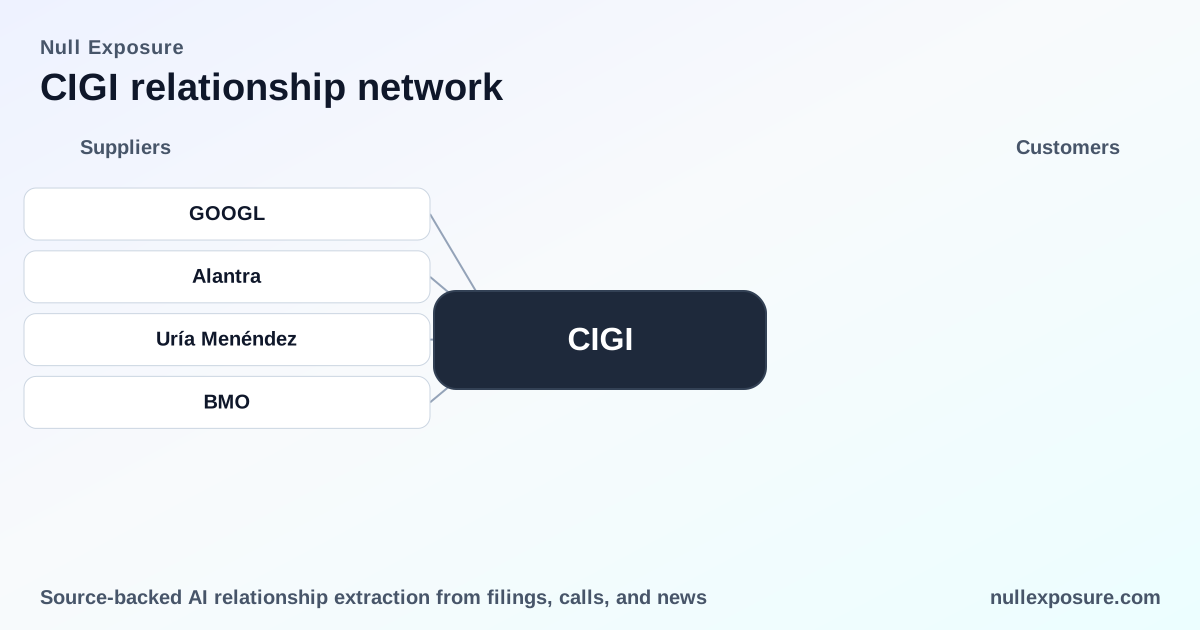
Colliers (CIGI) — supplier relationships shaping its technology, capital and deal execution
Thesis: Colliers International monetizes a global commercial real estate services platform by selling advisory, brokerage, property and project services to corporate and institutional clients; the firm extracts margin through fee-based services and scaled professional operations while selectively using technology and financial partners to extend capability and manage capital. With $5.56B in trailing revenue and a $5.53B market capitalization, Colliers runs a capital-light services model that increasingly leans on strategic cloud partnerships and external advisors to accelerate AI-enabled product differentiation and M&A execution.
Learn more about supplier exposure and relationship mapping at https://nullexposure.com/.
How Colliers funds growth and buys capability
Colliers’ operating model is a high-touch services business complemented by targeted investments in technology and acquisitions. Financially the company shows Revenue TTM of $5.56B, EBITDA of $657.5M and an EV/EBITDA of 11.73, signaling a mature professional services operator that uses leverage and syndicated credit to provide balance-sheet flexibility. Colliers monetizes client relationships via recurring and transaction-driven fees while outsourcing specialized technical and legal expertise when scale or speed is required.
Strategic technology partner — Google Cloud
Colliers has designated Google Cloud as its primary cloud solution to accelerate data architecture, AI adoption and workplace transformation; the relationship is presented as a strategic enabler of improved insights and client execution. In the 2025 Q4 earnings call Colliers described AI as strengthening its “data advance” by combining proprietary information with capabilities from Google Cloud and other third parties to deliver better client outcomes (earnings call, 2026-03-07). A March 2026 press release reiterated that Google Cloud will provide services and advice on AI adoption and data architecture as Colliers’ primary cloud provider (press release via Ritzau and related coverage, March 2026).
Source: 2025 Q4 earnings call (3/7/2026) and March 2026 press releases and market coverage.
M&A advisors — Alantra
Alantra served as financial advisor to Colliers on its acquisition of Ayesa, reflecting Colliers’ use of external boutique and specialist advisors to accelerate inorganic expansion and manage transaction execution. Coverage of the Ayesa deal identifies Alantra’s advisory role in the FY2026 announcement (news reports and transaction coverage, March 2026).
Source: transaction reporting on Colliers’ Ayesa acquisition (news coverage, March 2026).
Legal counsel on transactions — Uría Menéndez
For the same Ayesa acquisition, Uría Menéndez acted as Colliers’ legal advisor, demonstrating the company’s practice of engaging recognized law firms for cross-border deal compliance and structuring; this role is documented in the FY2026 transaction notices and current report filings (March 2026).
Source: Colliers’ public transaction announcements and Form 6‑K reporting (March 2026).
Lending and liquidity partner — Bank of Montreal (lead bank)
Colliers extended and restructured its US$2.25 billion credit facility led by Bank of Montreal, which was syndicated to 13 major Canadian, US and international banks to lengthen maturity and enhance flexibility — a clear signal that Colliers uses a diversified banking group to manage liquidity and support acquisition activity (news coverage of facility amendment, FY2026). The lead role of BMO places a large, traditional bank at the center of Colliers’ near-term funding strategy.
Source: syndicated credit facility coverage (March 2026).
What these relationships imply about operational posture
- Contracting posture: Colliers structures strategic, long-term engagements for capability (Google Cloud) while relying on short-term retainers and mandate-based contracts for deal advisors (Alantra, Uría Menéndez). This hybrid posture lets the company scale data and AI capability without absorbing full product development risk.
- Concentration and criticality: The designation of Google Cloud as the primary cloud provider makes cloud capability a critical vendor relationship for Colliers’ data and product roadmap; at the same time, the use of a 13-bank syndicate for its credit facility reduces single-lender concentration on liquidity.
- Maturity and externalization: Colliers is an established public company with 84% institutional ownership and a history of transactions that leverage external legal and financial advisors, indicating mature governance and a preference for outsourcing specialized execution tasks rather than building them in-house.
No explicit constraints (contractual limitations, exclusivity clauses or supplier-imposed caps) surfaced in the supplier-scope feed; the dataset included public disclosures and transaction notices without constraint excerpts. This absence should be treated as a company-level signal: Colliers discloses strategic supplier roles but did not publish supplier-level constraints in the referenced materials (FY2025–FY2026 filings and announcements).
Risks and operational considerations for counterparties and investors
- Vendor concentration risk around core cloud infrastructure. Making Google Cloud the primary cloud solution centralizes operational dependency for AI and data services; any disruption or commercial dispute would directly impede product rollout and client delivery.
- Execution and integration risk on M&A-led growth. Reliance on external financial and legal advisors (Alantra, Uría Menéndez) accelerates deal activity but pushes integration risk onto Colliers’ internal operating teams post-closing.
- Funding flexibility vs. covenant exposure. A syndicated facility led by Bank of Montreal improves lender diversification, but M&A-fueled growth will increase reliance on capital markets and bank facilities to finance deals.
For an operator negotiating with Colliers or for an investor sizing supplier risk, these relationships signal a deliberate mix of strategic technology partnership, external deal execution specialists, and diversified bank funding — a combination that supports growth while keeping balance-sheet and operational risk distributed.
Explore supplier risk mapping and contract exposure for your portfolio at https://nullexposure.com/ — the platform provides structured views of counterparties and vendor concentration.
How to act on these signals
- If you are a counterparty: treat Google Cloud integration and the syndicated facility as deal-critical elements during contract negotiations, and request clarity on SLAs and escalation paths for cloud services.
- If you are an investor: monitor progress on AI-enabled product launches tied to Google Cloud and any covenant or funding changes tied to the syndicated facility; these will materially affect near-term cash flow and acquisition capacity.
For a deeper mapping of Colliers’ supplier relationships and to track future disclosures and constraints, visit https://nullexposure.com/ for continuous coverage and relationship analytics.
Final takeaway: Colliers runs a capital-efficient professional services model that amplifies its internal capabilities through strategic external partners. The Google Cloud partnership is the operational lever for product differentiation, while advisory and banking relationships enable dealmaking and liquidity; investors and operators should prioritize vendor continuity and funding resiliency when evaluating counterparty risk.