Concorde International Group Ltd (CIGL): Strategic supplier relationships and what they mean for investors
Concorde International Group Ltd operates as a Singapore-headquartered provider of integrated security and safety services to commercial, financial, industrial and government clients, monetizing through contracted security services, facilities solutions and now software-enabled facilities management. Revenue comes from recurring and project-based security contracts; recent activity shows management is using tuck-in technology acquisitions and an underwritten offering to accelerate growth and de-risk operations through productization of services.
For a concise view of Concorde’s network and to cross-check primary filings and press releases, visit https://nullexposure.com/.
How Concorde really operates — business model signals investors must track
Concorde is a small-cap operator with service-led economics that it is pushing toward higher-margin, technology-augmented offerings. The public financials show revenue of $11.1M and negative operating margins, which drives the company’s tactical choices: raise capital and acquire software assets to lift margins and scale recurring revenue.
Key operating-model signals:
- Contracting posture: Predominantly B2B contracts with recurring on-site security and facilities services; contracts are service-intensive and depend on operational delivery and labor management.
- Concentration and scale: Market cap roughly $54.5M, low institutional ownership and a compact share float, indicating concentration risk and limited analyst coverage.
- Criticality: Security services are mission-critical for clients, giving Concorde pricing leverage in renewal cycles provided service quality remains high.
- Maturity: Early-stage public company profile — negative EBITDA and up-front integration work following acquisitions imply execution and cash-flow risk.
For source references and deeper supplier mapping, see https://nullexposure.com/.
Counterparties and what they mean for Concorde’s execution
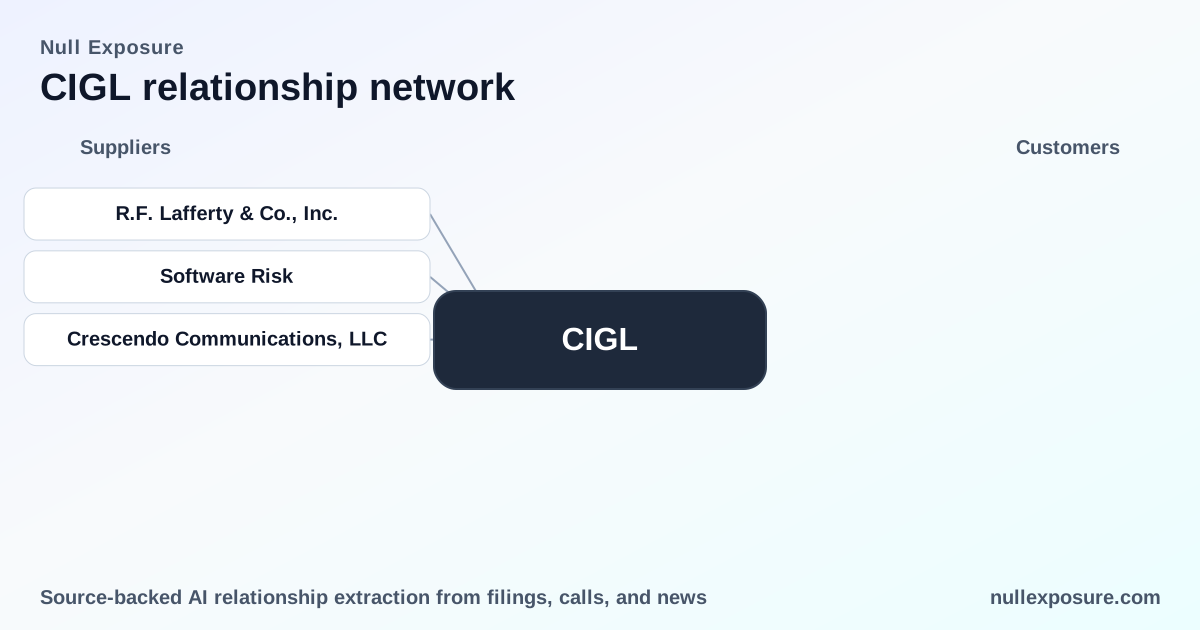
Concorde’s recent public disclosures list three recurring external relationships that drive capital, communications and product strategy.
R.F. Lafferty & Co., Inc.
R.F. Lafferty acted as the sole book‑running manager for Concorde’s offering, underwriting the capital raise that closed in early March 2026. This relationship provides access to near-term liquidity and distribution for new shares, which is material given the company’s negative operating cash flow. (Source: Yahoo Finance press release, March 9, 2026.)
Software Risk
Concorde’s subsidiary, Concorde International Group Pte. Ltd., acquired the assets of Software Risk — a cloud-based SaaS platform for facilities management — under a Software Purchase Agreement dated August 20, 2025. The asset purchase brings a ready-to-deploy software layer intended to improve productivity and generate higher-margin recurring revenue alongside Concorde’s core security services. (Sources: Yahoo Finance and The Globe and Mail press releases, August 20, 2025; supplementary coverage: Pulse2.)
Crescendo Communications, LLC
Crescendo Communications is listed as Concorde’s investor relations contact, handling public disclosure routing and investor communications. Maintaining an external IR firm signals management’s intention to build access to U.S. capital markets and improve liquidity, important for a company with limited institutional holders. (Source: Yahoo Finance press release, March 2026.)
Strategic implications — what investors should price in now
The combination of an underwritten equity offering, an IR mandate, and a bolt-on software asset creates a clear strategic narrative: Concorde is transitioning from pure labor-intensive service delivery toward a hybrid model that blends security operations with software-enabled facilities management. That transition improves addressable margin if integration executes cleanly; it also raises short-term execution risk and capital requirements.
Investors should weigh:
- Capital adequacy: The underwritten offering facilitated by R.F. Lafferty supplies near-term capital but raises dilution risk.
- Integration risk: The Software Risk asset is small but strategically relevant; successful deployment against existing client contracts is the critical execution vector.
- Communication and governance: Retaining Crescendo indicates management is prioritizing transparency and market access, a positive for small-cap liquidity and buy-side awareness.
For operational diligence and primary-source tracking, return to https://nullexposure.com/.
Risk checklist — concrete items to watch in the next 6–12 months
- Integration milestones: timelines for product rollout of the acquired facilities-management platform and the first contracts that monetize it.
- Cash burn and runway: how proceeds from the underwriting are allocated between operations, tech integration and sales expansion.
- Margin trajectory: quarterly shifts in gross and operating margins as the company layers software revenue onto services.
- Client retention and concentration: renewal rates on major security contracts given the company’s small scale.
- Governance and disclosure: frequency and quality of investor communications managed by Crescendo.
Each of these items will determine whether the technology acquisition converts into sustainable margin expansion or merely adds complexity to a capital-constrained services company.
Bottom line and recommended investor actions
Concorde is executing a recognizable small-cap growth playbook: raise capital, professionalize investor communications, and bolt-on a technology asset to convert labor into recurring software-enabled revenue. This is a high-conviction operational shift that increases upside if integration reduces costs and drives recurring margins, but it also concentrates short-term execution and financing risk.
If you cover CIGL or evaluate supplier relationships, take these steps:
- Monitor the operational deployment of Software Risk against client contracts and reported margin improvements.
- Track use of proceeds from the underwritten offering and any subsequent financing.
- Watch investor communications from Crescendo for updated milestones and governance developments.
For more supplier-relationship intelligence and primary-source tracking, visit https://nullexposure.com/.
Concorde’s trajectory is straightforward: convert service delivery into scaleable, higher-margin offerings while managing dilution and integration risk. Investors should price both the upside of a technology-augmented model and the near-term cash-flow realities into their thesis.