Chimera Investment Corporation (CIM): Supplier relationships, financing posture, and investor implications
Chimera Investment Corporation operates as a mortgage-focused REIT that acquires, finances and securitizes residential mortgage assets, monetizing through net interest margin on mortgage investments, spread capture between asset yields and secured financing costs, and selective capital markets transactions. The firm’s operating model depends on short-term secured financing and third-party service providers to hold and manage mortgage portfolios while selectively pursuing vertical moves such as the acquisition of HomeXpress Mortgage Corp. for origination and servicing scale. For a concise supplier-risk dashboard and deeper counterparty analytics, visit the Null Exposure research hub: https://nullexposure.com/.
How Chimera’s supplier and financing mix drives returns — and risk
Chimera’s business hinges on two complementary levers: asset selection and the cost/availability of secured funding. Short-term repurchase agreements and warehouse facilities dominate the capital structure, while the company also carries some longer-dated secured financings. Company disclosures at December 31, 2024 show exposure to 13 secured financing counterparties and principal balances that are in the hundreds of millions, underscoring material funding scale and counterparty importance.
Key operating characteristics investors should internalize:
- Contracting posture is financing-driven and time-sensitive: the firm relies on short-term repo-style funding that requires regular renewal and is vulnerable to market stress.
- Counterparty and geographic concentration are non-trivial: disclosures identify significant exposures in the United States (notably California, New York, Florida) and material relationships offshore — Japan, Canada and Spain are listed in funding exposure tables.
- Service-provider criticality is high: third-party servicers handle loan administration for Chimera’s holdings, making operational resilience dependent on external vendors.
- Scale of spend and financing is large: secured financing exposures and principal balances place Chimera in a greater-than-$100M spend band on financing arrangements.
These features create a profile where asset-level performance interacts directly with liquidity and counterparty conditions; investors should weight Chimera’s book-level economics together with its funding relationships when sizing positions.
Supplier and advisor relationships disclosed in the HomeXpress transaction
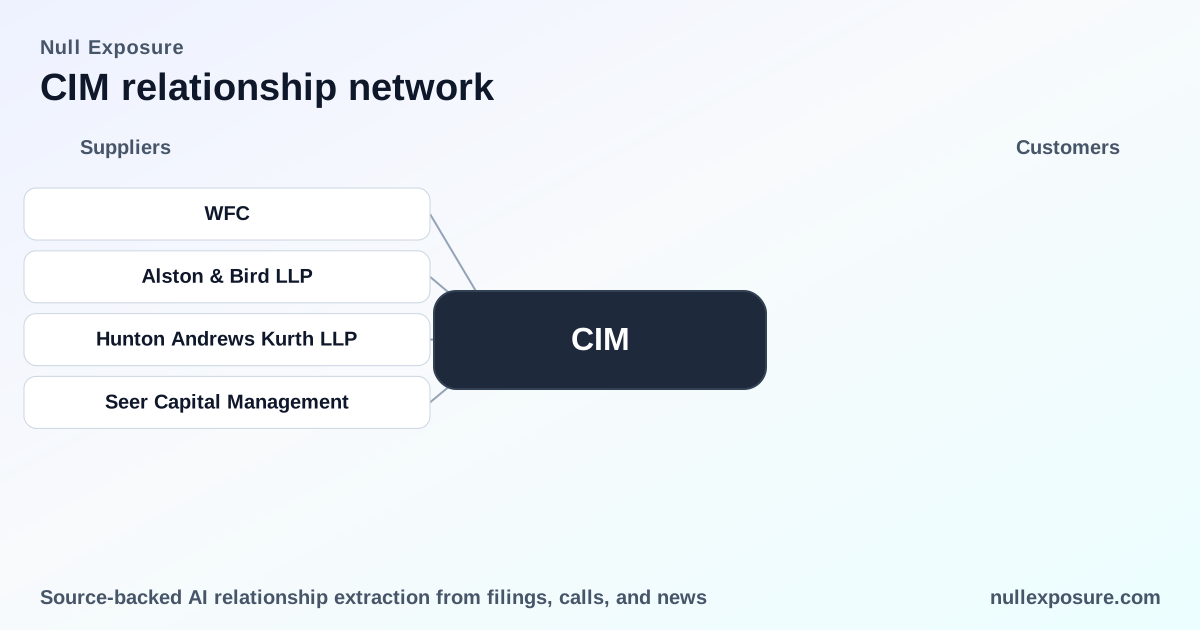
Chimera’s recent closing of the HomeXpress Mortgage Corp. acquisition produced a small set of disclosed supplier/advisory relationships that illuminate execution capability and strategic intent. All items below are drawn from coverage of the transaction.
-
Wells Fargo — Wells Fargo acted as the exclusive financial advisor to Chimera on the HomeXpress acquisition, positioning a major investment bank as the lead deal adviser on the transaction (CityBiz, March 9, 2026: https://www.citybiz.co/article/753745/chimera-investment-corp-completes-acquisition-of-homexpress-mortgage-corp/).
-
Alston & Bird LLP — Alston & Bird served as regulatory counsel to Chimera for the acquisition, signaling the transaction required focused regulatory review and external regulatory expertise (CityBiz, March 9, 2026: https://www.citybiz.co/article/753745/chimera-investment-corp-completes-acquisition-of-homexpress-mortgage-corp/).
-
Hunton Andrews Kurth LLP — Hunton Andrews Kurth acted as legal counsel to Chimera on the deal, providing transaction legal support and documentation capacity for purchase and integration (CityBiz, March 9, 2026: https://www.citybiz.co/article/753745/chimera-investment-corp-completes-acquisition-of-homexpress-mortgage-corp/).
-
Seer Capital Management — Chimera acquired HomeXpress Mortgage Corp. from affiliates of Seer Capital Management’s credit fund business and certain management sellers, representing a strategic transfer of an originations platform from a private credit owner to a mortgage REIT (CityBiz, March 9, 2026: https://www.citybiz.co/article/753745/chimera-investment-corp-completes-acquisition-of-homexpress-mortgage-corp/).
Each disclosed relationship is short and transaction-specific, but collectively they show Chimera using large-cap financial and law-firm partners to execute an acquisition that expands its platform reach into origination and servicing.
For a full supplier risk profile and a comparative view across mortgage REITs, consult the Null Exposure research center: https://nullexposure.com/.
What the company-level constraints tell investors about operating resilience
Company disclosures and contractual excerpts provide direct signals about Chimera’s operating model and vulnerabilities:
- Short-term funding dominance: The firm’s repurchase agreements “maturity dates are all less than one year and generally are less than 180 days,” which creates continuous rollover risk and sensitivity to repo market liquidity and counterparty credit decisions.
- Material long-term secured financing exists but is limited: There are long-term secured financing agreements with specified maturity (documented as maturing in October 2025), which represent a different class of refinancing risk and potential covenant considerations.
- Global counterparty footprint: A funding exposure table at December 31, 2024 lists counterparties across the United States, Japan, Canada and Spain, indicating cross-border funding relationships that diversify sources but introduce FX, legal and regional counterparty risk.
- Third-party service dependence: The company explicitly relies on third-party servicers for mortgage servicing, and also uses sales agents for equity offerings — these service relationships are operationally critical.
- Scale and concentration: Total secured financing exposures are reported in the multi-hundred-million to billion-dollar range across 13 counterparties, placing Chimera squarely in a high spend-band category.
These constraints combine into a clear investor signal: performance is as dependent on funding markets and counterparty access as on mortgage underwriting and securitization economics.
Strategic implications from the HomeXpress deal and supplier mix
The acquisition of HomeXpress from Seer Capital, advised by Wells Fargo and supported by prominent law firms, has two immediate implications:
- Vertical integration: Bringing an originations/servicing platform in-house changes Chimera from a pure buyer/securitizer toward a more integrated mortgage operator, which increases operational scope and escalates the importance of legal, regulatory and vendor relationships.
- Deal execution capability: The use of large advisors and regulatory counsel suggests Chimera is comfortable executing complex transactions and allocating capital to scale origination channels.
Investors should treat the deal as a structural move that raises operational complexity but also offers control over loan supply and servicing economics.
Mid-article action: if you are benchmarking REIT supplier risk or mapping counterparty exposure across mortgage portfolios, Null Exposure’s platform offers tailored exports and analyst support — see https://nullexposure.com/.
What to monitor next — practical investor checklist
- Funding rollovers and repo market pricing: monitor financing spreads and the company’s quarterly disclosures on secured financing exposure and counterparties.
- Long-term financing status: the October 2025 maturity cited in filings requires confirmation of refinance terms or payoff; track subsequent filings and investor presentations.
- Servicer performance and integration metrics: watch metrics tied to HomeXpress origination volumes, servicing KPI trends, and any reported operational issues with third-party servicers.
- Counterparty concentration shifts and geographic exposure: review updates to the financing exposure table and any changes in counterparty count or jurisdictional mix.
- Regulatory or enforcement actions: because the company levered regulatory counsel for the acquisition, regulatory developments around mortgage origination or servicing policies could affect integration costs.
Bottom line and recommended investor posture
Chimera’s model generates attractive spread economics when asset yields exceed secured financing costs, but that outcome is tightly coupled to short-term funding availability and counterparty discipline. The HomeXpress acquisition broadens Chimera’s revenue levers but increases operational and regulatory complexity. Investors should weight capital allocation and downside liquidity scenarios more heavily than simple book yields, and prioritize monitoring of funding counterparties, repo conditions, and servicer integration performance.
For a focused supplier-risk due diligence package and ongoing counterparty monitoring specific to mortgage REITs, start with the Null Exposure research tools at https://nullexposure.com/.