Chimera Investment Corporation (CIM‑P‑C): How the preferred stock fits into a securitization-driven REIT
Chimera Investment Corporation operates as a mortgage-focused REIT that originates, acquires and securitizes residential and commercial mortgage assets, monetizing through net interest spread, trading of mortgage-backed securities and retained positions in securitizations; its 7.75% Series C preferred is structured to deliver a stable income stream to investors while preserving capital through redeemable preferred terms. This review focuses on Chimera’s supplier relationships disclosed in recent public commentary and what those ties tell investors about execution, counterparty exposure and operational maturity. For a rapid vendor and supply-risk view, visit https://nullexposure.com/.
Why the supplier picture matters for a mortgage REIT
Chimera’s business model is execution-sensitive: profitability depends on sourcing loan flow at attractive spreads, executing securitizations efficiently, and managing the interest‑rate and credit profiles of retained securities. Supplier relationships—loan originators, data and servicing platform vendors, and structuring partners—drive all three of those levers. Two relationships highlighted in recent company remarks carry direct implications for Chimera’s sourcing and portfolio optimization:
- Sourcing and retention influence capital allocation and earnings volatility because loans either get sold outright or are pooled into securitizations where Chimera can retain parts of the capital stack.
- Systems and analytics vendors affect realized returns by improving loss forecasting and prepayment modeling, thereby boosting the performance of legacy portfolios.
Understanding these links clarifies where operational risk and concentration live inside the capital structure.
What the public record shows about Chimera’s supplier ties
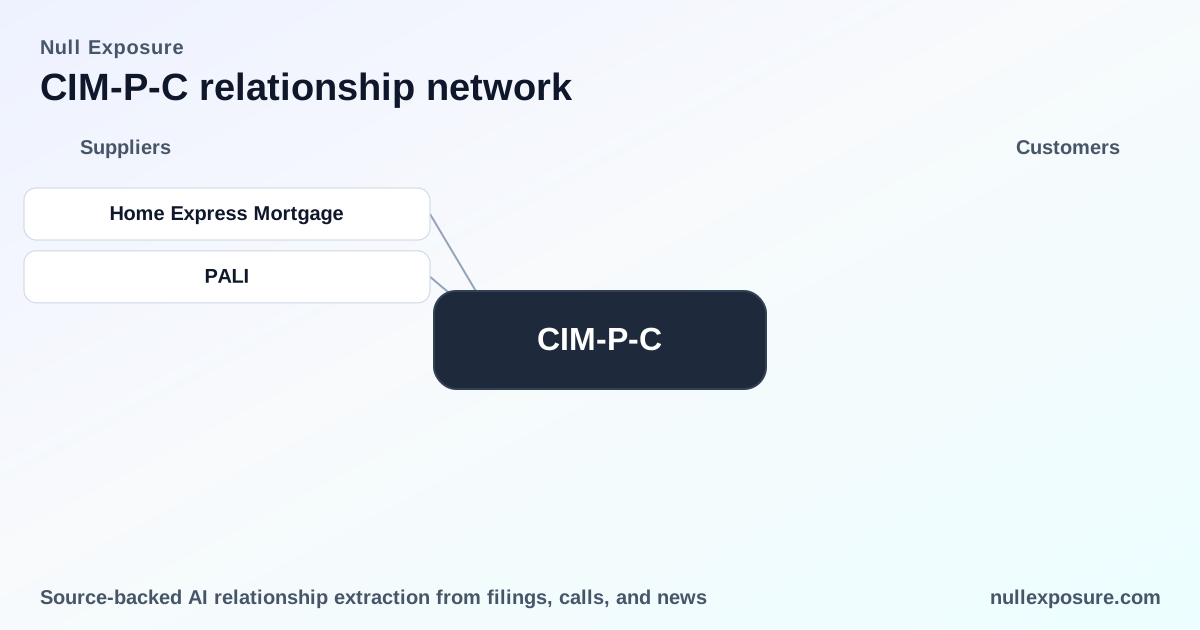
Home Express Mortgage — a production source for securitizations
Chimera disclosed that it will retain portions of Home Express Mortgage production in its securitization program while continuing to evaluate secondary-market sales versus securitization. This signals an active sourcing relationship where Chimera will both buy/retain production and optimize whether to sell loans or hold retained tranches for yield enhancement. According to the Q4 2025 earnings call transcript published by InsiderMonkey on March 9, 2026, Chimera explicitly discussed this dual pathway for Home Express originations.
Palisade — data integration to drive legacy portfolio performance
Chimera reported that it integrated its loan data into Palisade’s systems, improving the performance of the legacy portfolio; this is an operational vendor relationship that enhances modeling and execution. According to the same Q4 2025 earnings call transcript posted on InsiderMonkey on March 9, 2026, Chimera described measurable improvements from this integration that affect asset management outcomes.
What these relationships imply for investors
Both relationships underscore a single strategic posture: blend origination/retention flexibility with upgraded analytics to extract spread from held securitizations.
- The Home Express tie indicates direct access to loan flow and a willingness to retain credit risk when attractive, increasing potential yield but also elevating credit and liquidity exposure tied to retained securitization tranches.
- The Palisade integration signals investment in analytics and operations, which should reduce idiosyncratic execution loss and improve the risk-adjusted return on legacy holdings.
These dynamics point to a REIT that is sourcing selectively and investing in systems to control portfolio outcomes, not passively holding third-party originated paper.
If you are evaluating counterparty exposure or vendor concentration inside mortgage financing chains, review supplier mappings and contract terms directly at https://nullexposure.com/ for a structured view.
Company-level operational constraints and business model signals
No explicit contractual constraints were reported in the recent relationship excerpts. As a company-level assessment, the public comments generate these signals:
- Contracting posture: Chimera demonstrates an active, opportunistic contracting posture — it both purchases originations and retains securitization tranches rather than acting solely as a seller.
- Concentration: Originations from named partners like Home Express suggest source concentration risk if sizable production is retained; Chimera’s commentary implies diversification tactics (sell vs. securitize) are used to manage that.
- Criticality: Third-party analytics and systems (e.g., Palisade) are material to performance management; operational vendor performance will directly affect realized returns on legacy assets.
- Maturity: Integration of vendor systems and running a securitization program indicate operational maturity consistent with a REIT that executes repeated capital markets transactions rather than a start-up originator.
Monitor future filings and call transcripts for contract length, exclusivity clauses and retention levels to quantify these qualitative signals.
Key risks to watch, stated plainly
- Retained tranche concentration: Retaining portions of securitizations increases sensitivity to home‑price and interest‑rate shocks; monitor retention sizes and tranche seniority.
- Counterparty and originator risk: Heavy flow from a small number of originators raises single-counterparty risk — both credit quality of loans and operational continuity matter.
- Vendor dependency: Systems integrations that materially improve performance create operational dependency; vendor outages or data issues translate into portfolio performance risk.
- Market liquidity for securitizations: The choice to sell in the secondary market vs. securitize is inherently tied to market liquidity and funding cost — both cyclical and episodic.
Bold monitoring items are the ones that will move valuation: retention levels, tranche composition, and vendor SLAs.
How investors should act
- For income-focused allocation decisions, treat the 7.75% preferred as a yield play with embedded securitization risk; price it against both preferreds and high-quality MBS spreads.
- For counterparty analysis, request loan-level retention and concentration disclosures and ask management how Palisade-derived analytics change loss assumptions.
- To map supplier risk comprehensively, use a vendor-exposure review: originators, servicers, structurers, and analytics providers.
Explore deeper supplier intelligence and counterparty mappings at https://nullexposure.com/ to complement your diligence.
Bottom line
Chimera’s disclosed supplier ties reveal a REIT that manages loan flow actively and invests in analytics to squeeze more value from retained securitizations. Home Express supplies production that Chimera will sometimes hold inside securitizations, and Palisade provides analytics integration that improves legacy portfolio outcomes — together these relationships increase both yield potential and operational/retention risk. For investors and operators evaluating CIM‑P‑C, the decisive questions are how large retained positions will be, which tranches are kept, and how resilient vendor integrations are under stress. For a structured vendor-risk view and ongoing monitoring, visit https://nullexposure.com/.