Chimera Investment Corporation (CIMN): Supplier relationships and what they mean for investors
Chimera Investment Corporation operates as a mortgage-focused REIT that acquires, finances and manages portfolios of residential mortgage-backed securities and mortgage loans and monetizes those assets through interest income, securitizations and leveraged financing structures. The company's earnings profile depends on spread management across financing lines, underwriting of loan and RMBS positions, and access to capital markets to optimize liability mix. For investors and operators, supplier relationships and counterparty exposures are direct levers on funding cost, operational continuity and balance-sheet risk.
Explore detailed supplier mapping at https://nullexposure.com/ to contextualize these counterparties for portfolio decisions.
What to know up front: capital markets access is a core capability
Chimera monetizes a leveraged mortgage book: it buys loans and RMBS, funds positions with a combination of repurchase agreements, secured financing and securitized debt, and uses capital markets transactions (including note offerings and equity shelf programs) to manage leverage and liquidity. Capital providers and legal/placement agents are therefore strategic suppliers — they affect funding tenor, cost and the company’s ability to execute liability refinancings. The company’s recent activity shows active engagement with both long-dated secured financing and short-term repo markets as complementary funding channels.
Supplier relationships in the public record
The dataset returned one explicit supplier relationship. Below I summarize it in plain English and cite the source.
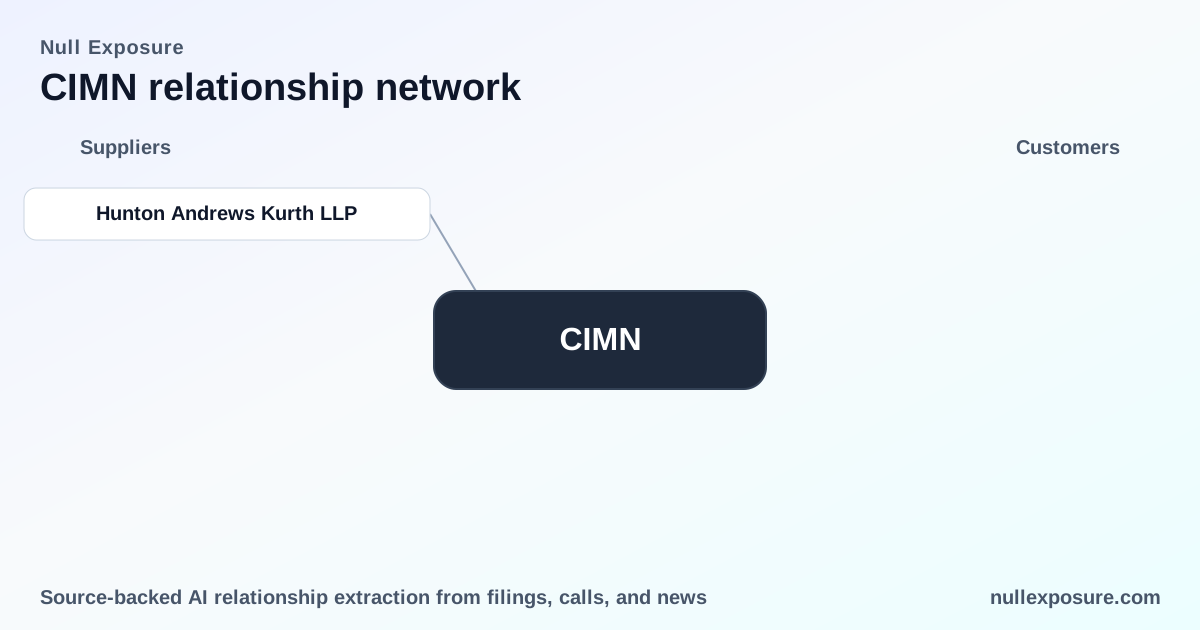
- Hunton Andrews Kurth LLP — Hunton acted as legal counsel representing Chimera in a follow-on offering of $74.7 million aggregate principal amount of 9.250% Senior Notes due 2029; this transaction is a direct example of Chimera using capital markets to extend and diversify its funding base. According to a Hunton press release dated March 9, 2026, the firm represented Chimera in that offering.
This is the full list of supplier relationships surfaced in the public results for CIMN. For a deeper roster of servicers, financing counterparties and sales agents linked to Chimera’s markets, see the supplier mapping at https://nullexposure.com/.
Constraints and what they reveal about Chimera’s operating model
The company-level constraints extracted from Chimera’s disclosures form a coherent picture of funding structure, counterparty footprint and operational risk. These should be read as corporate characteristics, not relationship-level statements.
- Contracting posture — both long-term and short-term financing coexist. Chimera uses long-term secured financing (maturities extending to 2029–2067 for certain securitized debt) alongside short-term repurchase agreements that typically mature in less than 180 days and are indexed to SOFR. This dual structure creates a laddered liability profile where liquidity and roll risk are active governance priorities (source: company filing as of December 31, 2024).
- Geographic counterparty diversity with concentration in North America and meaningful exposure to APAC/EMEA. At December 31, 2024 Chimera reported 13 secured-financing counterparties across the U.S., Japan, Canada and Spain with total secured financing exposure noted at roughly $2.84 billion (reported exposure columns totaling $1.23 billion in the disclosure table). This is an operational strength for diversification but creates multi-jurisdictional legal and settlement complexity (source: company filing as of December 31, 2024).
- Counterparty and operational criticality is material. The company warns that significant advances on serviced loans — a cash-flow obligation tied to its servicing rights — could have a material adverse effect on the business if large amounts must be funded (company disclosure). That language identifies servicing-related liquidity as a key operational constraint.
- Role profiles: Chimera is both buyer and client of service providers. The company sources residential mortgage loans through purchases from banks and non-bank originators and relies on third-party servicers, sales agents and legal/advisory firms to execute securitizations and equity/credit raises. That means counterparties span capital markets, custody/clearing, and loan servicing functions (company filing excerpts).
- Relationship stage: active and ongoing. The firm reports multiple active secured financing agreements and reliance on third-party servicers for ongoing loan management, indicating continuous engagement with its supplier base.
Taken together these constraints define a business that is capital-market dependent, operationally interconnected, and exposed to short-term roll risk even as it holds long-dated securitized liabilities.
Why the Hunton relationship matters to investors
Legal and placement counsel relationships like the one with Hunton Andrews Kurth are functional enablers for Chimera’s funding strategy. A reputable law firm executing a follow-on note offering improves transaction execution, supports regulatory compliance and reduces execution risk on capital raises. The March 2026 senior-note deal at a 9.250% coupon signals Chimera’s willingness to access unsecured market funding in addition to secured and repo channels (source: Hunton press release, March 9, 2026).
Funding mix, concentration and implied risk exposures
Chimera’s filings portray a funding profile that blends short-tenor repo (SOFR-indexed) with long-dated securitized debt and periodic public note offerings. Investors should monitor three dynamics:
- Roll and liquidity risk driven by high turnover in repurchase agreements versus long-term securitizations.
- Counterparty concentration: while counterparties are geographically diverse, material exposure in the U.S., Japan and Canada requires active legal, settlement and FX contingency planning.
- Servicing advance risk: cash needs arising from servicing obligations can be abrupt and sizable, and are identified by management as material if large advances are required.
For operational diligence across these vectors, use the supplier map and counterparty analytics available at https://nullexposure.com/.
Investment implications and next steps for operators
- Short-term monitoring: watch repo market spreads and SOFR movements; short-term funding cost volatility will transmit directly to current earnings.
- Medium-term strategy: track Chimera’s use of public note offerings and securitizations to judge whether management is extending duration or accepting higher coupons to shore up liquidity (the March 2026 senior note is a live data point).
- Operational diligence: verify servicer performance metrics and confirm contingency funding lines given the explicit servicing-advance risk.
If you want a structured digest of Chimera’s counterparty exposures and the legal/financial counterparties supporting its balance sheet, review the supplier intelligence at https://nullexposure.com/ for a practical, investor-oriented lens.
Bottom line
Chimera is a capital-markets-exposed REIT whose value creation depends on spread management, multi-tenor funding, and third-party operational performance. The Hunton relationship is an example of the legal and capital-marketing machinery that keeps Chimera funded; the mix of short-term repo and long-dated securitized debt creates both diversification and active roll risk. Investors should treat counterparty composition, servicing advance exposure and the cadence of public note offerings as primary risk indicators when evaluating CIMN. For ongoing monitoring and supplier-level detail, visit https://nullexposure.com/.