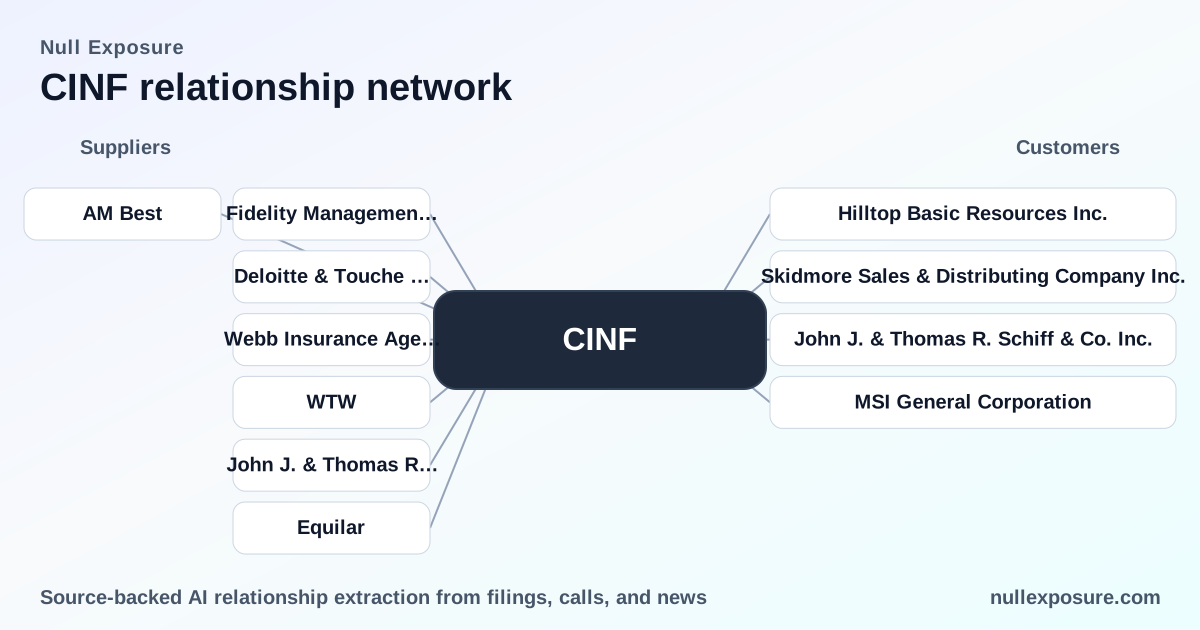
Cincinnati Financial (CINF) — Supplier relationships and what they mean for investors
Cincinnati Financial underwrites property & casualty risk through The Cincinnati Insurance Company and related subsidiaries, monetizing via net written premiums, underwriting margin and investment income on an investment portfolio. The company’s economics depend on distribution through independent agencies, third‑party professional services (audit, actuarial, benefits administration), and reinsurance arrangements that affect capital and net retention. For a concise supplier-risk view tied to investment analysis, visit https://nullexposure.com/.
Why supplier relationships matter for a P&C insurer investor
Supplier contracts are not peripheral vendor details for a carrier like Cincinnati Financial — they are operational levers that determine sales reach, regulatory compliance, reserve adequacy and ultimately underwriting profitability. Distribution partners control premium flow; auditors and actuaries validate financial integrity; benefits and trust providers support employee cost structures. Tracking these relationships is necessary to assess concentration risk, recurring cost lines and service continuity.
Who Cincinnati pays and why it matters
Below I cover every supplier relationship visible in recent public sources. Each entry is a plain-English summary with the supporting reference.
Fidelity Management Trust Company — retirement plan administrator
Fidelity is the third‑party administrator for Cincinnati’s defined contribution plans, handling plan recordkeeping and participant services for employees. This is documented in the company’s preliminary proxy statement for FY2026 filed with shareholders (preliminary proxy statement, FY2026: https://www.stocktitan.net/sec-filings/CINF/pre-14a-cincinnati-financial-corp-preliminary-proxy-statement-1171ff09cfa0.html).
Deloitte & Touche LLP — independent registered public accounting firm
Deloitte is ratified as Cincinnati Financial’s independent registered public accounting firm for 2026, providing statutory and public-audit services that support the company’s financial reporting and audit opinion. The auditor engagement is disclosed in Cincinnati’s FY2026 proxy materials (preliminary proxy statement, FY2026: https://www.stocktitan.net/sec-filings/CINF/pre-14a-cincinnati-financial-corp-preliminary-proxy-statement-1171ff09cfa0.html).
Webb Insurance Agency Inc. — commission-paid independent agent
Cincinnati’s insurance subsidiaries paid Webb Insurance Agency Inc. $1,197,444 in commissions for selling the company’s insurance products, illustrating the direct cash flow to independent agencies that generate new and renewal premium. This commission detail is in the FY2026 proxy disclosure (preliminary proxy statement, FY2026: https://www.stocktitan.net/sec-filings/CINF/pre-14a-cincinnati-financial-corp-preliminary-proxy-statement-1171ff09cfa0.html).
Willis Towers Watson (WTW) — actuarial and benefits consulting
Willis Towers Watson was engaged to provide actuarial and consultative services related to the design of Cincinnati’s retirement and employee benefit plans, a relationship that supports compensation design and liability estimation for pensions and benefits. The engagement is noted in the FY2026 proxy filing (preliminary proxy statement, FY2026: https://www.stocktitan.net/sec-filings/CINF/pre-14a-cincinnati-financial-corp-preliminary-proxy-statement-1171ff09cfa0.html).
John J. & Thomas R. Schiff & Co. Inc. — paid broker/agency fees
Cincinnati’s subsidiaries paid John J. & Thomas R. Schiff & Co. Inc. $10,716,101 in fees and commissions, reflecting a sizeable distribution relationship that channels large portions of written premium through that intermediary. The payment amount is disclosed in FY2026 proxy materials (preliminary proxy statement, FY2026: https://www.stocktitan.net/sec-filings/CINF/pre-14a-cincinnati-financial-corp-preliminary-proxy-statement-1171ff09cfa0.html).
Equilar — compensation benchmarking and peer reporting
Cincinnati procures reports from Equilar on executive compensation amounts and peer-group comparisons used in director and compensation committee deliberations, signaling reliance on an external provider for benchmarking and disclosure preparation. This sourcing is documented in the company’s FY2026 proxy filing (preliminary proxy statement, FY2026: https://www.stocktitan.net/sec-filings/CINF/pre-14a-cincinnati-financial-corp-preliminary-proxy-statement-1171ff09cfa0.html).
AM Best — credit and financial strength affirmation
AM Best affirmed Cincinnati Financial’s superior credit and financial strength ratings with a stable outlook, a third‑party rating that supports the company’s market credibility and pricing power with agents and customers. The rating affirmation was reported through market commentary in FY2026 (simplywall.st article summarizing AM Best activity, FY2026: https://simplywall.st/stocks/us/insurance/nasdaq-cinf/cincinnati-financial/news/am-best-confirms-cincinnati-financial-strength-while-valuati).
What the supplier map implies for operating posture and risks
Several company-level constraints in public disclosures provide a clear operational signal about Cincinnati’s vendor and capital exposure:
- Materiality of reinsurance counterparty risk is explicitly acknowledged in filings and is a company-level constraint: a reinsurer’s insolvency would have a material adverse effect on Cincinnati’s financial position, results or cash flows. This elevates the importance of counterparties in the capital stack and reinsurance contracting posture.
- Distribution is centralized and critical. The company self-identifies a distributor role for entities responsible for P&C sales, field underwriting management and independent agency relationships; that confirms distribution partners are an integral operating lever rather than incidental vendors.
- Third‑party service provider reliance is explicit. Cincinnati uses external auditors, actuarial consultants, benefits administrators and compensation benchmarking vendors as regular service providers, embedding external expertise into core control functions.
- Spend scale is meaningful. Public excerpts and ceded premium figures indicate a company-level spend and reinsurance flow consistent with six- and seven‑figure annual payments; existing disclosures include ceded written premium and commission figures that justify treating certain vendor lines as large recurring expense pools rather than isolated transactions.
These constraints collectively describe a contracting posture that is operationally mature, concentrated on agency distribution and materially exposed to reinsurer performance, and dependent on a small set of professional services for compliance, governance and benefits administration.
Operational takeaways for investors and operators
- Distribution concentration is observable and financially consequential. Commission payments to named agencies (Webb, Schiff) show clear premium routing and fee leakage that directly affects net written premium and retention.
- Governance and reserve integrity rely on a small set of professional firms. Deloitte and Willis Towers Watson perform audit and actuarial roles central to financial statements and benefit design.
- Counterparty quality matters to credit and solvency. AM Best’s affirmation supports current ratings, but the company’s own disclosure makes reinsurance counterparty risk a material financial lever.
For a structured supplier-risk view that maps payments, contract roles and materiality to investment decisions, visit https://nullexposure.com/ to see how these relationships integrate into enterprise risk scoring.
How to act on this analysis
Operators should prioritize contractual visibility with top-producing agencies and ensure reinsurance counterparties carry strong financial metrics and collateral arrangements. Investors should factor commission concentration and ceded premium flows into underwriting margin stress tests and reserve sensitivity analyses.
For an analyst-ready supplier risk briefing and ongoing monitoring, review the NullExposure platform at https://nullexposure.com/ — it connects supplier disclosures to investment signals and vendor risk scores.
Bold final takeaway: Cincinnati Financial’s profitability is driven by agency distribution and underwriting discipline, but both are sensitive to distribution concentration and reinsurance counterparty strength — two supplier-driven variables that materially affect the company’s financial resilience.