Cerberus Cyber Sentinel (CISO): Distribution and partner map investors should price into value
Cerberus Cyber Sentinel (NASDAQ: CISO) operates as a security software and services company that monetizes through licensed software, cloud marketplace distribution, and fee-based professional services and compliance offerings. Revenue derives from reselling vendor licenses, direct SaaS and platform subscriptions, and specialized compliance services, while capital needs have been met with convertible preferred facilities and placement agents. For investors evaluating supplier relationships, the commercial model is driven by channel integrations (AWS, Microsoft), targeted vertical partnerships, and the company’s role as both a software vendor and reseller. Learn more about supplier-risk intelligence at https://nullexposure.com/.
What to know in one paragraph
CISO is a small-cap security infrastructure player with roughly $27.7M revenue TTM and negative operating margins, distributing software through cloud marketplaces and strategic partnerships while supplementing revenues with professional services. The company’s commercial posture is dual: product-focused software sales plus reseller activity for third‑party licenses, a mix that shapes margin sensitivity, capital intensity and go‑to‑market risk. Insider ownership is high and institutional ownership is low, reinforcing a concentrated governance profile investors should consider alongside partner dependencies.
Partner and relationship inventory — concise summaries and sources
Below are the relationships surfaced in public filings and press releases. Each entry is covered with a plain-English summary and a direct source reference.
-
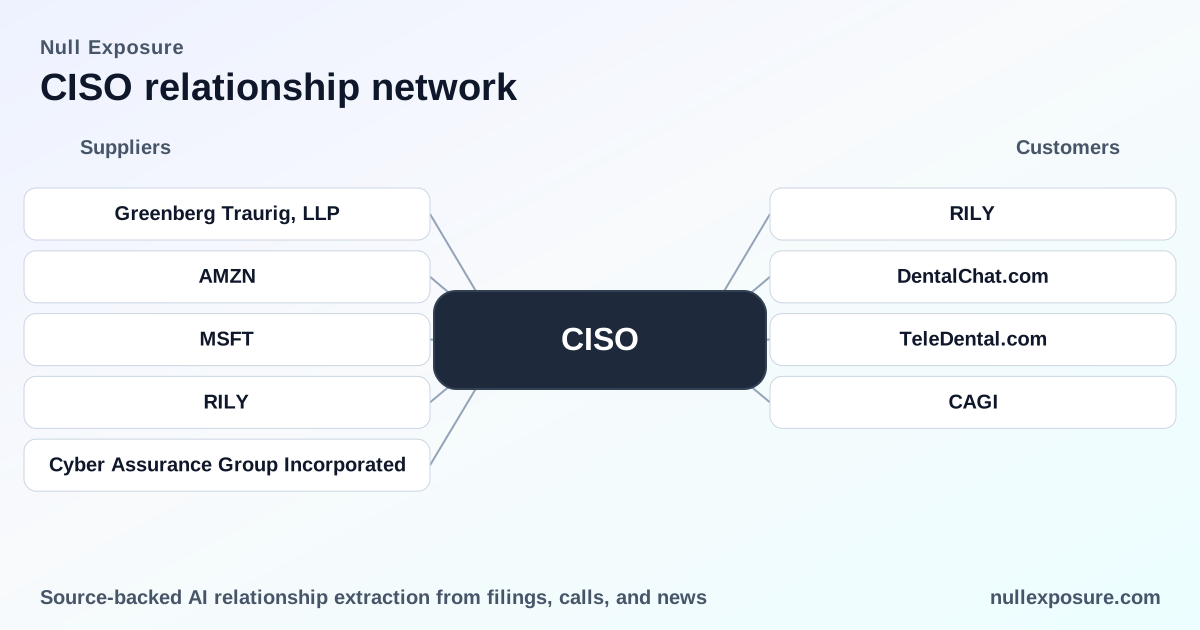
Greenberg Traurig, LLP — legal counsel (Yahoo Finance, FY2025). Greenberg Traurig acted as legal counsel to CISO in connection with corporate financings and related disclosures, including the announcements around a $15 million capital facility. (Source: Yahoo Finance coverage of company financing, reported FY2025.)
-
Amazon Web Services (AWS) — TIGRIS GRC in AWS Marketplace (GlobeNewswire, March 2025). CISO integrated its TIGRIS GRC solution into the AWS Marketplace, using AWS as a distribution and procurement channel for cloud governance customers. (Source: GlobeNewswire press release, March 5, 2025.)
-
Microsoft — Security Copilot program POC (GlobeNewswire, referencing 2023 POC). CISO participates in Microsoft’s Security Copilot program and built a proof-of-concept to integrate Microsoft Security Copilot with CISO’s Argo Secure platform, positioning the product to plug into Microsoft-led security workflows. (Source: GlobeNewswire release recalling the originally announced 2023 POC.)
-
Greenberg Traurig, LLP — counsel on convertible preferred facility (GlobeNewswire, September 2025). Greenberg Traurig again acted as legal counsel when CISO entered into a $15 million convertible preferred equity facility intended to fund expansion initiatives. (Source: GlobeNewswire press release, September 29, 2025.)
-
B. Riley Securities — sole placement agent (GlobeNewswire, September 2025). B. Riley Securities served as the sole placement agent on the $15 million convertible preferred equity facility, signaling reliance on capital markets intermediaries for balance sheet support. (Source: GlobeNewswire press release, September 29, 2025.)
-
Cyber Assurance Group Incorporated — channel/solution partner to serve dental vertical (QuiverQuant, FY2026). CISO announced a strategic partnership to offer Cyber Assurance Group’s CyberSimple® powered by CHECKLIGHT® to dental practices through TeleDental.com and DentalChat.com, expanding go-to-market into a regulated small-business vertical with tailored cyber and financial-protection services. (Source: QuiverQuant news, FY2026.)
How the partner map changes the risk/reward profile
The relationships illustrate a focused commercial strategy: cloud marketplaces and major platform integrations for scale, legal and capital intermediaries for corporate finance, and vertical specialty partners for niche expansion. AWS and Microsoft integrations provide distribution leverage but also increase the importance of maintaining technical and commercial alignment with platform policies and procurement models. The convertible preferred facility and the involvement of B. Riley highlight ongoing capital requirements. Greenberg Traurig’s repeated role as counsel underscores structured financing activity in FY2025.
Constraints and company-level signals that matter for investors
Use these operating-model characteristics to stress-test valuation and counterparty exposure:
-
Contracting posture and revenue mix: CISO behaves as both a seller of its own software and a reseller of third‑party licenses, supported by a disclosed prepaid cost of revenue line that explicitly references license resales. This dual role compresses gross margins relative to pure SaaS peers and creates vendor-resale contract complexity.
-
Portfolio composition: The company reports distinct software and services segments. Software drives product-scale economics while services provide higher-touch, lower-margin recurring or project revenue; a FY2024 disclosure showed a 22% year-over-year decrease in professional services cost due to reduced use of consultants, which signals either better internal execution or lower services demand—both of which materially change cash conversion dynamics.
-
Capital and maturity profile: Negative EBITDA, a sub-$20M market capitalization and a $15M convertible preferred facility indicate early-stage capitalization risk; investors should price in dilution or additional financing needs if revenue growth stalls.
-
Concentration and governance: High insider ownership (~39.9%) and very low institutional ownership (~4.8%) suggest concentrated control and limited institutional pressure, which can accelerate strategic moves but also reduce external governance oversight.
-
Channel and criticality: Dependence on AWS Marketplace listing and Microsoft Security Copilot participation is a distribution strength and a concentration risk—loss of marketplace status or program changes would have outsized revenue impact for a company of this scale.
Investment implications and tactical questions
-
Valuation should reflect execution risk tied to marketplace adoption and services demand, not just software roadmap; current multiples (EV/Revenue ~0.67) are consistent with high execution risk and modest revenue scale.
-
Capital structure events (convertible preferred facility) and the role of placement agents are near-term liquidity levers; monitor dilutive potential and covenants in financing disclosures.
-
Vertical partnerships like the dental channel can increase revenue stickiness if cross-sell and insurance-like protections scale, but these require repeatable distribution economics to move the needle on profitability.
If you want a supplier-risk scorecard or a partner-concentration heatmap for CISO, start here: https://nullexposure.com/.
Bottom line and next steps for investors
Cerberus Cyber Sentinel is a niche cybersecurity provider that combines resold license revenue, proprietary software, and services—a hybrid model that delivers flexibility but also compresses margins and raises distribution concentration risk. The company’s agreements with AWS and Microsoft are positive commercial endorsements but come with platform dependence; legal and placement relationships show active capital management. For active investors, priority actions are to verify marketplace ingestion metrics, review convertible facility terms, and monitor service revenue trends.
Explore more supplier profiles and relationship analytics at https://nullexposure.com/ to convert partner disclosures into investment signals and actionable risk assessments.