CITR (General Enterprise Ventures): Supplier concentration, service economics, and capital-market dependency
General Enterprise Ventures (CITR) develops and supplies non‑toxic wildfire defense and flame suppression products and monetizes through product sales and fee‑based services while relying on equity and capital markets to fund operations and advisory services. The company’s procurement footprint shows acute supplier concentration, and its supplier and service spend profile is mixed — ranging from sub‑$100k engagements to multi‑million equity issuances for consulting — which drives both operational risk and negotiating leverage for counterparties. For more structured supplier intelligence and tracking on this profile, visit https://nullexposure.com/.
Quick read: what investors need to know up front
- CITR’s supply base is highly concentrated. Four named suppliers account for roughly three quarters of purchases as disclosed in the 2024 Form 10‑K.
- The company uses a mix of cash and equity to pay service providers, including convertible preferred and common stock issuances for advisory/consulting services.
- Capital markets activity is material to operations—Univest Securities has been engaged as the sole placement agent since March 2025.
If you evaluate supplier risk or vendor concentration for underwriting or operational diligence, explore additional profiles at https://nullexposure.com/.
Supplier roster and what each relationship means
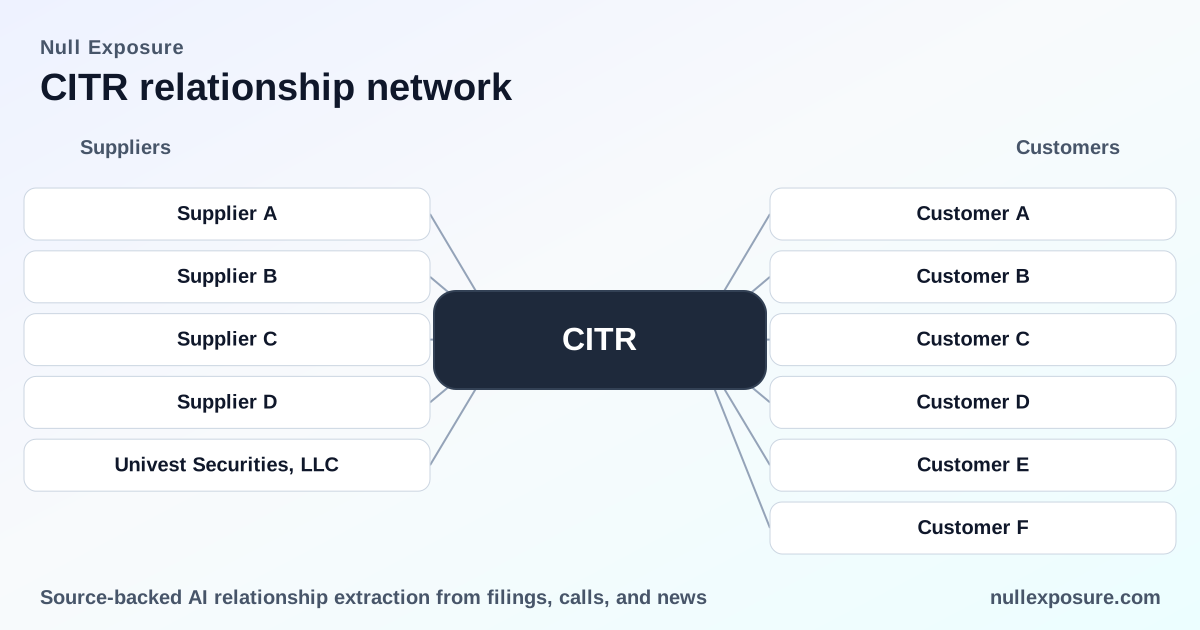
The following summaries cover every relationship disclosed in the materials for fiscal 2024 and related press: each entry includes a plain‑English description and the source.
-
Supplier A — Supplier A represented 33.09% of purchases in FY2024 and was a dominant counterparty the prior year as well (77.01% in FY2023), signaling a single large supplier relationship that drives a large share of procurement. Source: Company Form 10‑K for the year ended December 31, 2024.
-
Supplier B — Supplier B accounted for 12.25% of purchases in FY2024 and was associated with a very large accounts payable balance in FY2024 (74.46% of accounts payable reported), indicating both material purchase activity and a sizeable payable position at year‑end. Source: Company Form 10‑K for the year ended December 31, 2024.
-
Supplier C — Supplier C made up 23.80% of purchases in FY2024, positioning it as the second‑largest supplier by purchase share and a critical vendor for the company’s inputs or services. Source: Company Form 10‑K for the year ended December 31, 2024.
-
Supplier D — Supplier D represented 8.25% of purchases in FY2024 (and smaller percentages in prior periods), a meaningful but lower share compared with the top three suppliers. Source: Company Form 10‑K for the year ended December 31, 2024.
-
Univest Securities, LLC — Since March 2025, Univest has served as the company’s sole placement agent for capital market activities, a commercial relationship that formalizes how CITR accesses equity capital and investor placement services. Source: GlobeNewswire press release (Dec 4, 2025) announcing Univest’s engagement.
How to read the supplier concentration and spend signals
CITR’s procurement pattern is concentrated and lumpy. The 2024 disclosure shows Supplier A, B, C and D collectively account for roughly 77–81% of purchases as a group — a degree of concentration that translates directly into procurement risk and supplier negotiating leverage. Because those names capture the majority of spend, operational continuity depends on stable relationships with a small number of vendors. Source: Company Form 10‑K for the year ended December 31, 2024.
-
Contracting posture: The company functions as a concentrated buyer; heavy reliance on a few suppliers reduces bargaining flexibility and increases vulnerability to disruptions or pricing shifts. This is a company‑level signal derived from the materiality excerpts in the 10‑K.
-
Criticality and maturity: Suppliers with double‑digit purchase shares are de facto critical partners in CITR’s go‑to‑market. The company’s operational maturity is uneven: large equity‑for‑services transactions and placement‑agent dependency indicate a firm still reliant on capital markets and non‑traditional vendor compensation mechanisms rather than stable recurring commercial terms. Evidence for equity compensation and placement arrangements comes from the company’s filings and the Univest press release.
-
Spend profile: The company’s spend bands are diverse: sub‑$100k, $100k–$1m, and $1m–$10m engagements coexist, and the company has issued both common and convertible preferred shares as consideration for services in prior periods—reflecting cash constraints and a willingness to use equity as currency. These observations are company‑level signals supported by the governance and transaction excerpts in CITR’s filings.
For vendor risk assessment or counterparty diligence, these structural signals should drive scenario planning and contingency mapping.
If this supplier concentration impacts your underwriting, procurement strategy, or M&A diligence, get a tailored report at https://nullexposure.com/.
Operational implications and investor read-through
-
Supply disruption risk is the primary single‑point concern. With the top four suppliers representing most purchases, any supply interruption or unilateral price increase from Supplier A or C would materially affect gross margins and delivery timelines. Source: Company Form 10‑K for the year ended December 31, 2024.
-
Non‑standard compensation raises governance and liquidity questions. The company’s use of equity to satisfy consultant and advisory invoices (including large share issuances disclosed in filings) signals constrained operating cash and a strategic choice to conserve liquidity while preserving access to expertise. Source: excerpts in company filings (referenced in the constraints evidence).
-
Capital markets function as an operational lifeline. The engagement of Univest as sole placement agent formalizes CITR’s pathway to raise capital, which underpins working capital and compensatory flexibility for suppliers and advisors. Source: GlobeNewswire press release (Dec 4, 2025).
Risk checklist for investors and operators
- Concentration risk: Top suppliers account for the majority of purchases; map alternatives immediately.
- Payment mix risk: Equity compensation can dilute shareholders and complicate vendor incentive alignment.
- Liquidity dependency: Placement agent engagement is necessary but not sufficient; monitor capital‑raise cadence and terms.
Final takeaways and next steps
CITR’s supplier disclosures paint a company with high supplier concentration, a mixed cash/equity compensation model, and active reliance on capital markets. For investors and operators, the priority is clear: stress‑test supply continuity and quantify the cash versus equity cost of services under several capital scenarios.
For ongoing monitoring or a deeper supplier concentration analysis, visit https://nullexposure.com/ for portfolio‑grade vendor intelligence and alerts.
If you want a bespoke supplier exposure brief or an operational risk memo tied to CITR, request a tailored report at https://nullexposure.com/.