Civista Bancshares (CIVB): Funding relationships and operational constraints that determine near-term liquidity
Civista Bancshares operates as a community bank holding company, monetizing through net interest income on a loan-heavy balance sheet, deposit products, and fee income from retail and commercial customers. The company’s funding mix and vendor dependencies drive short-term liquidity flexibility and operational risk—factors that materially affect returns given Civista’s modest market cap and concentrated institution-level exposures. For a consolidated view of supplier relationships and how they map to credit and operational risk, visit NullExposure.
Why this matters to investors: Civista’s profit engine is interest spread and deposit capture, but the bank’s reliance on short-term Federal Home Loan Bank (FHLB) advances historically and dependence on a single core systems vendor are the two operational levers that determine funding cost, stability, and service continuity.
Funding and business model — concise investor read Civista earns interest from loans and securities while funding itself through core deposits, retail time deposits, and wholesale borrowings. Core deposit growth in 2025 reduced reliance on short-term FHLB borrowings, improving net interest margin stability, but FHLB remains an active counterparty for liquidity management. Financial characteristics: market capitalization ~$464m, trailing P/E ~8.5, price-to-book ~0.85, ROE ~9.9%, dividend yield ~3.06% (data through FY2025–FY2026 reporting). These metrics position Civista as a modestly valued regional bank with a yield and return profile sensitive to funding costs and deposit behavior. For a deeper supplier-driven risk map, see NullExposure.
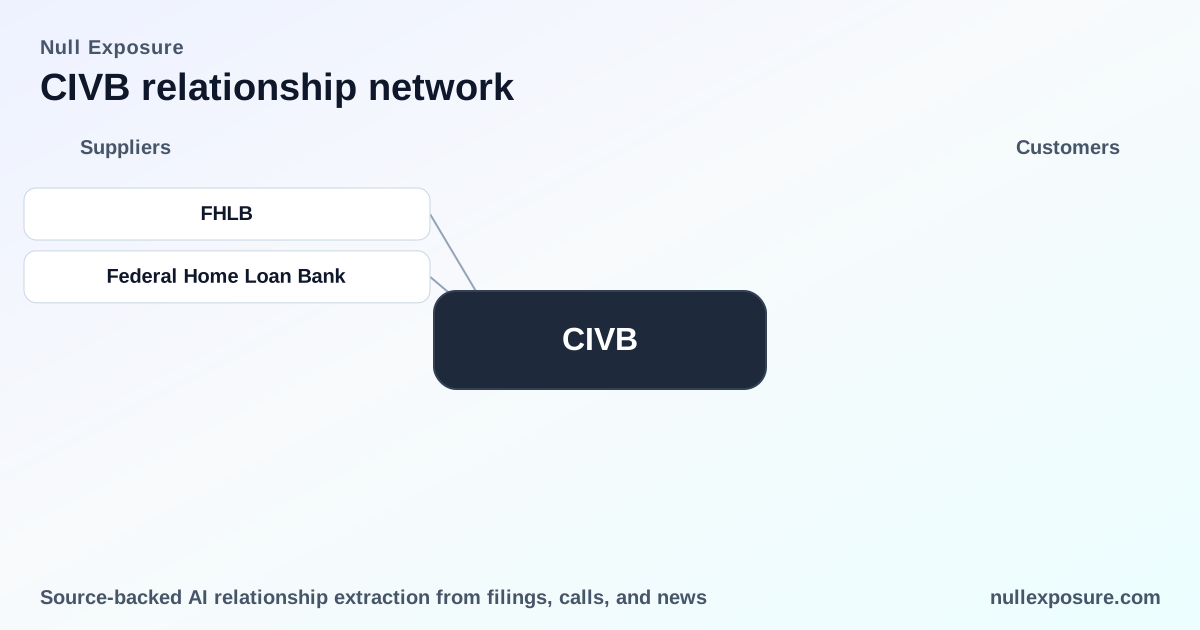
The relationships on record: what the sources report Civista’s supplier/financing interactions in our feed center on the Federal Home Loan Bank system. Each of the items below is reported separately in company releases and market summaries.
FHLB mention — PR Newswire, FY2026 financial results (March 2026)
Civista reported FHLB short-term advances of $175.0 million on December 31, 2025, down $57.0 million from the prior quarter and down $164.0 million from December 31, 2024, signaling meaningful paydown of FHLB balances in the quarter. According to the PR Newswire release announcing FY2025/FY2026 results (filed March 9, 2026), this reduction coincided with deposit growth. (PR Newswire, FY2026).
FHLB mention — Finviz news aggregation, FY2026 (March 2026)
A Finviz report reproducing the company’s FY2026 announcement highlighted the same funding change: short-term FHLB advances reduced to $175.0 million at year-end, underscoring the company’s shift toward more stable deposit funding. (Finviz, FY2026).
Federal Home Loan Bank — PR Newswire, Q3 2025 results (filed March 2026)
In the Q3 2025 results posted earlier, the company noted $232.0 million in short-term FHLB advances on September 30, 2025, a sequential decline from mid-year and a reduction versus year-end 2024 that reflects active liquidity management across 2025. (PR Newswire, Q3 2025 release).
FHLB and deposit shift — TradingView summary of SEC filing (FY2026)
A market summary of Civista’s 10-K and related filings observed a deposit and funding shift: core deposits increased materially (savings, money markets, CDs), which reduced reliance on short-term FHLB borrowings, improving funding composition. (TradingView summary of FY2026 filing).
What the constraints tell investors about Civista’s operating posture The constraint extraction in filings adds texture to the relationship observations and should inform diligence.
- Short-term contracting posture: Filings explicitly reference “Short-term Federal Home Loan Bank advances” and exclude leases with terms under one year from ROU asset recognition, indicating Civista structures a portion of its funding and operating commitments on short-duration contracts. That creates flexibility to react to market rates but produces refinancing and rollover exposure during stress.
- Government-counterparty exposure at the company level: The company states it primarily invests in securities issued by U.S. government agencies and sponsored entities; this is a company-level investment policy signal rather than a supplier-level contract, and it reduces credit risk in the securities portfolio while exposing the balance sheet to duration and agency prepayment dynamics.
- Relationship roles and concentration: Filings show Civista as a buyer of liquidity from the FHLB and note a material dependence on a single vendor for core banking systems, indicating two operational concentrations—one in funding and one in service delivery. The vendor concentration is a critical operational risk that affects customer-facing continuity and regulatory compliance if disrupted.
- Derivative and counterparty activity: The company enters offsetting fixed-rate swaps with bank counterparties, which signals active interest-rate risk management tied to funding and balance sheet hedging; swap counterparty arrangements carry settlement and credit exposures.
Implications for investors and operators
- Liquidity risk versus flexibility: Short-term FHLB advances give Civista flexibility to manage seasonal loan demand and deposit flows; however, rollover risk exists if deposit growth reverses or FHLB access tightens. The reported paydown in late 2025 improves the near-term profile, but the bank retains wholesale access as an option.
- Operational concentration is material: Dependence on a single core vendor creates an outsized operational risk. Covenants, SLAs, and contingency plans are priority items for operators and should be a focus for investors performing counterparty risk analysis.
- Interest-rate sensitivity is managed but present: Swap activity and securities allocation indicate active hedging, but the bank’s net interest income remains sensitive to deposit re-pricing and loan yields given its regional bank profile.
Practical next steps for investors and managers
- For investors: monitor quarterly FHLB balances and deposit mix trends to detect shifts in funding stress or normalization; review the bank’s contingency funding plan and swap counterparty limits. For bespoke supplier risk reports and ongoing monitoring, visit NullExposure.
- For bank operators: validate vendor continuity plans and strengthen contractual protections with the single core provider; model multiple funding scenarios that include sudden deposit runoff and restricted wholesale access.
- For credit committees: stress-test liquidity under rates and deposit stress scenarios, incorporating the company-level signal of government-agency securities exposure and the operational vendor dependency.
Bottom line Civista has actively reduced short-term FHLB dependence as core deposits rose, improving liquidity composition, but two structural characteristics remain: a short-term contracting posture for some funding and operating items, and concentration in critical vendor systems. Both are manageable with governance and contingency planning, and they should be the focus of diligence for any investor or counterparty. For a consolidated supplier intelligence briefing and supplier-focused risk scoring, go to NullExposure.