Clarus Corp (CLAR): Supplier and advisor relationships that shape near-term capital strategy
Clarus Corporation operates, acquires, and manages brands in the consumer outdoor and leisure sector, monetizing through wholesale and direct retail sales of outdoor equipment and accessories while funding inorganic growth via a mix of cash on hand and senior credit facilities. Its operating model combines brand portfolio management with capital-intensive inventory and lease commitments, and the company relies on external banking, legal, and capital markets advisors to execute acquisitions and manage investor communications.
For a concise lookup of Clarus’s supplier and advisor footprint, visit https://nullexposure.com/ for an investor-ready map of counterparties and risk signals.
Operational profile and why counterparties matter Clarus is a brand acquirer and distributor: revenue comes from selling owned brands across global channels while corporate growth often requires acquisition financing and targeted investor relations. The company’s September–December 2025 disclosures show negative operating margins and net losses, signaling reliance on external financing and advisors to execute strategic transactions and manage communications with markets. This profile makes Clarus’s counterparties—lenders, financial advisors, legal counsel, and PR firms—integral to execution risk and cost of capital.
Key company-level signals that shape supplier risk and structure
- Contracting posture: Clarus holds long-term leases with remaining contractual terms up to ten years (and extension options up to five years), indicating multiyear fixed commitments for facilities and equipment that increase operating leverage.
- Geographic sourcing: Packaging and component sourcing is global: Clarus sources materials domestically and from Asia and Europe, supporting a multi-region supply chain footprint with the operational complexity that brings.
- Buyer role and spend profile: Clarus functions as a material buyer across raw materials, components and finished goods, and company disclosures suggest a spend band in the $10M–$100M range for lease and related capital commitments—evidence of mid-market procurement scale.
- Maturity and criticality: Given Clarus’s scale and recent acquisition activity, third-party advisory and lending relationships are critical to capital deployment and integration; legal and investor-relations partners appear as recurring external dependencies.
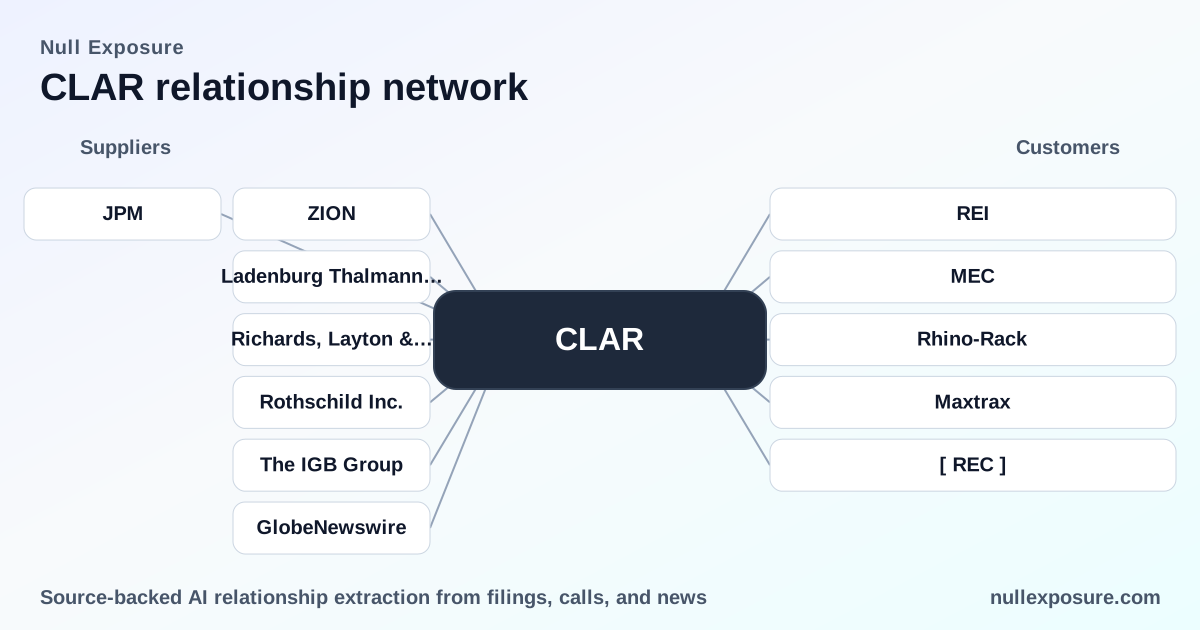
Supplier and advisor map: every named relationship in public reporting Below are the parties named in the sourced results and the plain-English role each plays for Clarus.
-
Zions Bancorp — Clarus expects to use proceeds from a senior credit facility with Zions Bancorp to finance cash consideration for acquisitions, positioning Zions as a lending partner on deal finance. According to Climbing.com coverage of Clarus’s acquisition announcement (March 2026), Zions was cited as the incumbent lender of Black Diamond and expected lender for transaction financing.
Source: Climbing.com (acquisition announcement, March 2026). -
Ladenburg Thalmann & Co. Inc. — Served as financial advisor to Clarus’s special committee and provided a fairness opinion on an acquisition, functioning as independent valuation and transaction counsel. Climbing.com notes Ladenburg Thalmann rendered a fairness opinion to Clarus’s special committee in connection with the Gregory transaction.
Source: Climbing.com (acquisition announcement, March 2026). -
Richards, Layton & Finger — Acted as independent legal counsel to Clarus’s special committee during an acquisition process, providing legal oversight for transaction governance. Climbing.com reports the special committee was represented by Richards, Layton & Finger.
Source: Climbing.com (acquisition announcement, March 2026). -
Rothschild Inc. — Provided financial advisory services and rendered an opinion regarding Clarus’s Black Diamond acquisition, positioning Rothschild as an investment bank involved in assessing transaction terms. Climbing.com indicates Rothschild advised on the transactions and provided an acquisition opinion.
Source: Climbing.com (acquisition announcement, March 2026). -
The IGB Group — Functions as Clarus’s investor-relations/PR contact across multiple filings and press releases; named contacts appear repeatedly in Clarus press material. A QuiverQuant repost of Clarus’s conference-call notice (March 2026) lists IGB Group contacts for investor relations, and a GlobeNewswire release (July 2025) similarly references IGB Group for the PIEPS sale announcement.
Source: QuiverQuant (conference call notice, March 2026) and GlobeNewswire (press release, July 2025). -
GlobeNewswire — Used as a distribution channel for Clarus press releases; press releases distributed via GlobeNewswire appear in reporting and recaps of company announcements. A GlobeNewswire release covering Clarus’s FY2025 transaction activity (July 2025) was noted in subsequent media distributions.
Source: GlobeNewswire (press release distribution, July 2025) and related QuiverQuant repost (March 2026). -
J.P. Morgan — Identified as the lead bank on an upsized credit facility to finance a cash consideration for an acquisition (Rhino-Rack), indicating use of J.P. Morgan as a lead arranger for larger financing tranches. TheShopMag coverage of the Rhino-Rack acquisition (date referenced in reporting) cites J.P. Morgan as leading the upsized credit facility.
Source: TheShopMag (acquisition financing note, reported).
Implications for investors and operators Clarus’s relationship map highlights a recurring pattern: external lenders and boutique advisors are central to transaction execution, while PR/IR desks are outsourced for market communications. For investors this implies:
- Execution leverage: The company’s ability to complete and integrate acquisitions depends on continued access to senior credit facilities and independent advisory validation, which influences deal timing and dilution risk.
- Cost of capital sensitivity: With negative profitability metrics and reliance on outside financing, Clarus’s borrowing terms and lender relationships directly influence cash runway and strategic optionality.
- Supply-chain exposure: Multi-region sourcing (Asia, Europe, North America) and long-term leases create fixed-cost pressures; procurement disruptions or FX shifts will have outsized margin effects.
If you need a full counterparties report or a counterparty risk heatmap for Clarus, see our investor tools at https://nullexposure.com/.
Practical checklist for counterparty diligence
- Confirm the tenor and covenants of the senior credit facilities led by Zions and J.P. Morgan; covenant stress drives refinancing and dilution risk.
- Validate the independence and scope of fairness opinions from Ladenburg and Rothschild to assess valuation conservatism on recent acquisitions.
- Monitor IR flow via The IGB Group and press-distribution timing on GlobeNewswire for market reaction windows that could affect liquidity.
Final takeaways and next steps
- Clarus runs a buy-and-integrate model supported by external lenders and advisors; these counterparties are operationally and financially material.
- Long-term lease commitments and multi-region sourcing increase fixed-cost exposure and operational complexity.
- Investor relations and press distribution are centralized through named firms, which shapes market signaling and timing of disclosures.
For a detailed counterparty exposure brief and contract-level analysis tailored to institutional diligence, visit https://nullexposure.com/ and request the Clarus supplier dossier.